
Health-Flow: Prioritizing Life-Critical Traffic in SDN-Based Healthcare IoT
Health-Flow: Criticality-Aware Flow Control for SDN-Based Healthcare IoT
This paper introduces Health-Flow, a criticality-aware traffic forwarding scheme for Software-Defined Healthcare Networks (SDHN). It combines Machine Learning for physiological risk assessment with a Gaussian Mixture Model (GMM) for mobility prediction to optimize flow-rule placement at edge Access Points (APs).
TL;DR
Researchers at IIT Kharagpur have developed Health-Flow, a smart networking scheme that prioritizes medical emergencies. By combining Machine Learning for health risk prediction and Gaussian Mixture Models for mobile user tracking, the system optimizes Software-Defined Network (SDN) flow tables. This approach slashes network latency by 52% and energy use by 12%, ensuring that critical health alerts reach patients instantly without overwhelming the network hardware.
Background: The Infrastructure Bottleneck in Smart Health
The rise of wearable SpO2 sensors, ECG trackers, and smart medical IoT has created a data deluge. While traditional Software-Defined Networks (SDN) offer flexibility by separating the control plane from the data plane, they struggle with mobility and resource constraints.
In a hospital or remote monitoring scenario, if every mobile device's movement triggers a global update of flow-rules in every Access Point (AP), the "Flow Table" (the memory within the AP) quickly overflows. Moreover, current networks treat a "step counter" packet with the same priority as a "heart attack" alert, which is a dangerous oversight in healthcare.
The "Criticality-Aware" Insight
The core innovation of Health-Flow is its selective intelligence. Instead of treating all traffic equally, it introduces a "Criticality Index" (). If a patient's physiological parameters are normal, the network remains in a low-overhead state. If a threshold () is crossed, the system activates a high-priority "Hot Path" for that specific user.
How It Works: Hybrid Intelligence
- Criticality Prediction: An ML-based Health Controller (HC) analyzes incoming sensor data.
- Mobility Prediction (GMM): If the patient is critical and moving, the system uses a Gaussian Mixture Model to predict their trajectory, rather than just reacting to their current location.
- Hybrid Flow Placement: Flow-rules are placed proactively only in the APs along the predicted path and reactively everywhere else.
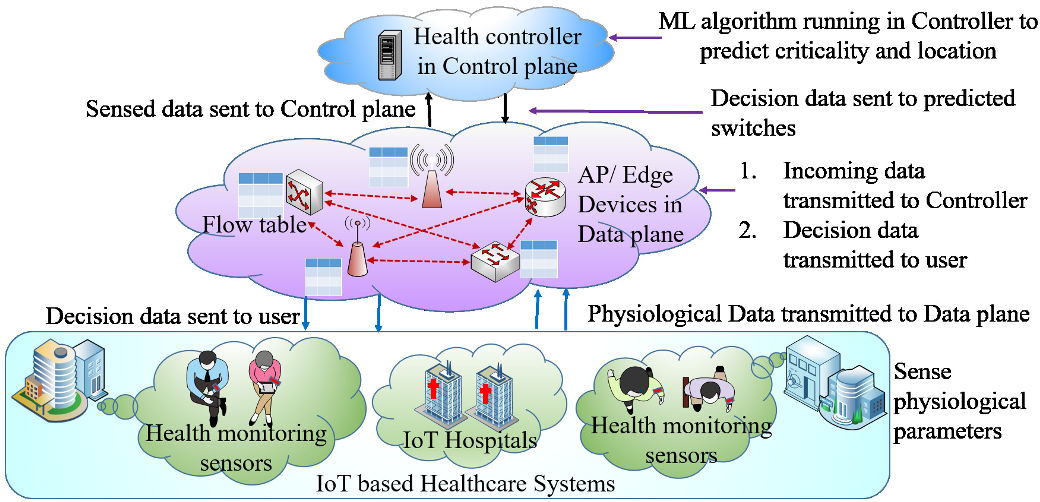 Fig 1: The Health-Flow architecture integrating IoT sensors, SDN Controllers, and Edge APs.
Methodology: From Math to Movement
The authors formulate the selection of APs as an Integer Linear Programming (ILP) problem. The objective is to minimize the number of activated APs while satisfying constraints on:
- Memory: Flow-rules cannot exceed .
- Energy: Total consumption must stay within .
- Latency: Must be below the threshold for critical alerts.
For trajectory prediction, the GMM accounts for the subjective nature of human movement by clustering patterns from the Geolife dataset, allowing the network to "hand over" the patient's connection smoothly as they move.
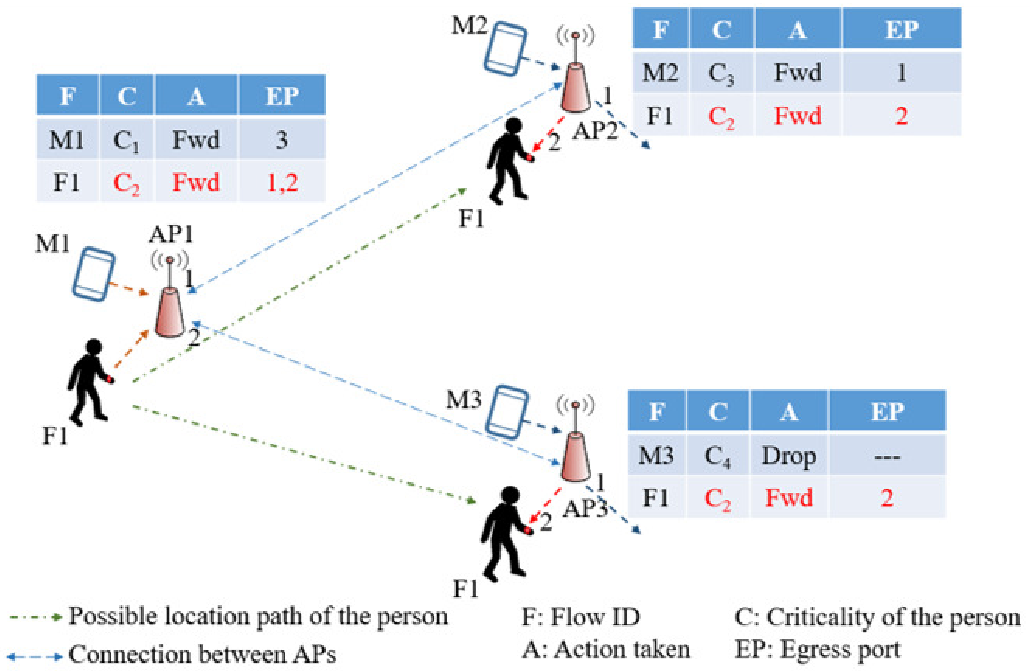 Fig 2: GMM-based trajectory prediction identifying which AP flow tables need proactive updates.
Performance Benchmarks
Health-Flow was tested against Mobi-Flow and traditional SDN architectures. The results prove that context-awareness is a powerful tool for network optimization:
- Latency Reduction: By avoiding unnecessary flow-rule updates for non-critical data, the system responds 52% faster during emergencies.
- Energy Efficiency: Since APs only stay "active" for specific critical handovers, energy consumption dropped by 12%.
- Overhead: Control traffic was reduced by 19% due to the efficiency of the hybrid placement strategy.
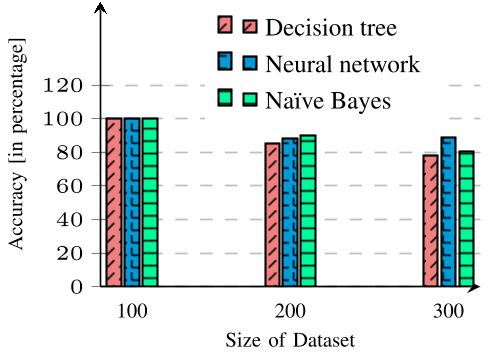 Fig 3: Quantifying the gains in Delay, Energy, and Overhead across varying network sizes.
Critical Analysis & Conclusion
Health-Flow effectively bridges the gap between medical diagnostics and network engineering. By using the content of the data (health status) to dictate the behavior of the network (flow control), it moves toward a truly "intent-based" healthcare infrastructure.
Limitations: The current model assumes a homogeneous SDN environment. In the real world, "gray zones" (non-SDN legacy hardware) might break the flow-rule logic. Furthermore, the GMM approach, while robust, may require significant computational power at the controller level as the number of users scales into the thousands.
Future Work: The authors aim to test this in real-world heterogeneous environments where SDN and non-SDN devices coexist, potentially bringing this "Criticality-Aware" logic to the 5G/6G edge.