
VPA Framework: Leveraging Big Data and Feature Fusion for Scalable Voice Diagnostics
SPECIAL SECTION ON HEALTHCARE BIG DATA
This paper introduces a robust Healthcare Big Data framework tailored for Voice Pathology Assessment (VPA) using fused signal features and a cloud-based multi-classifier system. By combining MPEG-7 low-level audio descriptors with Interlaced Derivative Patterns (IDP) and utilizing an ensemble of ELM, SVM, and GMM, the framework achieves a state-of-the-art accuracy of 95.6% in identifying vocal abnormalities.
TL;DR
Researchers have developed a high-accuracy (95.6%) framework for diagnosing voice pathologies within a Big Data context. By fusing MPEG-7 audio features with Interlaced Derivative Patterns (IDP) and using a majority-vote ensemble of ELM, SVM, and GMM, the system overcomes the noise and heterogeneity typical of multi-hospital data sources.
Problem & Motivation: The Heterogeneity Trap
Healthcare data is no longer just a spreadsheet of patient ages and weights. It is a "Big Data" problem characterized by the 5Vs: Volume, Variety, Velocity, Variability, and Value. Specifically, in Voice Pathology Assessment (VPA), signals are captured across different microphones, sampling rates, and environmental conditions.
Prior works often relied on specific acoustic features like MFCC or Jitter/Shimmer, which can be brittle when faced with the "unstructured" nature of healthcare big data. The authors' insight was to move toward a more robust, multi-faceted feature extraction and a redundant classification strategy to eliminate the "unfortunate misdiagnosis" of a single model.
Methodology: The Core of Robustness
1. Dual-Feature Fusion
The framework employs two powerful feature sets that view the voice signal through different "lenses":
- MPEG-7 Low-Level Descriptors: These are standard spectral features (like Audio Spectrum Flatness and Harmonicity) that capture the global "feel" of a voice.
- Interlaced Derivative Pattern (IDP): Originally from image processing, IDP captures second-order derivatives in time and frequency. It is exceptionally good at encoding the subtle time-frequency variations that distinguish a "raspy" pathological voice from a clear one.
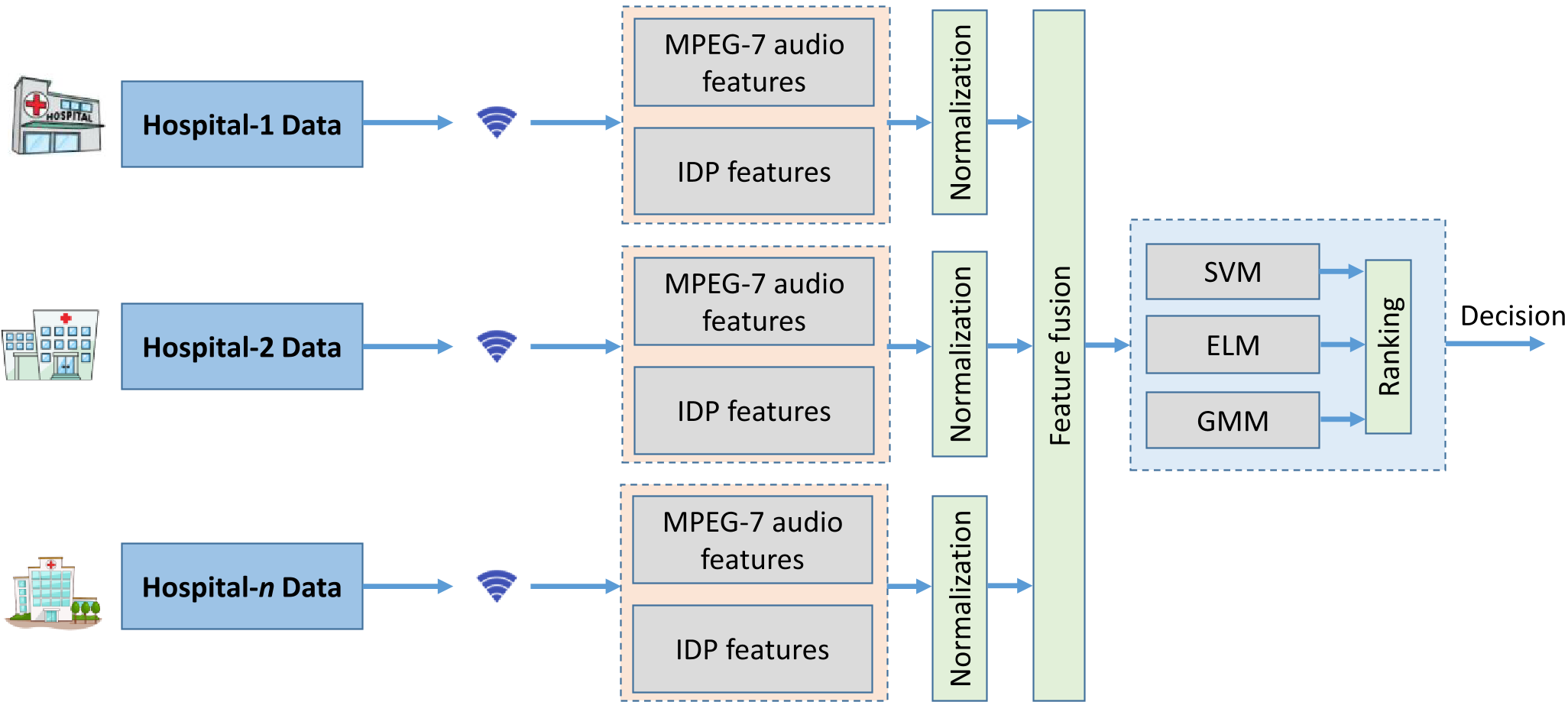
2. Multi-Classifier Ensemble (The Ranking System)
Instead of betting on one algorithm, the framework uses a Majority Voting mechanism:
- SVM: Provides a unique solution via optimal hyperplane kernels.
- ELM (Extreme Learning Machine): A fast, single-hidden layer feedforward network known for its generalization capabilities.
- GMM (Gaussian Mixture Model): A stochastic model that excels at capturing the underlying distribution of speech parameters.
Experiments & Results
The system was validated using the MEEI and Saarbruecken Voice Databases.
Key Findings:
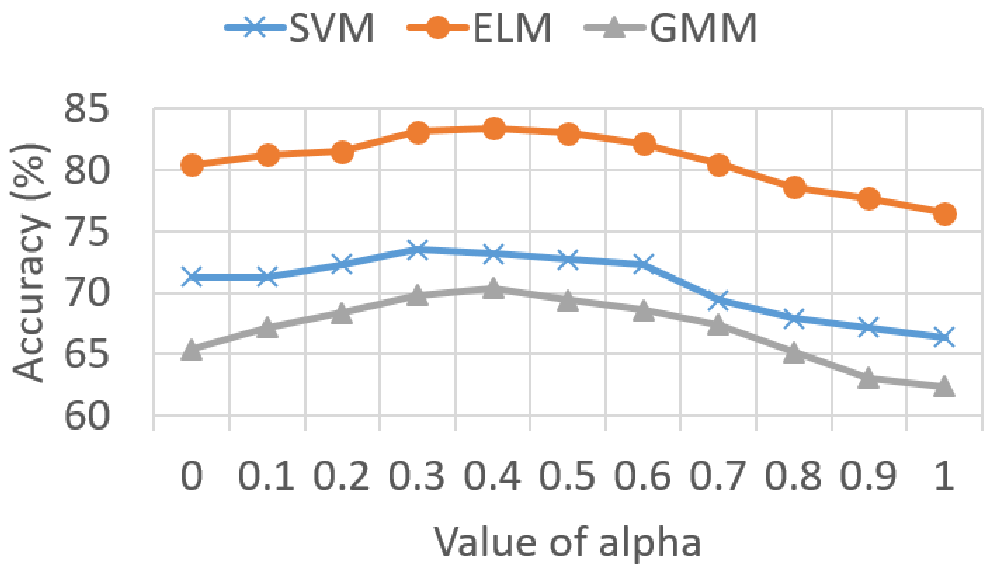
- The Power of ELM: Surprisingly, ELM with a Gaussian mapping function outperformed both SVM and GMM individually, reaching 80.4% accuracy on its own.
- Alpha Weighting: The authors found that the optimal weight for fusion () leaned towards the IDP features, suggesting that local derivative patterns are more descriptive of pathology than global MPEG-7 descriptors.
- Speed: Inference takes only 1.1 seconds, meeting the requirements for real-time telehealth applications.
Critical Analysis & Conclusion
The Healthcare Big Data Voice Pathology Assessment Framework represents a significant step toward clinical-grade AI. Its primary strength lies in its Inductive Bias—the assumption that pathology is encoded both in spectral energy (MPEG-7) and local directional changes (IDP).
Limitations:
- Unstructured Data Filtering: While the paper mentions filtering incorrectly labeled samples, automating this "quality control" in a truly massive, unsupervised Big Data stream remains a challenge.
- The "Black Box" of IDP: While more robust than MFCC, interpreting why a specific IDP pattern triggers a "pathological" flag remains difficult for human clinicians.
Future Outlook:
This methodology isn't limited to voice. The authors suggest that the same "Feature Fusion + Ensemble Ranking" architecture can be applied to ECG (Heart) or Mammogram (Cancer) data, providing a specialized blueprint for the next generation of cloud-assisted medical diagnostics.