
Business Microscope: Quantifying the "Heartbeat" of an Organization via Wearable Sensors
Healthcare of an organization: Using wearable sensors and feedback system for energizing workers
The paper introduces "Business Microscope," a wearable sensor-based system designed to quantify and optimize organizational behavior. By combining badge-shaped sensors (Hi-badges) with behavioral analysis and feedback loops, the system successfully improved communication and productivity in a large-scale software development project.
TL;DR
Hitachi researchers have developed a comprehensive "Business Microscope" system that uses wearable badges to capture the intricate dance of human interaction in the workplace. By analyzing motion rhythms and face-to-face networks, the system identifies the behavioral signatures of high-performing teams. In a real-world software development trial, it successfully diagnosed communication bottlenecks and utilized a feedback-loop system to revitalize team dynamics and boost productivity.
The Motivation: The High Cost of "Mental Insufficiency"
In a volatile financial climate, organizational stress often leads to "mental insufficiency"—a state where workers underperform due to depression or burnout even if they aren't clinically ill. Hitachi estimates the financial loss from this phenomenon to be in the billions. The core problem is that traditional management is "blind" to the actual physical and social mechanics of work. We know what people produce, but we rarely understand how they interact or whether they are in a state of "Flow."
The Hardware: The Hi-Badge and "Beam-Scan" Technology
The foundation of the Business Microscope is the Hi-badge, a 33g wearable device. Unlike simple step counters, this device is an organizational stethoscope:
- Face-to-Face Interaction: Uses four infrared modules with a "beam-scan" technique to detect interactions within a 120-degree range while maintaining a 21-hour battery life.
- Motion Rhythm: 3-axis acceleration is sampled at 50 Hz. This isn't just for movement; it's to detect "rhythm." Consistent rhythms around 2 Hz are used as a proxy for the psychological "Flow" state.
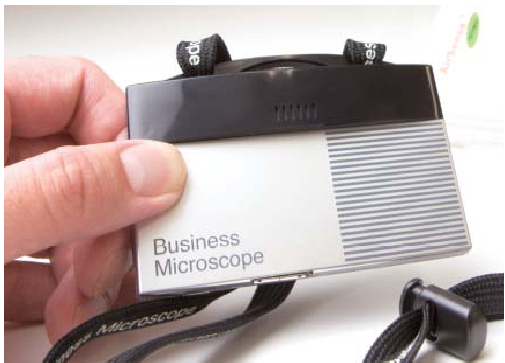
Methodology: From Raw Motion to Organizational Insight
The true power of the system lies in its Data-Analysis Engine, which processes raw signals into over 200 indicators.
1. Predicting "Flow"
Researchers found that simply moving a lot doesn't mean a worker is productive. Instead, the consistency of a specific motion rhythm (approx. 2 Hz) over time was the best predictor of "flow-rich" workers. This aligns with the theory that mastery involves repeated, rhythmic trial-and-error.
2. The Communication Quality
By measuring "gestures" during conversation (nodding, laughing, or stillness), the system distinguishes between active engagement and boredom. In software projects, they discovered that developers who primarily "listen" (low motion during talk) often report higher stress levels.
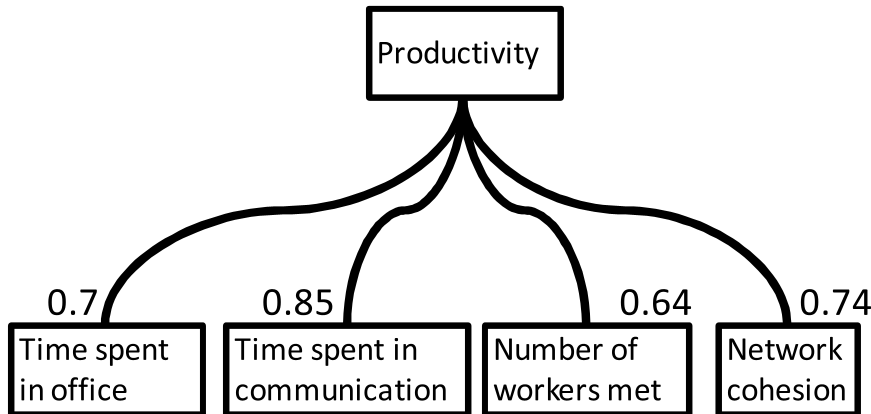
Case Study: Revitalizing a Software Development Team
The system was deployed with 125 workers in a waterfall-process software company. The goal was to bridge the gap between high-level managers and the developers "in the trenches."
The Intervention: WorkX & Xcafe
Using the real-time network topology, the researchers implemented WorkX—a dynamic member rotation system. Instead of static teams, members were reassigned based on communication gaps identified by the sensors.
The Visual Transformation: The results were stark. Before the intervention, the team was decentralized, with a clear "communication gap" where developers were isolated from decision-makers. After applying the sensor-informed feedback and WorkX rotations, the network became highly cohesive.
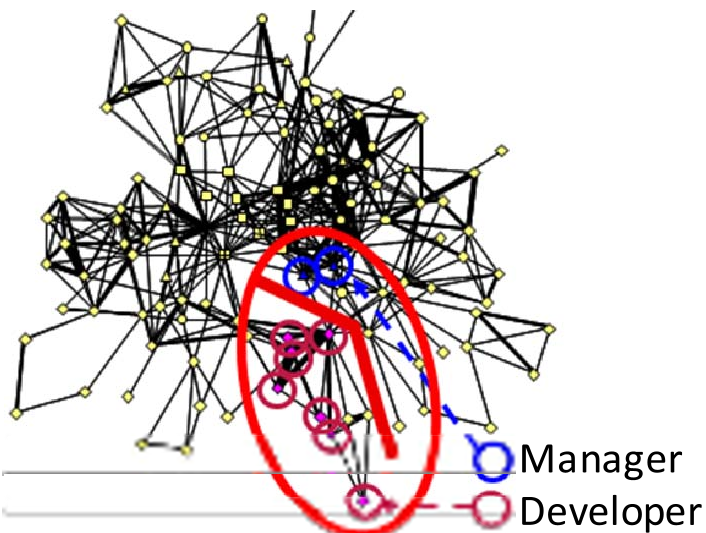 (a) Before: Siloed communication vs. (b) After: Integrated network.
Critical Analysis & Future Outlook
The "Business Microscope" represents a shift toward Evidence-Based Management. By moving feedback from private web portals to public "Hi-touch" displays, Hitachi encouraged workers to collectively analyze their own social patterns, transforming "big brother" surveillance into a tool for mutual support.
Limitations & Challenges:
- Privacy: High-resolution behavioral data is sensitive. The researchers emphasize anonymization, but the "uncanny valley" of being tracked for "voice energy" remains a hurdle for broad adoption.
- Context: Sensors tell you that people are talking, but not what they are saying. The system relies on humans to provide the qualitative "why" behind the quantitative "what."
The Vision: Hitachi aims to expand this "Sensing of Humanity" beyond the office into schools, hospitals, and customer-facing roles, potentially creating a global database of human organizational behavior.
Conclusion
The Business Microscope proves that the most valuable asset in an organization—human interaction—is no longer an "invisible" variable. By quantifying the heartbeat of a team, companies can move beyond restructuring on paper to actually re-engineering the way humans connect.