
From Innovation to Necessity: Mapping the Shift in Telehealth Perceptions During COVID-19
Healthcare Professionals’ Perceptions of Telehealth: Analysis of Tweets from Pre- and During the COVID-19 Pandemic
2021-01-01
Summary
Problem
Method
Results
Takeaways
Abstract
This study analyzes healthcare professionals' perceptions of telehealth on Twitter before (2019) and during (2020) the COVID-19 pandemic. Using Sentiment Analysis and Epistemic Network Analysis (ENA), the research tracks the shift from viewing telehealth as a niche innovation to a critical tool for safe care delivery.
## TL;DR
The COVID-19 pandemic didn't just increase telehealth usage; it fundamentally rewired the mental models of healthcare professionals. By applying Epistemic Network Analysis (ENA) to Twitter data, this study reveals a pivot from viewing telehealth as a "novelty/innovation" in 2019 to a "critical safety utility" in 2020, while identifying persistent anxieties regarding data privacy and the limitations of virtual physical exams.
## Paradox of Progress: The Forced Evolution of Virtual Care
Before 2020, telehealth was often discussed in academic or "early adopter" circles as a promising innovation—something that *could* improve access but was hindered by infrastructure costs and traditional care models. When COVID-19 struck, the conversation shifted from "Why should we use this?" to "How do we survive without it?"
The researchers sought to quantify this shift by scraping tens of thousands of tweets from healthcare professionals, comparing the pre-pandemic landscape of early 2019 to the crisis response of early 2020.
## Methodology: Sentiment Meets Network Analysis
The study employed a dual-layered technical approach:
1. **Sentiment Analysis**: Using the **Liu Hu Lexicon** via the Orange Data Mining suite, they classified the "valence" (emotional tone) of the tweets.
2. **Epistemic Network Analysis (ENA)**: This is the high-value core of the paper. Unlike simple word clouds, ENA models the *structural connections* between concepts. If a doctor tweets about "Safe Delivery" and "Insurance" in the same context, ENA documents that link as a specific epistemic connection.

## The Pivot: Innovation vs. Safety
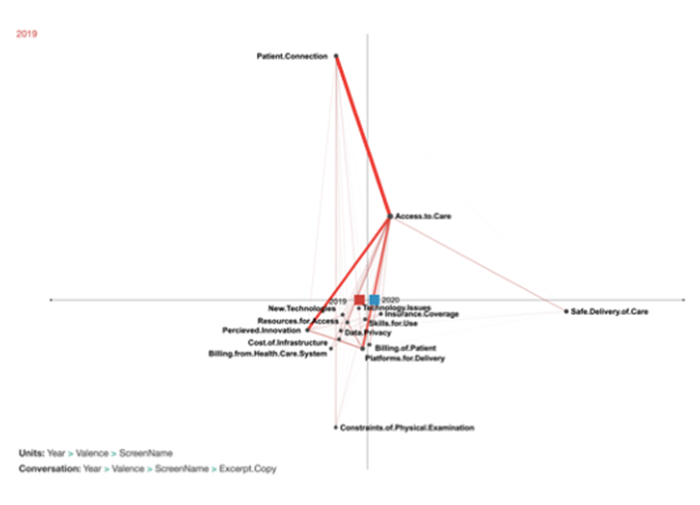
The results, visualized through ENA mean networks, show a stark contrast in the professional discourse:
* **2019 (The Innovation Era)**: The discourse was anchored in **Platforms for Delivery**, **Access to Care**, and **Innovation**. The red network (2019) in the researchers' models shows strong ties between new technology and the *potential* to reach remote areas.
* **2020 (The Safety Era)**: The blue network (2020) shifts dramatically toward **Safe Delivery of Care**, **Insurance Coverage**, and **Billing**. The conversation became practical, administrative, and urgent.
### Key Technical Insight: The Negative Valence
The study found that negative sentiment wasn't usually about the tech failing, but about **systemic constraints**. Professionals expressed concern regarding:
* **Data Privacy**: Fear of HIPAA-related issues when using non-traditional platforms.
* **Physical Exam Limitations**: Acknowledging that virtual care cannot yet replicate the "observational skills" of face-to-face medicine.
* **Reimbursement**: "Doctors were never paid for telephone calls... they won't be now" (a common pre-policy-shift complaint).
## Critical Analysis & Conclusion
This research confirms that the pandemic broke the "inertia of innovation." In 2019, the primary barrier was perceived to be the "technology" or "innovation" itself. In 2020, the barrier shifted to "policy"—specifically insurance and billing.
**Takeaway for the Future**: The technical maturity of telehealth is no longer the bottleneck. The future of virtual care rests on solving the **billing of patients**, **state-line licensure**, and ensuring **data privacy** remains robust even as access expands.
**Limitations**: The study is limited to English-speaking Twitter (now X) users and potentially misses the context provided by images or external links within tweets. However, as a barometer for professional sentiment, it provides a rigorous look at how a global crisis can redefine the "Industrial Logic" of healthcare overnight.