
When Safety Mechanisms Fail: The Paradox of Rigid Surgical Protocols
11920_Healthcare safety the impact of Disabling safety protocols.
This paper investigates the "counting protocol" in surgical settings, a safety procedure intended to prevent retained foreign objects. Through focus groups and observational studies, it uncovers how rigid adherence to such protocols can introduce significant cognitive load and secondary risks to patient safety.
TL;DR
In the high-stakes environment of the Operating Room (OR), "Safety Protocols" are often treated as sacred. However, research by Dierks et al. reveals a startling truth: the manual counting of sponges and instruments—intended to protect patients—can actually disable medical teams. By consuming nearly 15% of surgical time and creating massive cognitive distractions, these protocols sometimes create more risk than they mitigate.
The "Safety" Trap: Motivation and Blind Spots
The medical community has long relied on the "Count Protocol" (counting every needle, sponge, and tool) to prevent Retained Foreign Bodies (RFB). While the intent is noble, the Human Factors reality is messy.
The authors argue that many safety protocols are implemented without "Vetting." Unlike drug treatments, which undergo rigorous clinical trials, procedural protocols are often born from policy consensus rather than empirical evidence of their impact on the human-system interface. The core problem is complexity: as surgeries become more demanding, the protocol meant to safeguard the patient begins to compete with the surgery itself for the nurses' limited attention.
Methodology: From Interviews to the "Front Lines"
The study utilized a qualitative-quantitative hybrid approach:
- Focus Group: Tapping into the collective experience of OR nurses (averaging 18 years of experience) to identify where the "counting" system breaks down.
- Field Observation: A "fly-on-the-wall" study of nine complex surgeries, tracking exactly how many minutes were lost to the protocol and how it disrupted communication.
The Operational Flow
Through Task Analysis, the researchers mapped out the hierarchy of surgical goals. They found that the "Count Protocol" often functions as a disruptive loop that breaks the normative flow of patient care.
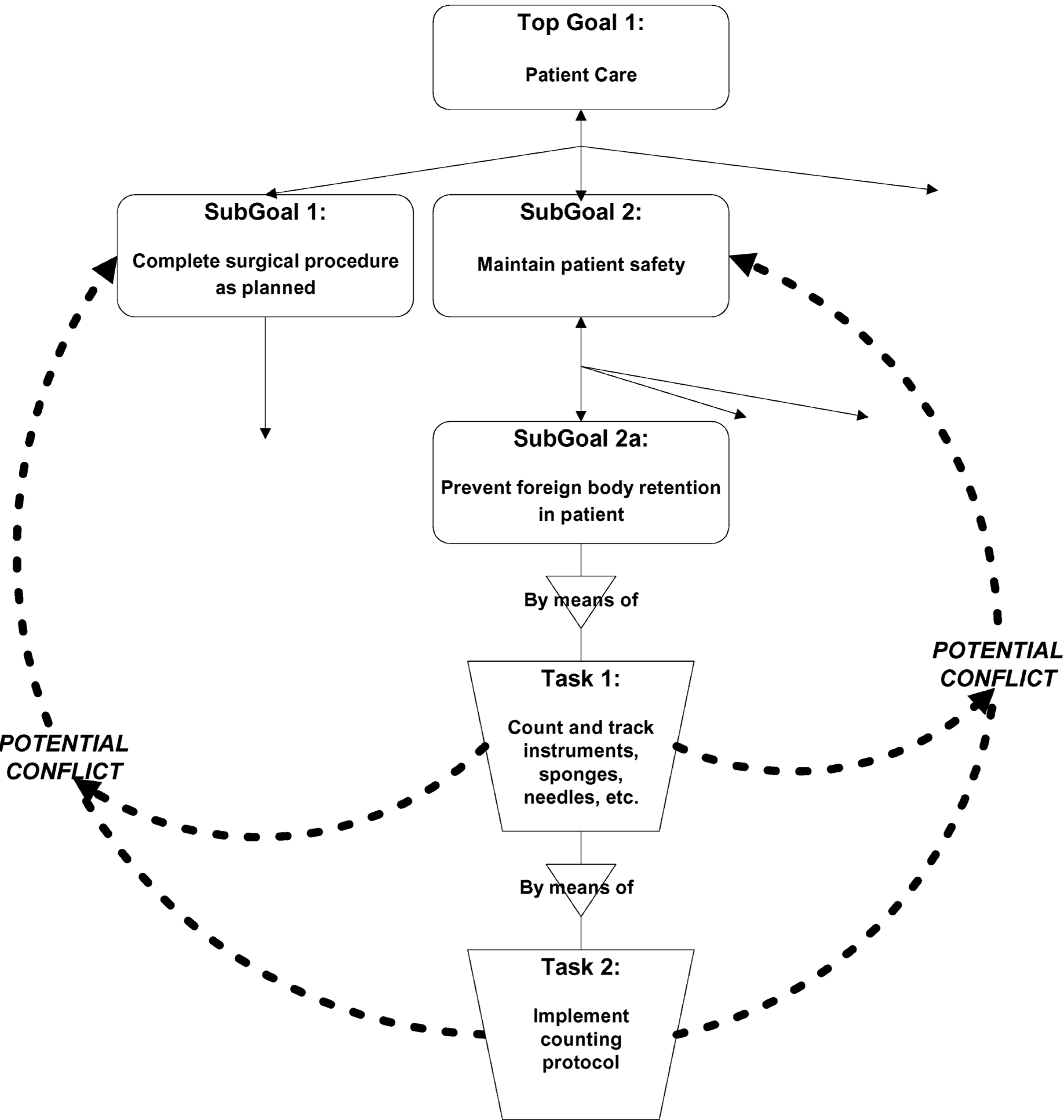
Key Findings: The Cost of Counting
The data suggests that the burden of safety is heavy:
- Time Sink: Nurses spent an average of 35.9 minutes per case just counting.
- Attentional Tunneling: In high-complexity cases, inconsistencies in counts (often due to mid-surgery shift changes or adding new tools) forced nurses to ignore surgeon requests.
- The Near-Miss: The most chilling evidence was a "slip" where a nurse, preoccupied by a count discrepancy, handed a surgeon contaminated irrigation fluid.
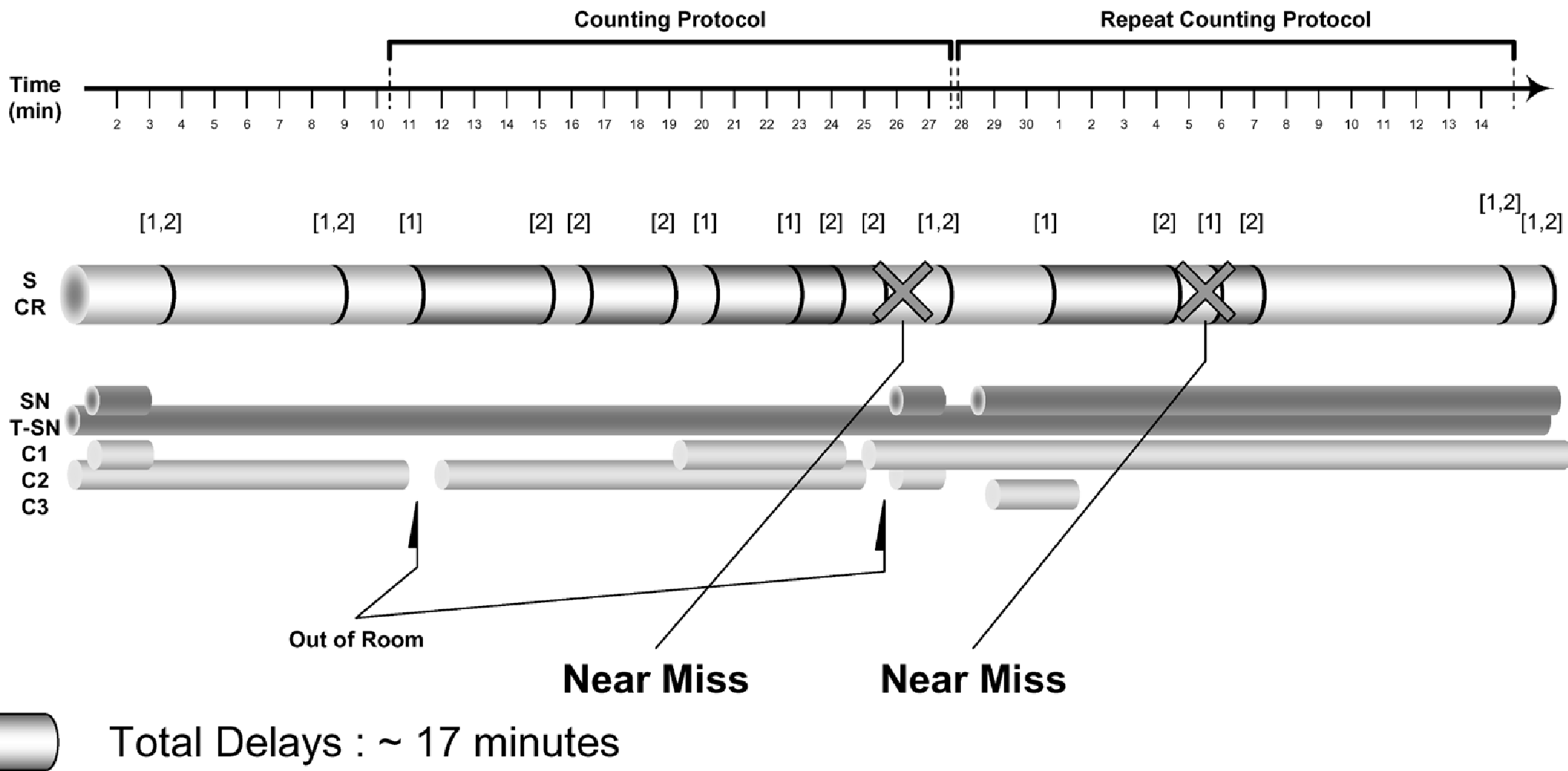 The figure above illustrates a "disabling" scenario where counting persisted even after a decision was made to use X-ray imaging, effectively wasting nursing resources when the patient needed them most.
Why Does This Happen? (Critical Insight)
The paper introduces the concept of "Disabling" Protocols. This occurs when a rule is followed so rigidly that it ceases to serve its purpose and instead actively hinders the primary goal (saving the patient).
The authors identify several "System Pathologies":
- Boundary Conditions: The protocol doesn't tell you when to stop. Nurses continue counting even when they know the discrepancy is clerical, not clinical.
- Cognitive Load: Manual counting is a repetitive, error-prone task that is highly sensitive to the constant interruptions inherent in an OR.
- Production Pressure: The drive to finish the case often clashes with the meticulous requirements of a "correct count."
Critical Analysis & Future Outlook
The takeaway is clear: Safety is not a zero-sum game. Simply adding more checks and protocols can eventually reach a point of diminishing returns—and eventually, negative returns.
Limitations: The study is based on a small sample size (9 cases at one institution). While deep in detail, more massive data sets are needed to quantify the national "near-miss" rate caused specifically by protocol distraction.
The Path Forward:
- Technological Mitigation: Shifting from manual human counts to RFID-tagged sponges or barcode scanners to reduce cognitive load.
- Flexible Heuristics: Allowing clinical leaders to "suspend" counts during high-complexity phases in favor of post-operative imaging (X-rays).
System safety in healthcare must evolve from "blind compliance" to "resilient performance."