
Measuring the Unmeasurable: A Deep Dive into Hedonic and Content Quality of SNS
Measuring Hedonic and Content Quality of Social Networking Sites Used in Interactive Learning Ecosystems
This paper presents a psychometric evaluation of a newly designed instrument for measuring the Hedonic Quality (HDQ) and Content Quality (CNQ) of Social Networking Sites (SNS) in high education. Using a representative sample of 322 students across four platforms (Facebook, Instagram, Twitter, and YouTube), the study confirms the reliability and validity of a multi-attribute questionnaire framework.
TL;DR
In the digital age, why do we prefer YouTube over Twitter for learning? It is not just about the features—it is about the "feel." This paper validates a comprehensive questionnaire designed to measure Hedonic Quality (HDQ) and Content Quality (CNQ). By testing 322 students, the researchers proved that dimensions like Playfulness and Added Value are the true differentiators of success in interactive learning ecosystems.
Context: Beyond "Usability"
Historically, we evaluated software based on Usability (can I complete the task?). However, as Social Networking Sites (SNS) become central to the "Digital Classroom," we must shift toward User Experience (UX) (how do I feel while doing it?).
The authors argue that prior work focuses too much on adoption (the "What") and not enough on the human-centric "Why." This paper maps the academic terrain of SNS quality, positioning hedonic value as a critical driver for student engagement and academic loyalty.
Methodology: The Hedonic-Content Framework
The core of this research is a two-pronged quality model. The authors don't just ask if a site is "good"; they decompose "good" into 11 granular attributes.
1. Hedonic Quality (The "Vibe")
- Aesthetics & Uniqueness: Visual appeal and branding.
- Playfulness & Pleasure: The spark of curiosity and emotional response.
- Satisfaction & Loyalty: The long-term relationship with the platform.
2. Content Quality (The "Meat")
- Accuracy & Credibility: Is the info right, and can I trust it?
- Coverage & Timeliness: Is it complete and up-to-date?
- Added Value: Is this actually useful for my goals?
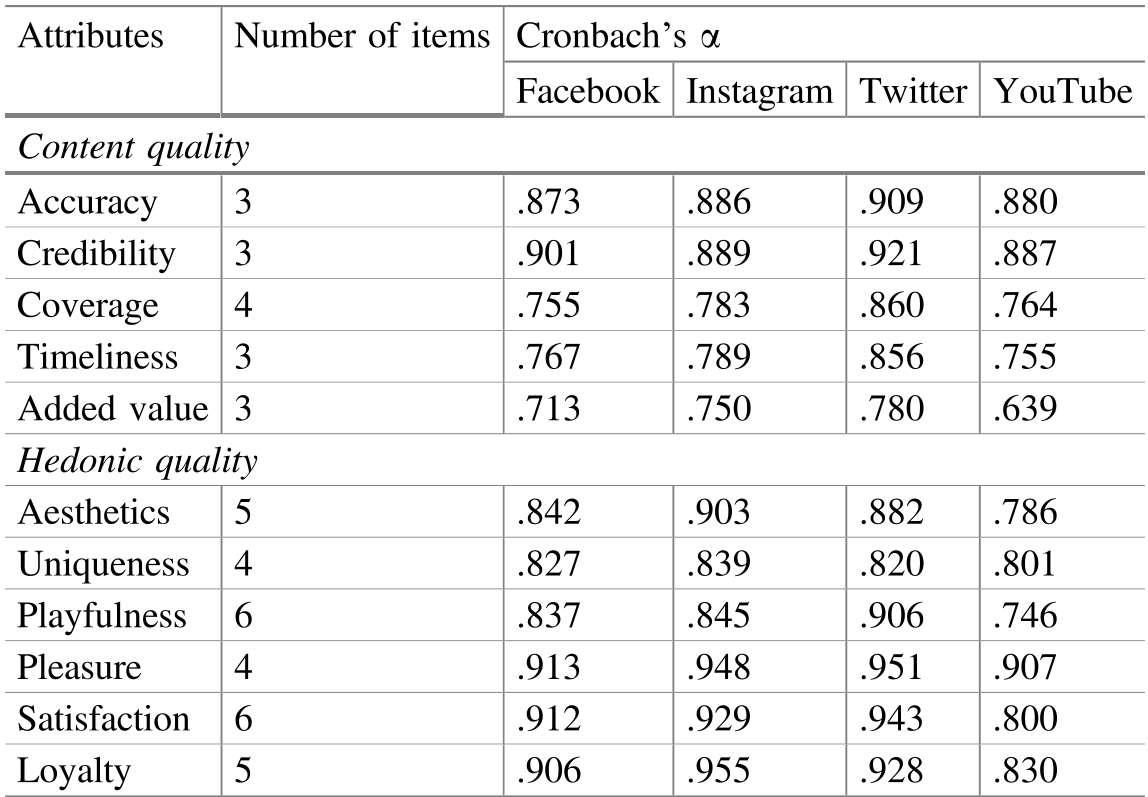 Table 1: The model shows high Cronbach’s alpha values, proving the questionnaire is a reliable "yardstick."
Experimental Showdown: YouTube vs. The World
The researchers didn't just propose a theory; they put the four giants—Facebook, Instagram, Twitter, and YouTube—into a head-to-head battle.
Key Statistical Insights:
- YouTube is the Champion: YouTube dominated in nearly every category, particularly in Playfulness and Overall Quality. This suggests that for students, the video format provides a richer "Flow" experience.
- Twitter’s Struggle: Twitter ranked significantly lower across most dimensions. The students perceived its content as less "complete" (Coverage) and the experience as less "pleasurable."
- The Instagram-Facebook Blur: Interestingly, the study found no significant difference between Instagram and Facebook regarding Loyalty () or Content Quality (). This suggests users treat Meta’s ecosystem as a singular, unified utility.
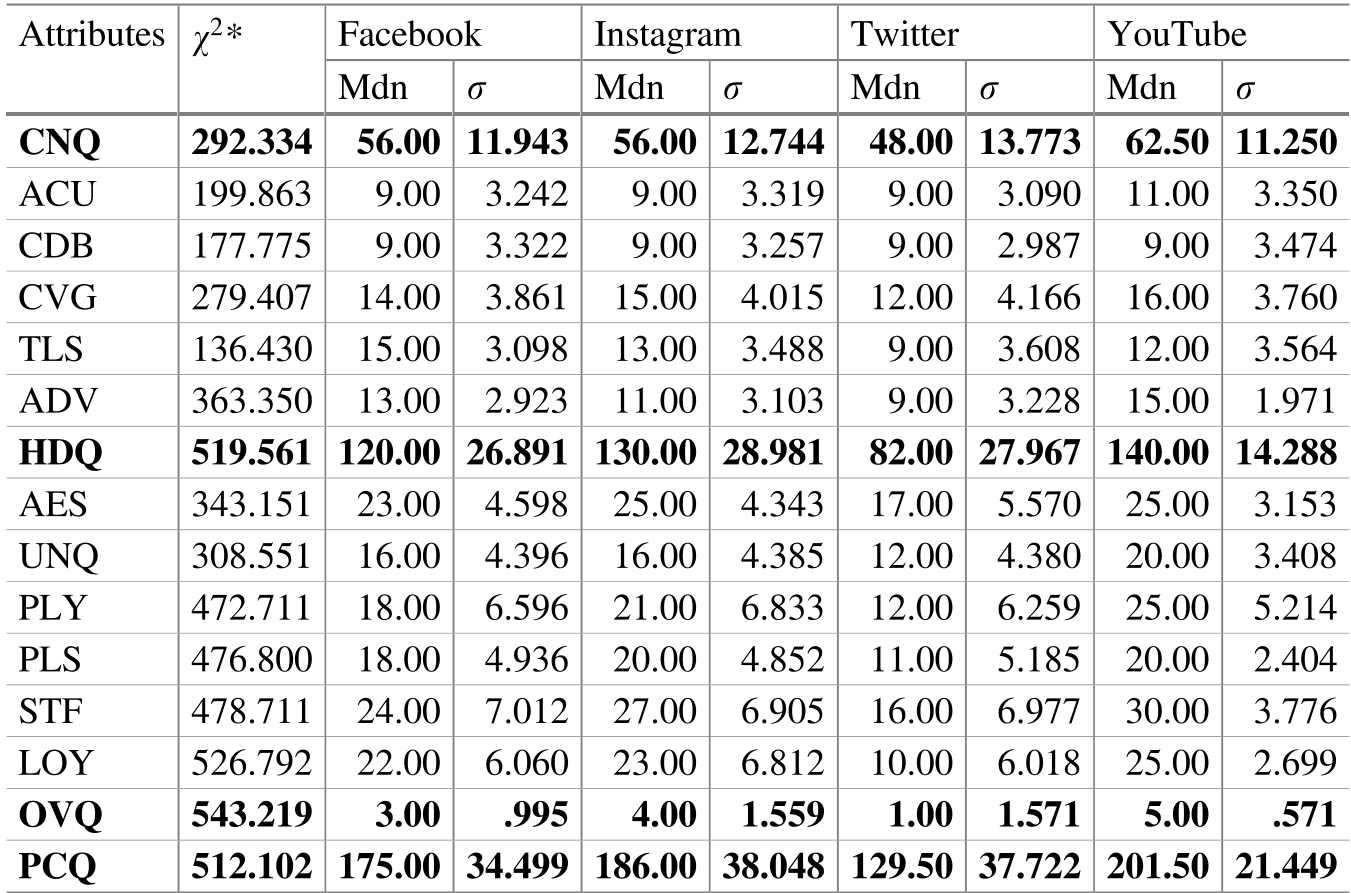 Table 2: Median values highlight the massive gap between YouTube (high medians) and Twitter (low medians).
Critical Insight: The Playfulness Factor
One of the most striking findings is that Playfulness yielded the highest percentage of "large size" differences () among the platforms. This tells us that in an educational ecosystem, the ability of a platform to stimulate curiosity is more important for branding than simple accuracy or aesthetics.
Takeaway & Limitations
While this study provides a "gold standard" questionnaire for practitioners, it is not without limits. The sample was restricted to Croatian university students.
Why should you care? If you are developing an EdTech platform or managing a university's social presence, this paper provides the blueprint. Stop focusing only on site speed or login ease; focus on Added Value and Playfulness. Those are the dimensions that build loyalty in the digital classroom.
Future Outlook
As we move toward AI-driven social feeds, how will "Accuracy" be perceived? The next frontier for this research will likely involve applying this hedonic scale to generative AI interactions, where the "creativity" of the system replaces the traditional "content" of the platform.