
HFLTS: Bridging Human Hesitation and Linguistic Computing in Decision Making
Hesitant Fuzzy Linguistic Term Sets for Decision Making
This paper introduces Hesitant Fuzzy Linguistic Term Sets (HFLTS), a novel framework for qualitative multi-criteria decision making (MCDM). By combining hesitant fuzzy sets with context-free grammars, it allows experts to express uncertainty using rich, comparative linguistic expressions (e.g., "between medium and high") rather than single terms.
TL;DR
Most decision-making models assume experts can provide a crisp "Good" or "Bad" assessment. This paper introduces Hesitant Fuzzy Linguistic Term Sets (HFLTS): a framework that allows experts to say things like "between medium and high." It uses context-free grammars to convert these human-like expressions into a rigorous mathematical format, enabling precise computation under qualitative uncertainty.
The Motivation: Why Single Terms Fail
In complex Multi-Criteria Decision Making (MCDM), human experts often hesitate. Forcing an expert to choose a single term (e.g., "High") when they feel the answer is "High or Very High" introduces artificial precision, which leads to information loss.
While Hesitant Fuzzy Sets (HFS) were proposed for quantitative data (sets of membership values), the qualitative domain lacked a flexible counterpart. Previous linguistic models either used Type-2 fuzzy sets (complex to compute) or 2-tuples (accurate but still limited to single base terms). This paper's insight is to allow a "set" of linguistic terms to represent a single assessment.
Methodology: From Grammar to Math
1. The Context-Free Grammar ()
The authors define a grammar that generates comparative linguistic expressions closer to human natural language.
- Unary Relations: "lower than", "greater than"
- Binary Relations: "between and "
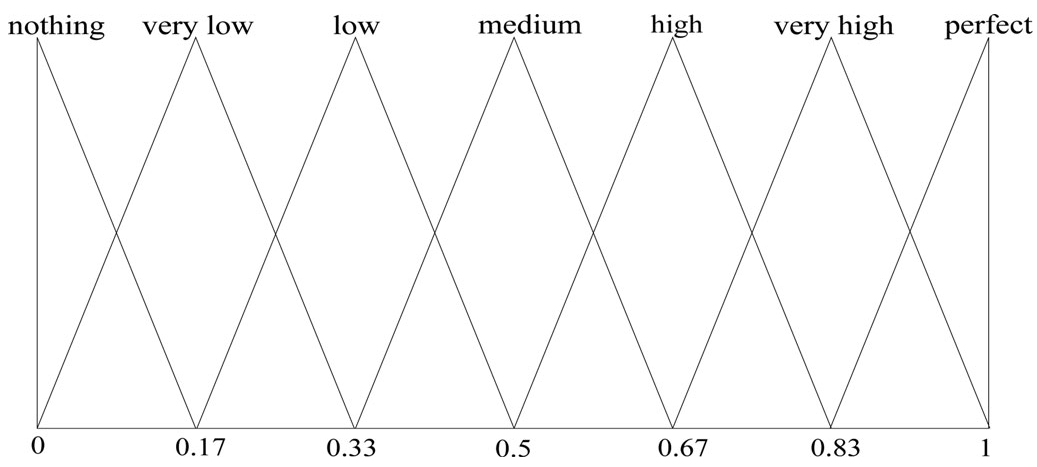
- Primary Terms: Standard labels like "Medium," "High."
2. Transformation into HFLTS
Any expression generated by the grammar is transformed into an HFLTS (). For instance:
E("between low and medium")E("greater than high")
3. Aggregation and Interval Construction
To rank alternatives, the paper proposes two symbolic operators:
- Min-Upper: Selects the worst of the superior values among criteria.
- Max-Lower: Selects the best of the inferior values among criteria.
These two bounds form a Linguistic Interval, which encapsulates the "core" of the hesitant information.
Scaling Decision Models
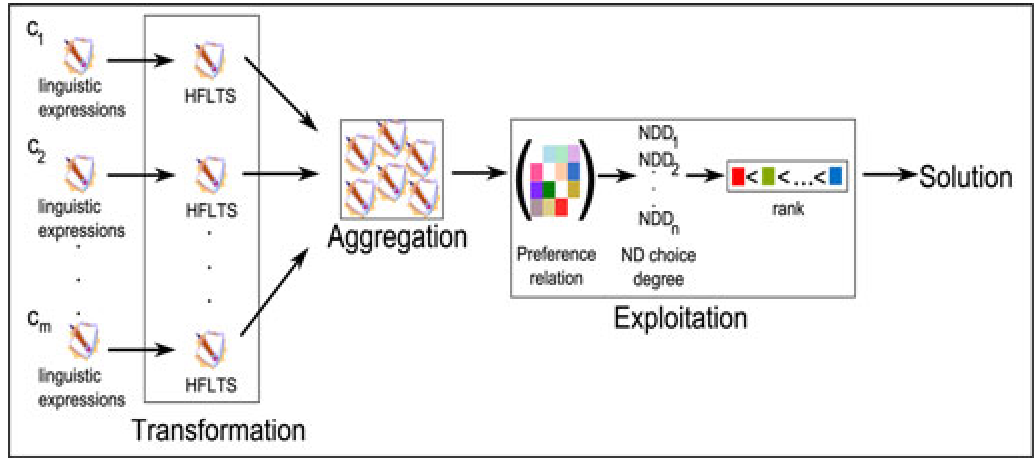
The decision workflow follows a three-phase pipeline: Transformation (Natural language to HFLTS), Aggregation (Creating intervals via operators), and Exploitation (Ranking alternatives).
In the experimental case study, the model successfully processed diverse assessments:
- Alternative 1 (Criteria 1): "between very low and medium"
- Alternative 1 (Criteria 2): "between high and very high" The model condensed these into a final preference relation, resulting in a Non-Dominance Choice Degree (NDD) that clearly identified the winner where traditional methods might have resulted in a tie or skewed results.
Critical Analysis
Core Contributions
- Linguistic Expressiveness: It allows for "hesitation" without forcing it into a single numerical value too early.
- Computational Simplicity: Unlike standard Type-2 fuzzy sets, HFLTS uses symbolic computation (indices of labels), which is computationally efficient.
Limitations & Future Work
The current model assumes that all linguistic terms are consecutive and equally probable within the set. Future research might benefit from adding weights to specific terms within a hesitant set—for instance, if an expert is "mostly sure of High, but maybe Very High."
Conclusion
HFLTS represents a significant step towards Computing with Words. By treating linguistic "hesitation" as a first-class citizen in decision theory, the authors provide a pathway for building AI systems that understand the nuances of human uncertainty.