
SMCACM: Breaking the Independent Encoding Barrier in Multi-Modal CQA Matching
Heterogeneous Community Question Answering via Social-Aware Multi-Modal Co-Attention Convolutional Matching
The paper introduces SMCACM, a Social-aware Multi-modal Co-attention Convolutional Matching method designed for Community Question Answering (CQA). It integrates textual, visual (object-level), and heterogeneous social context features using a novel co-attention mechanism and a pooling-based CNN to achieve state-of-the-art matching accuracy.
TL;DR
Community Question Answering (CQA) is no longer just about text; it is a rich ecosystem of images, social relations, and user tags. The SMCACM framework revolutionizes CQA matching by moving beyond independent encoding. By employing a co-attention convolutional matching network fed by heterogeneous social embeddings and object-level visual features, it achieves a near-perfect nDCG@8 of 0.98 on real-world datasets like Quora and Zhihu.
Problem & Motivation: The Limits of Isolation
Existing CQA matching systems typically treat questions and answers as isolated entities. Even recent deep learning models often encode them separately before comparing them in a latent space. This approach has three fatal flaws:
- Implicit Interactions: It ignores that a question provides the "context" needed to disambiguate an answer (and vice versa).
- Multi-Modal Blindness: Visual content and social context (who answered? what are the tags?) are often discarded.
- The Length Paradox: Answers vary from three words to thousands. Standard CNNs use "padding" or "cutting," which introduces noise or loses critical information.
Methodology: Synergy through Co-Attention
The core innovation of SMCACM lies in its Social-aware Multi-modal Co-attention architecture.
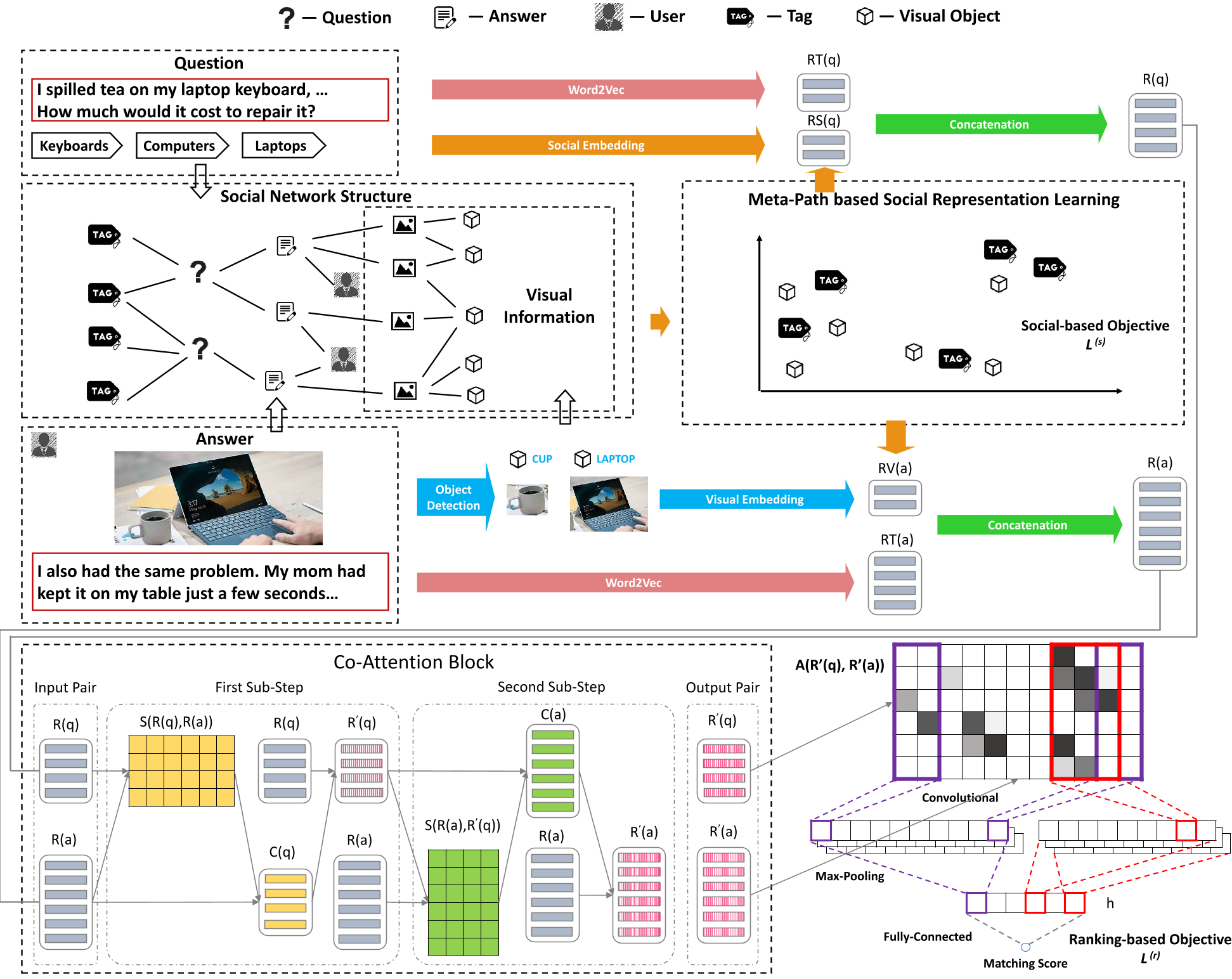
1. Heterogeneous Social Graph & Visual Objects
Instead of using a generic CNN to encode images, the authors use YOLO-v3 to detect specific objects. These objects are then treated as nodes in a heterogeneous social network alongside users, tags, questions, and answers.
A Meta-Path based learning objective (e.g., t-q-a-img-vo) ensures that the representations of these diverse nodes reflect their structural proximity. For instance, a "laptop" object detected in an image is semantically linked to the "Tech" tag through the user behavior graph.
2. The Co-Attention Mechanism
The model refines representations through a "fake reconstruction" process:
- Step 1: It constructs a "fake question" by calculating a weighted sum of the answer's words based on an affinity matrix.
- Step 2: The real question is updated with this "fake" information to include complementary signals from the answer.
- Step 3: This process is repeated for the answer, ensuring both representations "know" about each other before the matching starts.
3. Solving Variable Lengths
To avoid the pitfalls of padding, the model utilizes a pooling-based convolutional strategy. It applies kernels (capturing -grams of the answer across the entire question) and then uses global max-pooling to collapse the (answer length) dimension into a fixed-size feature map.
Experiments & Results: SOTA Performance
The authors tested SMCACM against heavyweights like K-NRM and MMAICM.
Key Findings:
- Precision Gain: On the Zhihu dataset, SMCACM achieved a Precision@1 of 0.8020 (at 70% data ratio), significantly outperforming MMAICM’s 0.7190.
- Data Efficiency: Remarkably, the model trained on only 10% of the data outperformed baselines trained on 70% of the data, proving that the multi-modal and social features provide a massive inductive bias.

Ablation Study Highlights:
- Impact of Co-Attention: Removing the co-attention block (the
CMvariant) led to a consistent drop in performance, validating that mutual reinforcement is key to capturing implicit semantics like "tea-milk" interactions.
Critical Insight & Conclusion
SMCACM’s primary contribution is the demonstration that matching is not just a similarity calculation—it is an interactive refinement process. By merging object detection with heterogeneous graph embeddings, the paper provides a roadmap for "Social Multimedia Retrieval."
Limitations: The model relies on a fixed set of YOLO labels. If an image contains an object outside the COCO dataset, its visual signal remains largely untapped. Future iterations might benefit from open-vocabulary object detectors or CLIP-style vision-language backbones to eliminate this label bottleneck.
Future Outlook: We expect to see this "Co-attention + Heterogeneous GNN" approach migrate into personalized recommendation engines and expert finding systems where "who" says something is just as important as "what" is being said.