
HOSTP: Navigating Trust in Complex Social Networks via Heuristic Optimization
A Heuristic Algorithm for Trust-Oriented Service Provider Selection in Complex Social Networks
The paper introduces HOSTP, a heuristic algorithm for optimal social trust path selection in service-oriented complex social networks. It models trust evaluation as a Multi-Constrained Optimal Path (MCOP) problem by integrating a novel Quality of Trust (QoT) metric, achieving superior efficiency and path quality compared to traditional MCOP solvers like HMCOP.
TL;DR
As social networks evolve into service-oriented ecosystems, finding a "trustworthy" provider is no longer just about the shortest path. This paper introduces HOSTP, a heuristic algorithm that solves the NP-Complete problem of selecting the most trustworthy path under multiple Quality of Trust (QoT) constraints. By considering social intimacy and expert roles alongside traditional trust ratings, HOSTP achieves a ~15% improvement in path quality and a ~50% reduction in latency over current benchmarks.
The "Trust" Crisis in Network Propagation
In a massive network like LinkedIn or eBay, how do you know if a stranger ten "hops" away is reliable?
Previous methods typically suffered from two fatal flaws:
- Over-simplification: They treated all links equally or only looked at peer ratings, ignoring that you trust a close friend more than a distant acquaintance (Social Intimacy) and an expert's advice more than a novice's (Role Impact).
- Computational Bottlenecks: Finding a path that satisfies multiple constraints (e.g., "Trust > 0.8 AND Intimacy > 0.5") is mathematically an MCOP problem, which is NP-Complete. Existing solvers like HMCOP often return infeasible paths or get bogged down in heavy non-linear calculations.
Methodology: The QoT Framework and HOSTP
The authors define a new metric: Quality of Trust (QoT). It is a multi-dimensional vector:
- Trust (T): Probability of expected outcome.
- Social Intimacy (r): Non-linear attenuation of relationships.
- Role Impact (ρ): Weight of expertise in a specific domain.
The HOSTP Algorithm
The core innovation is a bidirectional search strategy designed to navigate these constraints efficiently.
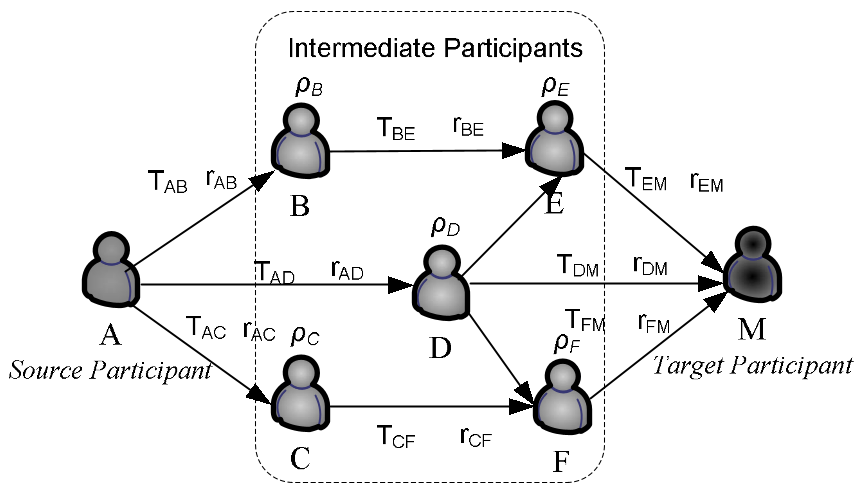 Figure: The Complex Social Network Model integrating T, r, and ρ attributes.
- Backward Search: Starting from the target, the algorithm investigates the sub-network to determine if a feasible solution even exists. It uses a "bottleneck" function to find the most likely feasible path.
- Forward Search: Once feasibility is confirmed, it moves from the source to the target. Unlike standard Dijkstra, it uses "foreseen" path data from the first step to prune nodes that would lead to a constraint violation, focusing only on maximizing the Utility Function ().
Experimental Results: Faster and Better
The authors validated their approach using the Enron email corpus, a classic real-world dataset.
- Utility Gains: HOSTP consistently found paths with higher utility scores (10-15% higher than HMCOP). This proves that HOSTP's pruning strategy doesn't just save time—it finds better routes that other heuristics miss.
- Efficiency: HOSTP slashed execution time by nearly half across all path lengths (4 to 7 hops). By removing the need for complex -based power calculations used in prior MCOP heuristics, HOSTP remains lightweight.
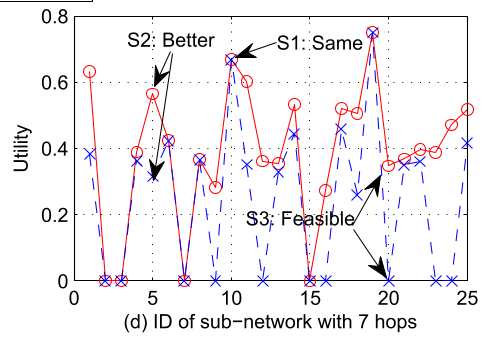 Figure: Performance comparison showing HOSTP identifying consistently higher utility paths than HMCOP.
Critical Insight & Future Outlook
The brilliance of HOSTP lies in its foreseen path strategy. By "looking ahead" using the metadata gathered during the backward pass, it avoids the "greedy trap" where an algorithm picks a locally optimal node that eventually leads to a dead end (constraint violation).
Future Directions: While HOSTP is powerful, its current reliance on static sub-networks might limit it in extremely dynamic environments where trust values fluctuate in real-time. Integrating Reinforcement Learning to update path weights dynamically could be the next frontier for this research.
Conclusion
HOSTP represents a significant step forward in making social trust actionable. It moves beyond theoretical propagation toward a practical, scalable engine capable of powering the next generation of trustworthy service marketplaces.