
Personality-Driven Graphs: Bridging Psychology and Graph Theory for Realistic Social Synthesis
Heuristic methods for synthesizing realistic social networks based on personality compatibility
This paper introduces two heuristic algorithms, Probability Search (PS) and Compatibility-Degree Matching (CDM), to synthesize realistic social networks by assigning human personality types to nodes. The core method leverages personality compatibility based on the Myers-Briggs Type Indicator (MBTI) to stochastically generate links, outperforming the standard Configuration Model (CM) in structural realism.
TL;DR
Researchers have developed a method to synthesize social networks that aren't just random mathematical abstractions, but are driven by human personality compatibility. By utilizing the Myers-Briggs Type Indicator (MBTI) and two new algorithms—Probability Search and Compatibility-Degree Matching—this work achieves a new level of "structural realism," outperforming standard models in mimicking how real-world communities form.
Background: The Structural Void in Synthetic Networks
In social network analysis (SNA), we often lack the ground-truth data of real-world relationships due to privacy concerns or high collection costs. Traditionally, we fill this gap with synthetic models like the Configuration Model (CM), which replicates the "degree sequence" (how many friends each person has) but ignores why those people became friends.
The authors of this paper argue that social ties are not random. They are governed by "implicit psychological and social rules." To capture this, they pivot from purely mathematical constraints to a personality-first approach.
Methodology: The MBTI Compatibility Engine
The researchers' insight is that if we know the personality of two individuals, we can estimate the likelihood of a link between them.
1. The Personality Compatibility Table
They constructed a 16x16 matrix (Table 4) based on eight environmental factors: Authority, Harmony, Loyalty, etc. This table serves as the "DNA" of the generative process.
- Homophily: The tendency of similar types to connect.
- Heterophily: The drive for complementary opposites to link.
2. The Search for Effective Assignments
The challenge is: Given a real-world network structure, which personality types should we assign to which nodes to make the final result look "natural"?
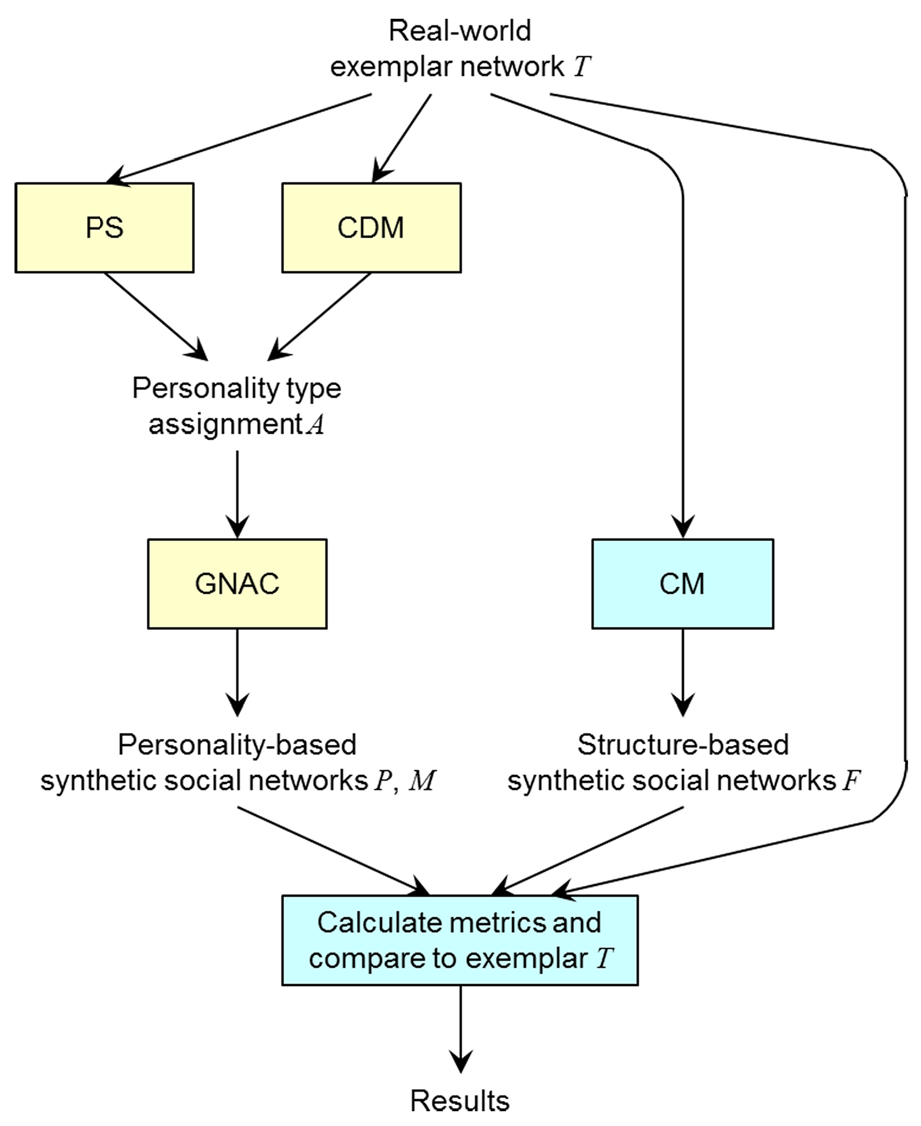
- Probability Search (PS): A heuristic that iteratively tweaks personality assignments to maximize the global "Network Probability." It uses a hill-climbing approach to ensure that the assigned personalities "explain" the existing structure.
- Compatibility-Degree Matching (CDM): A more efficient approach that maps highly compatible personalities to the most "popular" (high-degree) nodes based on US population distributions.
3. The GNAC Generator
Once personalities are assigned, the Generate Network using Assignment and Compatibility (GNAC) algorithm builds the graph. Unlike random models, it prioritizes creating "triangles" (communities) based on local compatibility sums.
Experiments: Do Personalities Lead to Realistic Networks?
The authors tested their algorithms against 14 real-world social networks (ranging from law firms to monasteries) using 20 standard metrics like Clustering Coefficient, Betweenness Centrality, and Eigencentrality.
Key Results
- PS and CDM vs. CM: Both personality-driven models were statistically closer to the exemplar networks than the purely structural Configuration Model.
- Clustering Insights: The personality models were exceptionally good at replicating "Mean Path Length" and "Global Clustering," suggesting that compatibility is indeed the engine of community formation.
- Efficiency: While PS is mathematically rigorous, the CDM algorithm is significantly faster, making it a viable candidate for scaling to larger networks.
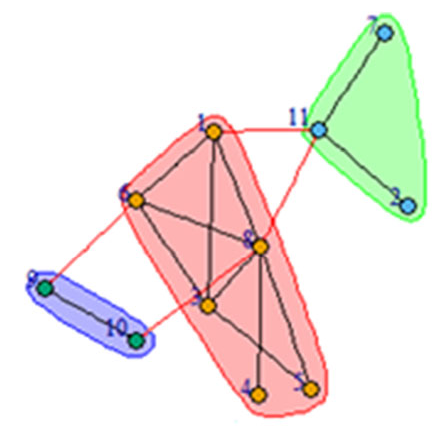 (Fig 3: Comparison between (a) Empirical, (b) Random, (c) PS-generated, and (d) CDM-generated networks. Notice the tighter, more realistic community "bounding boxes" in the personality-based models.)
Deep Insight: Beyond Mere Graph Theory
What makes this work stand out is its predictive potential. The authors were motivated by NASA's future space exploration missions. In a small, confined colony on Mars, a manager can't rely on random graph theory. This model allows planners to:
- Input crew candidate personalities.
- Simulate potential social network emergence.
- Identify "information brokers" or potential "bottlenecks" before they happen.
Limitations & Future Directions
- Organizational Networks: The model struggled slightly with the "Schwimmer Taro Exchange" network because its nodes were households, not individuals. Personality models obviously require "person-nodes."
- Complexity: Probability Search becomes computationally expensive (O(n³)) as networks grow, limiting its use to smaller organizations.
- Dynamic Evolution: Future work could transition this from static snapshots to dynamic models that show how networks evolve as personalities clash or harmonize over time.
Conclusion
This research proves that "Personality Compatibility" is a powerful heuristic for generating synthetic data that feels human. By moving from purely structural replication to behavioral simulation, we gain a tool that protects privacy while offering deep insights into the social fabric of our organizations.