
Intelligent Ad Allocation: Maximizing OSN Revenue through Multi-Stage Heuristics
Heuristics for advertising revenue optimization in Online Social Networks
The paper addresses the challenge of maximizing advertising revenue in Online Social Networks (OSNs) by optimizing the allocation of ad impressions over multiple stages. It extends a Stochastic Dynamic Programming model to incorporate social influence and proposes the "Maximum Influence" (MI) and "Local Search and Monte Carlo" (LSMC) heuristics to solve the computationally intractable problem of impression distribution.
TL;DR
Social advertising is no longer just about who sees an ad, but when they see it relative to their friends. This paper tackles the "Revenue Optimization" problem in Online Social Networks (OSNs) by treating ad delivery as a multi-stage stochastic process. The authors propose heuristics that outperform traditional methods in speed while maintaining near-optimal revenue by intelligently choosing both who to target and how many ads to show at each stage.
Context: The Social Influence Multiplier
In a modern OSN, a user is significantly more likely to click an advertisement if they know a friend has already engaged with it. This creates a "network effect" where an early impression can trigger a chain reaction of clicks. However, companies have limited budgets (impressions). The challenge is: How do we sequence these impressions across multiple time steps to maximize the total expected clicks?
The Problem: The Curse of Latent Outcomes
The problem is naturally modeled using Stochastic Dynamic Programming (SDP). In each stage, we decide which users get an ad. We then observe who clicked, update the probabilities for their friends, and move to the next stage.
The bottleneck is complexity. For an OSN with users and impressions, the number of possible allocations is , and for each allocation, there are possible outcomes. For a network of a million users, the optimal solution is mathematically impossible to compute in real-time.
Methodology: High-Efficiency Heuristics
The authors move beyond the exact DP solution and propose three tactical approaches:
1. Maximum Influence (MI) Heuristic
Instead of calculating every branch of the DP tree, the MI heuristic uses a scoring function for each user :
- : The current probability that user will click.
- : The number of 's friends who have not yet received an ad.
Intuition: This scores users based on their "Conversion Potential" (the likelihood they click) multiplied by their "Influence Potential" (how many new people they can reach).
2. Stage-Volume Optimization (-vector)
One of the most unique contributions is the heuristic for determining , the number of impressions per stage.
 The authors suggest that should be chosen such that the expected number of newly influenced users exactly matches the number of impressions available for the next stage. This prevents "influence waste" where you prime users for a click but run out of budget to actually show them the ad.
Experiments & Results
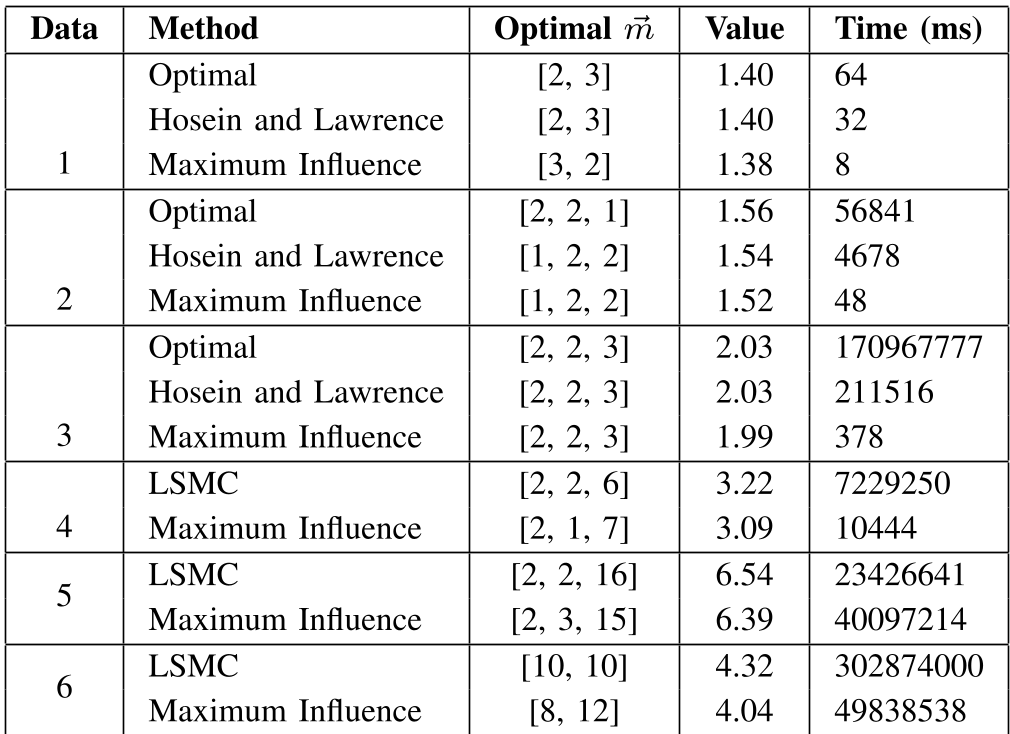
The authors tested their heuristics against "Optimal" (calculated for small sets) and LSMC (Local Search and Monte Carlo).
| Dataset | Users | Method | Value (Clicks) | Runtime |
|---|---|---|---|---|
| 3 | 15 | Optimal | 2.03 | ~170k ms |
| 3 | 15 | MI Heuristic | 1.99 | 378 ms |
| 6 | 1000 | MI Heuristic | 4.04 | 49k ms |
Key Findings:
- Speed: For Dataset 3, the MI heuristic was ~450,000 times faster than the optimal solution while achieving 98% of the revenue.
- Scalability: While the Hosein-Lawrence heuristic (a greedy approach) failed to run on larger datasets (50+ users), the MI heuristic successfully processed 1,000 users in under a minute.
Critical Insight & Evaluation
The brilliance of this work lies in the -vector heuristic. Most advertising research focuses solely on targeting. By deriving a closed-form approximation for how much budget to spend in early vs. late stages based on average node degree (), the authors provide a practical tool for media planners.
Limitations:
- The model assumes an undirected graph (reciprocal friendships), which doesn't perfectly fit "following" networks like Twitter or Instagram.
- The influence function is relatively simple (); real-world human behavior likely involves more complex non-linear saturation effects.
Conclusion
This research demonstrates that for revenue optimization in social networks, "simple but smart" heuristics like the Maximum Influence score are more viable for production environments than rigourous Dynamic Programming. For engineers building ad-tech stacks, the takeaway is clear: prioritize users who are both likely to engage and well-connected to the "unseen" population, and mathematically balance your stage-by-stage budget to bridge the gap between initial influence and final conversion.