
Hexagram Linkage: Bridging the Care Gap for the Elderly with Non-Invasive AI
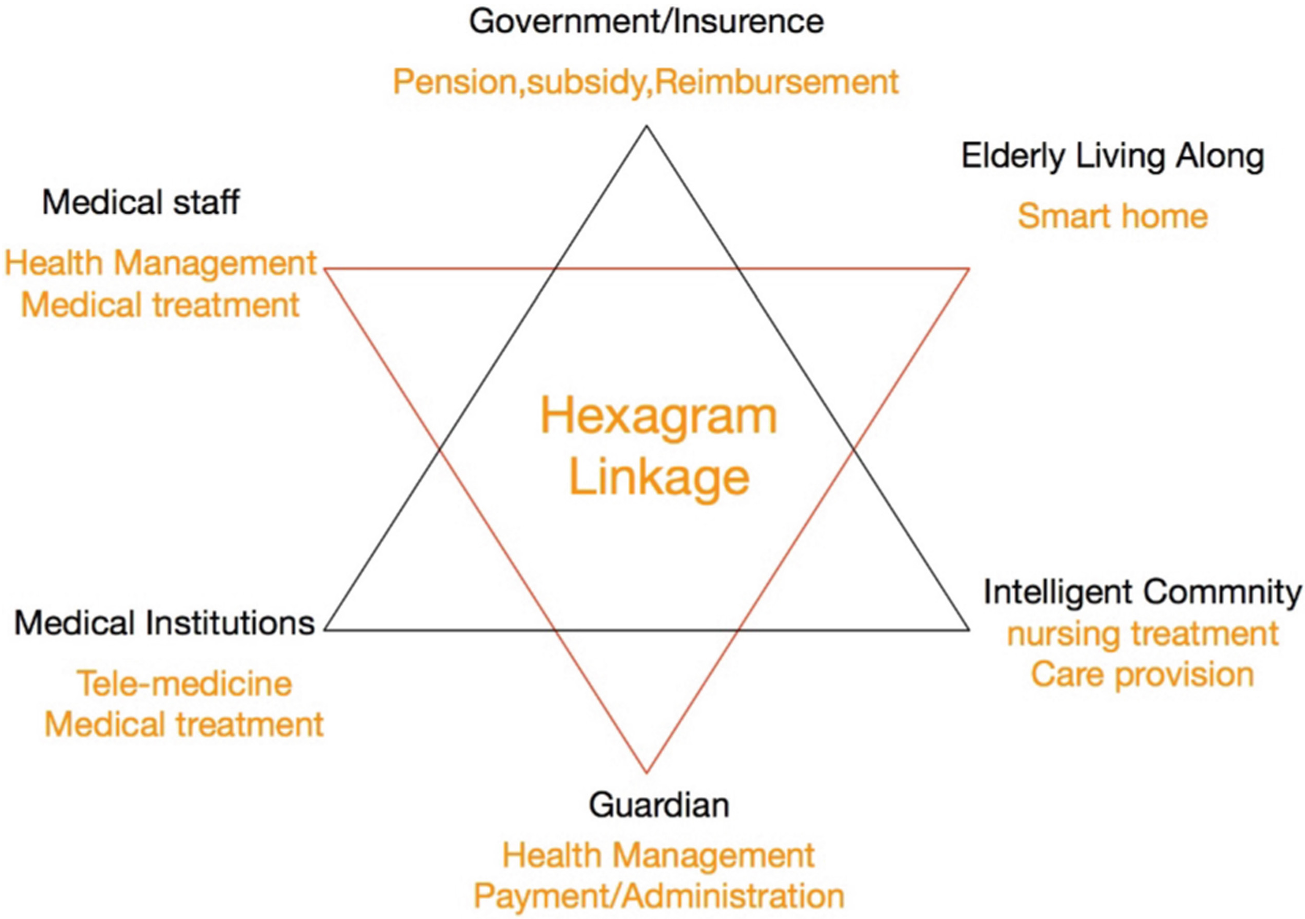
Hexagram Linkage: An Ambient Assistive Living System with Healthcare for Elderly People Living Alone
The paper introduces "Hexagram Linkage," an Ambient Assisted Living (AAL) system designed for elderly people living alone. It features a multi-level hierarchical activity recognition framework (Atomic, Basic, Complex) and employs a robust anomaly detection pipeline to identify point, set, scene, and trend deviations.
TL;DR
With the global aging crisis intensifying, "Hexagram Linkage" provides a scalable, cost-effective Ambient Assisted Living (AAL) platform. By moving away from invasive video surveillance and toward hierarchical sensor-driven modeling, it detects anomalies—from sudden falls to gradual health degradation—providing a safety net for nearly 200 users in a real-world two-year study.
Background: The Crisis of Loneliness and Labor
Statistics are sobering: in China alone, the demand for elderly care staff is 38 million, while only 1 million are qualified. Most elderly people prefer "aging in place"—living independently at home—but this carries the risk of undetected emergencies or "lonely deaths." Existing AAL solutions often fail because they are either too expensive or too intrusive (cameras).
The Hexagram Linkage system addresses this by focusing on three design pillars:
- Privacy Maximization: Avoiding cameras in favor of ambient sensors (PIR, vibration, temperature).
- Cost-Effectiveness: Utilizing civil-grade hardware and open-source platforms (Raspberry Pi/Arduino).
- Robust Anomaly Detection: Identifying not just "events," but "patterns."
Methodology: The Three Levels of Human Activity
The core innovation lies in the hierarchical definition of activity, which allows the system to apply the right algorithm to the right scale of data.
- Atomic Activity (AA): The smallest unit of movement (e.g., a door sensor trigger). Modeled via ID3 algorithms.
- Basic Activity (BA): A sequence of AAs within a Fixed Time Window (FTW), such as "using the bathroom." These are automatically labeled using frequent pattern mining and modeled with Hidden Markov Models (HMM).
- Complex Activity (CA): Long-term abstractions (e.g., "daily routine") within a Dynamic Time Window (DTW). These are modeled using Conditional Random Fields (CRF) to capture dependencies over days or weeks.
Detecting the "Invisible" Anomaly
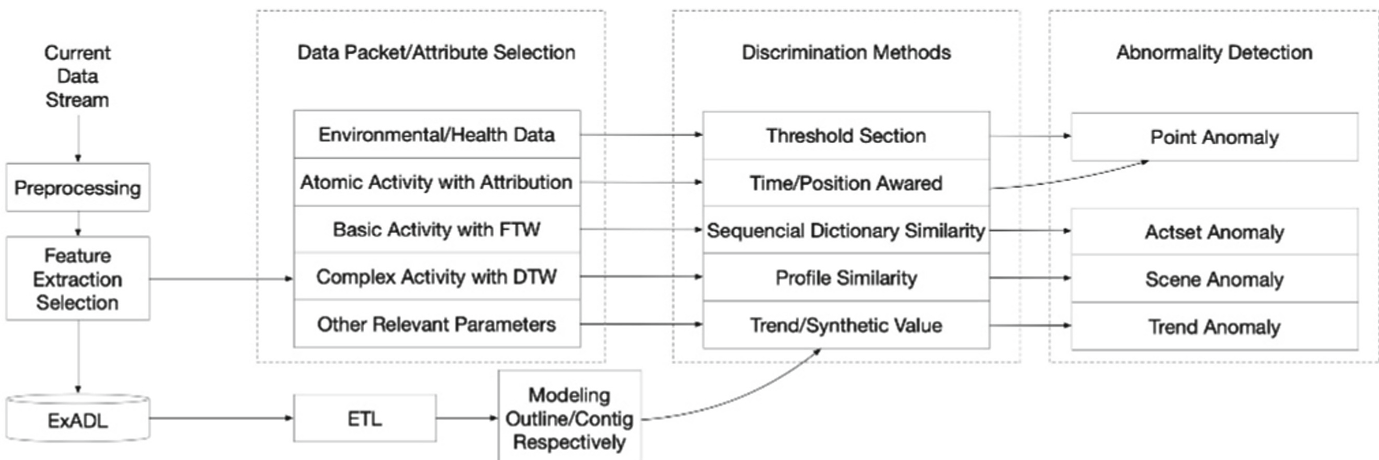
The paper categorizes anomalies into four types, each requiring a different mathematical approach:
- Point Anomalies: Instantaneous deviations (e.g., a smoke sensor firing). Handled by Adaboost and simple thresholding.
- Set Anomalies: Deviations in the sequence of actions (e.g., staying in the bathroom for 3 hours). Detected via Cosine Similarity between current sequences and the "Behavior Dictionary."
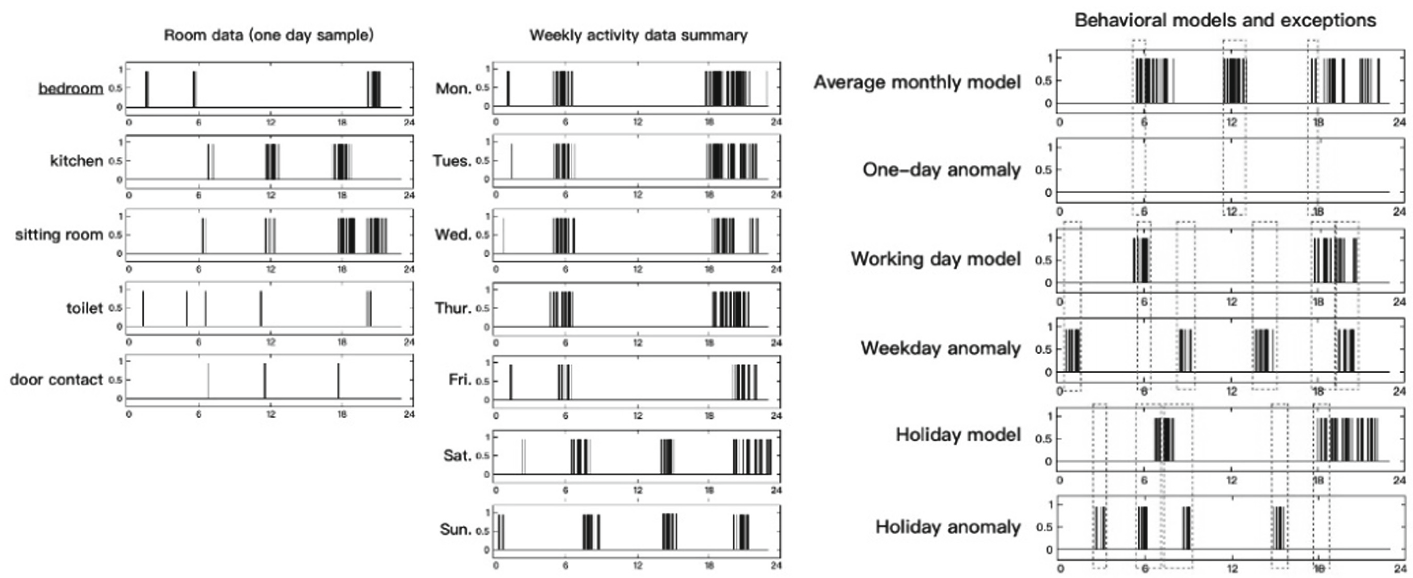
- Scene Anomalies: Changes in long-term routines (e.g., gradual onset of depression leading to inactivity). Identified using Self-Organizing Maps (SOM) for unsupervised drift detection.
- Trend Anomalies: Fluctuations in health metrics like heart rate or blood pressure, identified when data deviates from the historical Gaussian distribution (e.g., beyond ).
Real-World Impact: The Xi'an Case Study
Unlike many theoretical AI papers, this work was stress-tested in the field. 184 users were monitored over two years in Shaanxi Province.
Key Results:
- Safety: 114 hazards were detected in time; zero injuries occurred during the study.
- Accuracy: In a sample of 117 alarms, only 5 were false positives (most were actual cases of user illness like colds or diarrhea).
- Efficiency: The back-end system manages high-frequency data from PIR sensors and Low-frequency data from medical devices (ECG bands) seamlessly.
Critical Insight: Beyond Technology
The authors conclude with a surprising observation: the "working population" often exhibits poorer health markers (stress, irregular sleep) than the elderly. However, for the elderly, the Hexagram Linkage system serves as a "digital companion."
While the system is robust, the future of AAL lies in User Experience (UX). The thresholding for alarms needs to be "smarter" to account for holidays or visitors, reducing the friction for caregivers. Ultimately, this paper proves that by fusing classical ML (HMM/CRF) with modern IoT, we can achieve a highly practical and dignified care model for the global aging population.
Takeaway for Researchers
If you are building AAL systems, don't just chase the latest Deep Learning model. The combination of Hierarchical Activity Modeling and Unsupervised Drift Detection (like SOM) provides a more interpretable and stable solution for real-world healthcare deployment where "Black Box" explanations are often insufficient for medical accountability.