
Hide and Seek: Why We Guard Others' Privacy Better Than Our Own
Hide and seek: location sharing practices with social media
This paper explores location-sharing behaviors within mobile social networks using the rule-based application Locaccino. Through a multi-pronged study involving interviews and scenario-driven discussions, it identifies that location is a unique social profile element that users prefer to manage on a "need-to-know" rather than "broadcast" basis.
TL;DR
In the era of "friend finder" apps, sharing your live location isn't just about data—it's about social availability. This study reveals that while we are surprisingly lax with our own location privacy, we become "hyper-diligent" when managing the privacy of others. The research suggests that social networks need to move away from broadcasting locations and instead adopt a "need-to-know" request system that accounts for the physical and social context of the user.
The "Broadcast" Trap
Traditional social media operates on a broadcast model: you post once, and everyone in your circle sees it. This works for a profile picture or a birthday. However, the authors argue that location is qualitatively different.
The core problem is that sharing a location often signals interruptibility. If your boss sees you are at your desk, the expectation is that you are available for work. If a friend sees you at a bar, they might assume you are free to socialize. This "always-on" expectation creates a privacy friction that static profile data does not.
Methodology: The Third-Person Mirror
To dig deeper than simple questionnaires, the researchers used a clever psychological trick: Third-person scenarios.
Participants were asked to manage the location settings for "Alex," a fictional character in a variety of sticky situations (e.g., Alex is at a bar the night before a big project deadline, and a coworker asks for his location).
 Figure 1: The study utilized the Locaccino framework to contextualize real-time location sharing within the Facebook ecosystem.
Key Insights: Peers, Patterns, and Paradoxes
1. The Proximity Paradox
The study found a strict hierarchical distinction in privacy. At Work, people are open books (100% disclosure to bosses/colleagues). At Home, the walls go up. But the most fascinating shift occurred between first-person and third-person perspectives.
- Self-sharing: "Sure, my colleagues can know I'm home."
- Sharing for others: "No, Alex's boss shouldn't know he's home; it’s his private time."
2. Location = Action
Users don't think in GPS coordinates; they think in activities. Participants often wanted to annotate their location. Instead of just "Starbucks," they wanted the system to say "Working at Starbucks" to prevent the requester from inferring they were just loafing.
3. The City-Level "Nothing"
Participants viewed city-level granularity as a form of plausible deniability. If you are in your home city, saying you are "in London" is functionally the same as saying nothing, but it avoids the social awkwardness of a blunt "Access Denied."
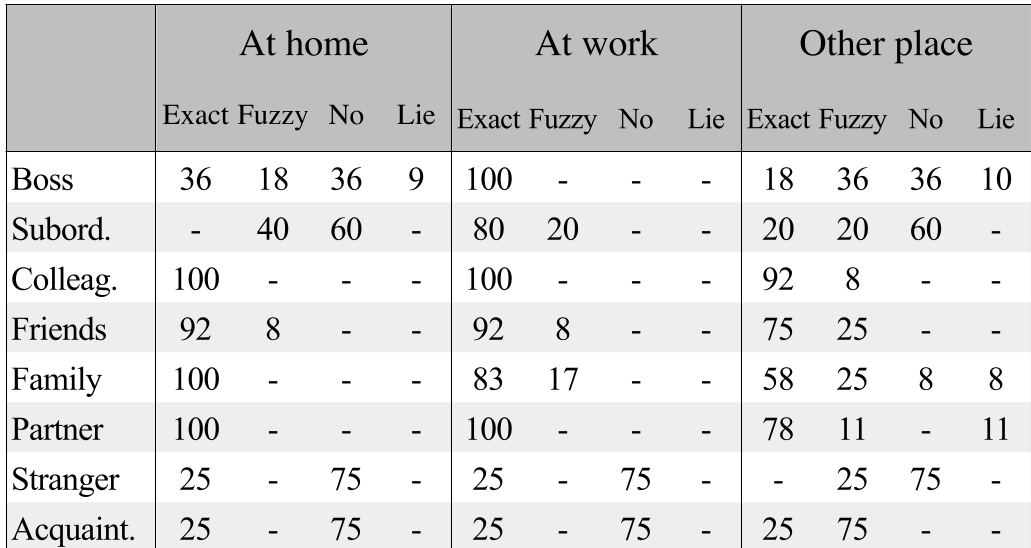 Table 1: Disclosure preferences show a sharp drop-off in "Exact" sharing when transitioning from colleagues to strangers or when moving from work to home.
Academic Insight: Why This Matters
The "Hide and Seek" paper provides a critical look at Inductive Bias in social software design. We shouldn't assume that because a user shares their "Relationship Status" with everyone, they want to share their "Current Longitude/Latitude" with the same group.
The study’s most significant contribution is the discovery that third-person scenarios are a superior tool for eliciting privacy requirements. When thinking about our own data, we are often biased by convenience or social pressure. When thinking about others, we apply a more rigorous ethical and safety-oriented logic.
Future Outlook: Beyond Real-Time
To solve the "availability" problem, the authors suggest:
- Introducing Delays: A 10-minute lag in location data can decouple "presence" from "immediacy."
- Explicit Justifications: Requesters should have to state "Why" they need to know where you are.
- Contextual Labels: Moving from "Address-based" to "Activity-based" labels (e.g., "In a Meeting" vs. "123 Main St").
While written in 2010, the insights regarding "Need-to-know" access remain more relevant than ever in our hyper-connected, post-privacy world.