
Hiding in Plain Sight: The Science of Detecting Modern Facebook Page Spam
Hiding in plain sight: characterizing and detecting malicious Facebook pages
The paper characterizes and detects malicious Facebook pages that spread harmful content beyond traditional phishing, such as scams, adult content, and untrustworthy news. By leveraging the Web of Trust (WOT) API to establish ground truth, the authors use supervised learning, specifically Artificial Neural Networks (ANN), to achieve a detection accuracy of 84.13%.
TL;DR
Social media threats have evolved from simple phishing links to sophisticated "malicious pages" that spread rumors, scams, and child-unsafe content. This paper characterizes 627 such pages, revealing they are significantly more active than benign ones and often operate in collusive Sybil networks. By applying Artificial Neural Networks to textual trigrams, the authors developed a system capable of flagging these pages with 84.13% accuracy.
Problem & Motivation: Beyond the Blacklist
For years, cybersecurity focused on "hard" threats: malware, viruses, and phishing. However, modern Facebook users are more frequently victimized by "soft" maliciousness—untrustworthy news, deceptive scams, and inappropriate content that violates community standards but bypasses traditional URL blacklists.
The authors argue that existing research is too narrow. They identify a critical gap: Trustworthiness and Appropriateness. These categories are subjective and historically required human moderation. The challenge lies in automating this "human" judgment to catch malicious entities that mimic legitimate brand behavior.
Methodology: Behavioral and Linguistic Fingerprinting
The authors took a two-pronged approach: analyzing the behavioral traits (how they post and interact) and the textual content (what they say).
1. Spatial & Temporal Analysis
The study discovered that 27.43% of malicious pages are active every single day, compared to only 8.6% of benign pages. More strikingly, the team uncovered collusive networks. Under manual inspection, these networks often consisted of adult-content pages that liked and shared each other's posts to artificially boost visibility—a classic Sybil attack.
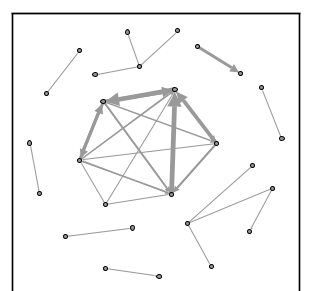 (a) Visualization of pages liking each other's posts, revealing tight clusters of malicious collusion.
2. The Bag-of-Words Model
To automate detection, the researchers extracted textual features from status messages, link names, and descriptions. They moved beyond simple word counts to Trigrams (sequences of three words), which better capture the context and deceptive intent of malicious posts. These features were fed into Sparsenn, a neural network optimized for high-dimensional, sparse data.
Experiments & Results: Neural Networks Lead the Way
The researchers compared several supervised learning models. While Naive Bayes struggled with the complexity of the data (68.27% accuracy), the Neural Network architecture using Trigrams achieved the highest performance.
| Classifier | Feature Set | Accuracy (%) | ROC AUC |
|---|---|---|---|
| Naive Bayesian | Trigrams | 69.77 | 0.697 |
| Logistic Regression | Trigrams | 73.93 | 0.789 |
| Random Forest | Trigrams | 72.18 | 0.794 |
| Neural Networks | Trigrams | 84.13 | 0.900 |
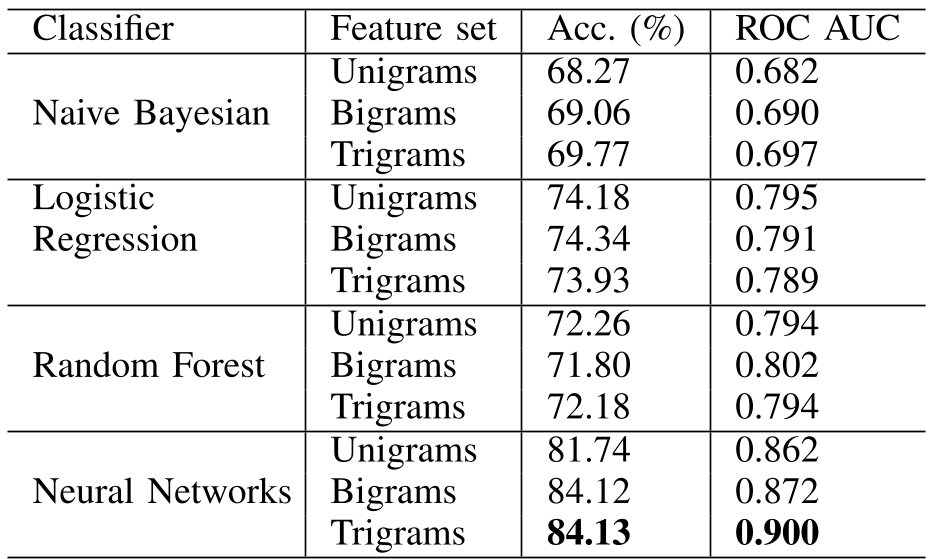 Comparison of various machine learning models across different feature sets.
The results prove that textual "intent" captured through n-grams is a powerful signal for identifying pages that exist solely to redirect users to untrustworthy domains.
Critical Insight & Conclusion
The core takeaway is that malicious pages "hide in plain sight" by mirroring the broadcast patterns of legitimate news outlets (like BBC). However, their hyper-activity (1.4x higher than normal) and inter-page collusion are massive red flags.
Limitations & Future Work
While 84% accuracy is strong, it still leaves a margin for false positives. Furthermore, as the authors suggest, malicious behavior is not static. A "self-adaptive model" that continuously updates based on the most recent 100 posts is necessary to combat "sleeper" accounts or pages that pivot from benign to malicious content over time.
In the future, this framework could be expanded to Facebook Groups and Events, which serve as similar focal points for information pollution.