
Hierarchical Matching with Peer Effect: Bridging Social Trust and Latency-Sensitive Caching in IoT
Hierarchical Matching With Peer Effect for Low-Latency and High-Reliable Caching in Social IoT
The paper proposes a hierarchical matching framework for D2D-based caching in Social IoT (SIoT) to optimize downloading latency and Successful Delivery Probability (SDP). It introduces a 3-D stable matching approach that decouples content sharing and resource allocation, achieving near-optimal performance with significantly lower complexity than centralized benchmarks.
TL;DR
In the evolving landscape of Social IoT (SIoT), the physical proximity of devices is only half the story—social relationships provide the "incentive" and "predictability" for data sharing. This paper introduces a 3-D stable matching framework that optimizes D2D caching by considering both social trust and physical interference (the "peer effect"). By moving from simple bilateral swaps to a Rotation-Swap distributed algorithm, the authors significantly reduce latency while ensuring high reliability.
The Bottleneck: Why Simple Caching Isn't Enough
As smart devices proliferate, backhaul congestion in cellular networks becomes a critical failure point. D2D caching (Device-to-Device) offloads this traffic. However, most current models treat users as anonymous data nodes.
The authors argue that Social Characters (community, centrality, and trust) are essential for two reasons:
- Incentive: Users are more likely to share data with "friends" or reliable community members.
- Stability: Social ties are often more persistent than random physical encounters.
Moreover, when multiple D2D pairs reuse the same cellular subchannel, they create interdependence—one pair's decision to switch channels affects the interference levels—and thus the utility—of everyone else in that group. This is known as the Peer Effect.
Methodology: The Hierarchical Approach
To solve this high-dimensional NP-hard problem, the authors decompose it into a Hierarchical Bipartite Graph with two distinct matching stages:
Stage 1: Content Sharing Oriented Stable Matching (CSOSM)
In this stage, Content Requesters (CRs) and Content Providers (CPs) are matched.
- Metrics: Interest similarity (Zipf distribution), contact history (intensity), and social trust (edge betweenness centrality).
- Mechanism: A modified Gale-Shapley (Deferred Acceptance) algorithm ensures that no pair would prefer each other over their assigned partners, achieving two-sided stability.
Stage 2: Resource Allocation with Peer Effects
Once CR-CP pairs are established, they must be assigned to cellular subchannels.
- The Rotation-Swap: Traditional algorithms only allow two users to swap resources. The authors propose a "Cabal" concept where users can participate in a cyclic swap.
- Coloring-based Heuristic: To find the largest possible "cabal" (cycle) to swap, the authors use a coloring-based search to avoid the NP-hardness of the Longest Cycle problem.
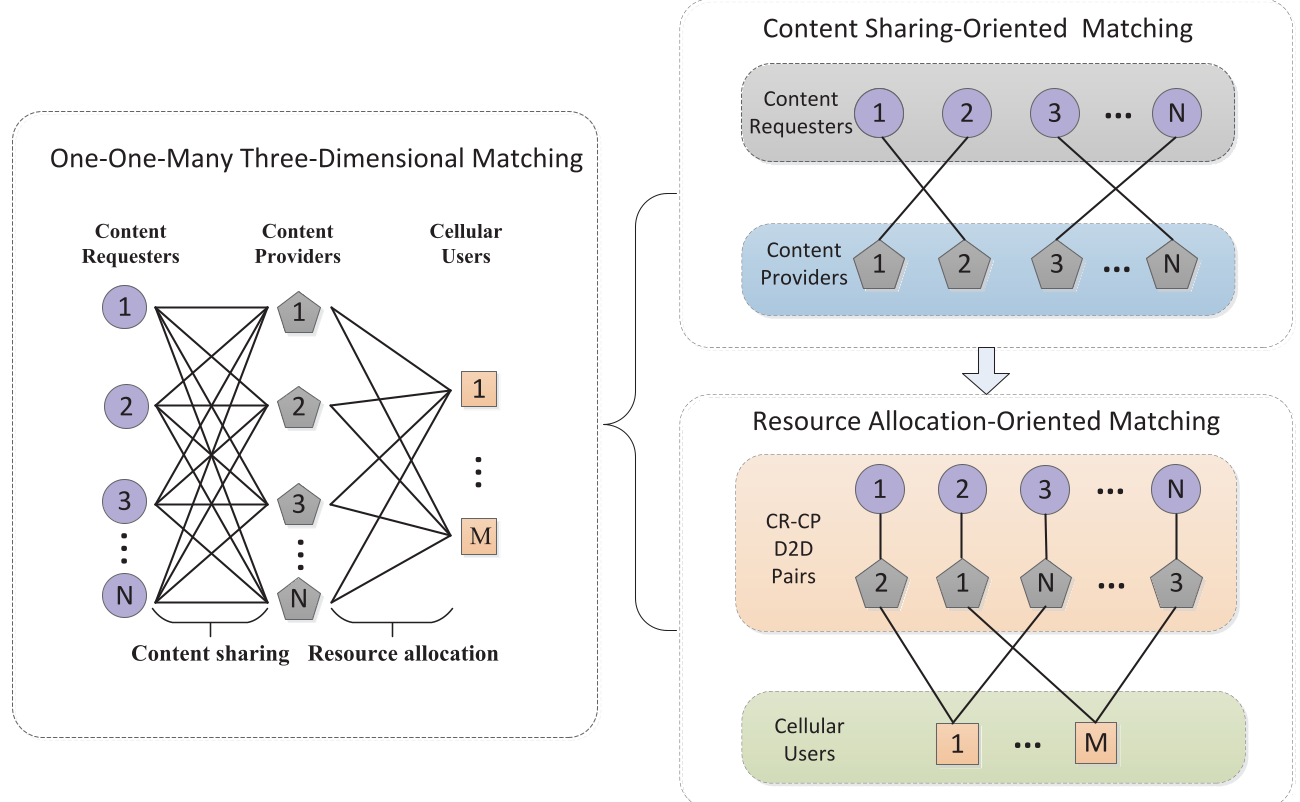 Caption: The hierarchical architecture showing the coupling between Social and Physical domains.
Key Insights from Experiments
The proposed TDSM (Three-Dimensional Stable Matching) was tested against several benchmarks:
- Convergence: The RSODPL (Rotation-Swap) converged much faster than the CARAD benchmark because it resolves interference conflicts for multiple users simultaneously, rather than one pair at a time.
- Latency vs. Reliability: By integrating the Successful Delivery Probability (SDP), the model ensures that content delivery doesn't just start but actually finishes within the expected contact duration.
- User Satisfaction: The proportion of admitted requests increased significantly as cellular users (CUs) scaled, outperforming random allocation by nearly 2x in high-load scenarios.
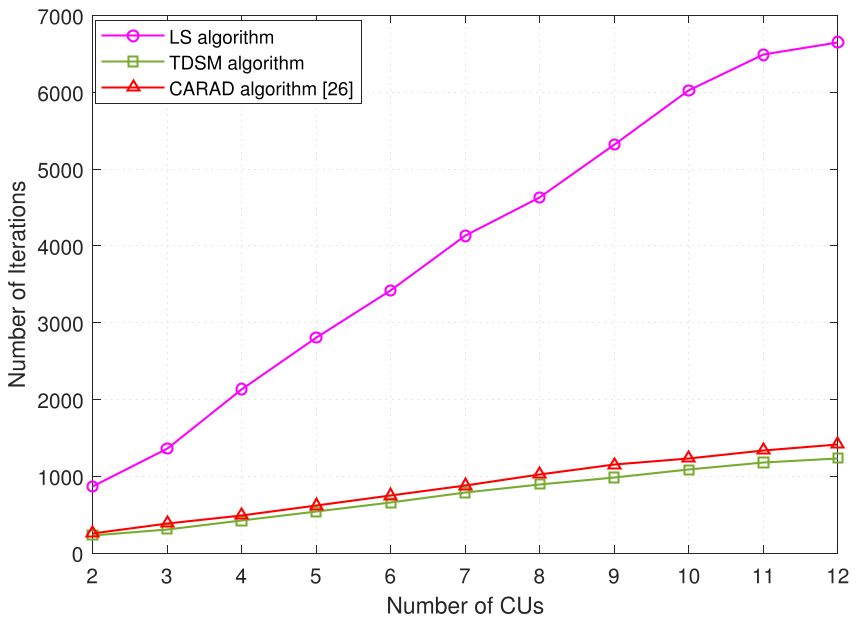 Caption: Average downloading latency significantly decreases as the number of available subchannels (CUs) increases.
Conclusion and Takeaways
This research highlights that in SIoT, interference is social. The "Peer Effect" isn't just a physical phenomenon but a game-theoretic challenge where user utilities are coupled.
Core Contributions:
- Physical-Social Projection: Turning abstract social trust into weights for physical link preferences.
- Rotation-Swap Stability: Proving that distributed cyclic exchanges reach a Pareto-optimal state faster than bilateral ones.
For future IoT architectures, this work suggests that "caching-intelligence" must sit at the intersection of human behavior and spectral efficiency.