
Weighted Consensus: Boosting Collective Decision-Making via Hierarchical Social Role Analysis
Hierarchical Modeling and Analysis of Social Roles for Collective Decision-Making Support
The paper proposes a hierarchical social role analysis framework to support collective decision-making in Social Network Services (SNS). By integrating a three-layer model (Content, Profile, and Relation) that spans both real-world and cyber-world contexts, the authors enhance group consensus-building and optimize the "Course-Offering Determination" (COD) task.
TL;DR
In the age of massive Social Network Services (SNS), reaching a group consensus is often hindered by opinion noise and the loss of expert influence. This paper introduces a three-layer hierarchical model to map social roles from both the real and cyber worlds. By assigning dynamic "voting weights" based on these roles, the system—demonstrated in a course-selection scenario—enables groups to reach consensus faster and more accurately.
The Problem: The "Loudest Voice" Fallacy in SNS
Collective decision-making in digital spaces often suffers from two main issues:
- Information Overload: Analyzing millions of messages with non-standard words (slang/logograms) is computationally expensive and semantically messy.
- Hidden Influence: In a standard voting system, the opinion of an industry expert and a random bot/troll might count equally.
Current methods often ignore the Inductive Bias provided by a user's real-world status (e.g., being a Professor) or their cyber-world behavior (e.g., being a highly active hub user).
Methodology: The Three-Layer Social Role Model
The authors argue that a user's influence isn't monolithic. They decompose social roles into a hierarchy that bridges the gap between the Physical and Digital manifolds:
- Content Layer: Roles derived from history and actions (e.g., academic records in the real world vs. frequency of posts in the cyber world).
- Individual Profile Layer: Static attributes (e.g., gender/occupation vs. "time since registration").
- Relation Layer: Structural positions (e.g., Teacher/Student hierarchy vs. Admin/General User status).
The Decision-Making Workflow
The paper proposes a four-module architecture:
- Opinion Collecting: Gathering raw preferences.
- Opinion Processing: Sharing info and applying the initial social-role weighted voting.
- Negotiation Module: Grouping users and re-ranking results through iterative discussion.
- Consensus: Finalizing results once the variance () falls below a specific threshold ().
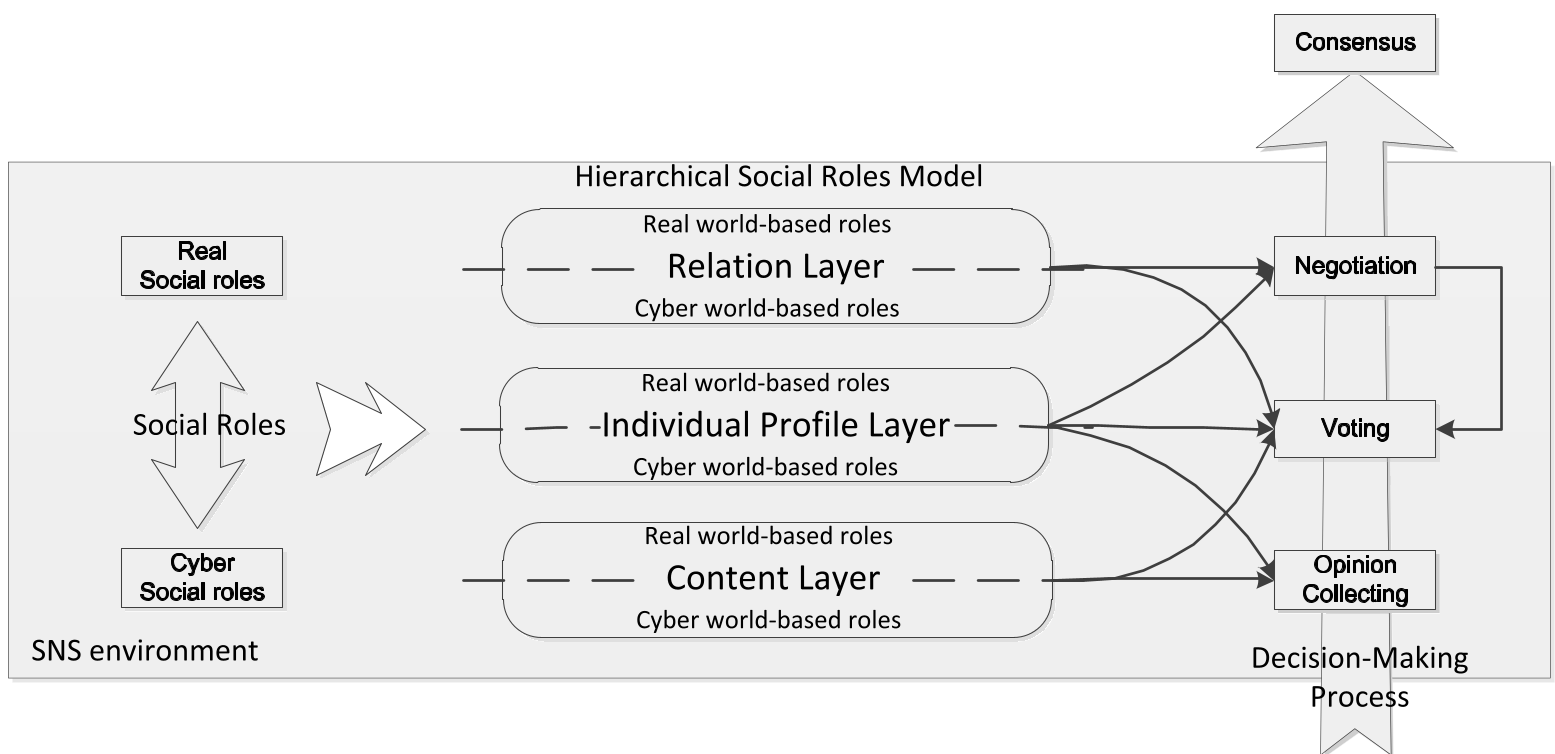 Figure: The Three-Layer Social Roles Framework used to calculate individual influence.
Mathematical Intuition
The core "magic" happens in the weight calculation. Instead of a flat average (), the evaluation is a function of a social role influence parameter ():
This ensures that a student who is a "Course Representative" in the real world () and a "Discussing Initiator" in the digital world () exerts more pull on the final group decision than a passive observer.
Case Study: Course-Offering Determination (COD)
In the COD application, the system helps students choose courses by:
- Filtering History: Showing "John" what students with similar academic profiles ( similarity) chose last year.
- Weighted Negotiation: If the group can't decide on a new elective, the professor’s and the student reps' opinions are prioritized during the re-vote, preventing the group from getting stuck in endless deliberation.
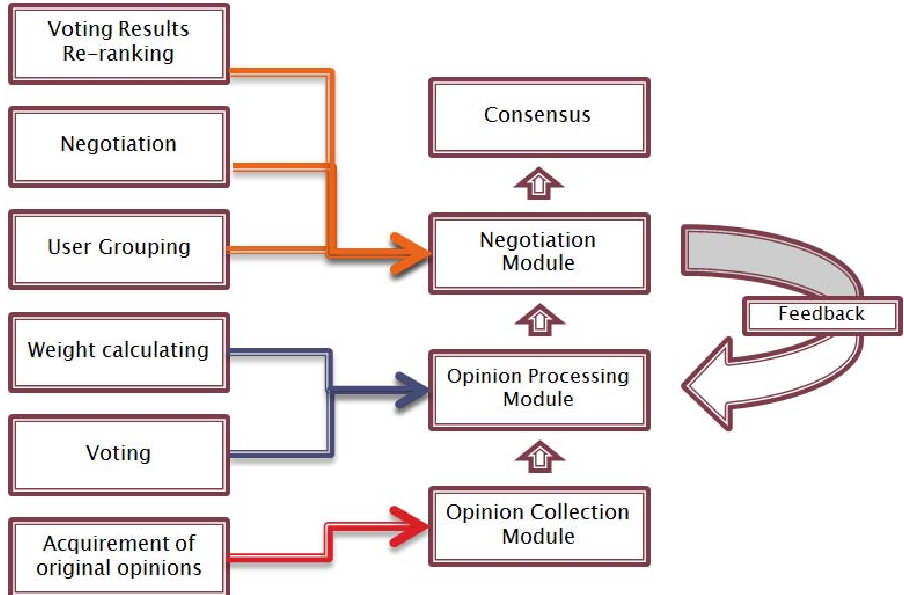 Figure: The operational loop from individual opinion to group consensus.
Critical Analysis & Future Outlook
Innovation: The true value here is the cross-domain role mapping. Many systems treat digital persona and real identity as separate; this work acknowledges that our real-world authority should and does inform our digital influence.
Limitations: The model assumes that "Real World" profiling data is readily available and verifiable, which raises significant privacy and data-integration challenges. Furthermore, the weighting factors ( and ) are manually tuned rather than learned via an optimization objective.
Future Work: The authors suggest moving toward automated algorithms for role identification. In a modern context, this would likely involve Graph Representation Learning to embed these roles into a latent space for more fluid weight adjustments.
Summary
By formalizing the "Social Role," this research provides a blueprint for building smarter collaborative tools that don't just count heads, but value the quality and context of every voice in the room.