
Hierarchical Thinking: Elevating Geometry Education through Social E-Learning and Bloom’s Taxonomy
Using Hierarchical Modeling of Thinking Skills to Lead Students to Higher Order Cognition and Enhance Social E-Learning
The paper presents a personalized social e-learning system for Geometry that utilizes Revised Bloom Taxonomy (RBT) and Digital Bloom Taxonomy to guide students toward higher-order thinking. It integrates adaptive testing and multimedia instructional delivery to align cognitive skill levels with pedagogical activities within a social networking environment.
TL;DR
This research introduces a novel social e-learning platform specifically designed for Geometry. By bridging the gap between social networking and the Revised Bloom Taxonomy (RBT), the system ensures that students don't just memorize formulas but progress systematically toward "Creating" and "Evaluating"—the hallmarks of higher-order cognition.
Background: Beyond Passive Learning
The digital transformation of education has often struggled to replicate the instructional rigor of a classroom. While social media connects students, it rarely teaches them in a structured way. This work positions itself as a specialized educational framework that uses the Cognitive Domain of RBT to transform social interactions into meaningful learning milestones.
The Problem: The Plateau of Basic Understanding
Most e-learning platforms focus heavily on the bottom of the cognitive pyramid: Remembering and Understanding.
- The Gap: Students often get stuck at identifying shapes (Factual Knowledge) but fail when asked to apply these properties to solve complex, non-routine geometric proofs (Metacognitive Knowledge).
- The Motivation: Teachers need a way to track the depth of a student's thought process, not just their final score. The authors argue that by using Digital Bloom Taxonomy, we can map specific digital tools (like mind maps or screencasts) to specific cognitive needs.
Methodology: The Hierarchical Architecture
The core of the system is its Hierarchical Modeling. It doesn't treat all content equally; instead, it enforces a learning path that mirrors the human cognitive process.
1. Digital Content Delivery (The "How")
The system uses different tools for different RBT levels:
- Remember: Slides and flashcards for definitions (e.g., types of triangles).
- Understand/Analyze: MindMaps are used to visualize the classification of quadrilaterals based on angles and sides.
- Apply: Interactive tools allow students to manipulate peaks of shapes to observe property changes in real-time.
2. The Feedback Loop
The architecture (see below) integrates social tools so that students can discuss these hierarchical challenges with peers, effectively using social pressure and collaboration to solve higher-level problems.
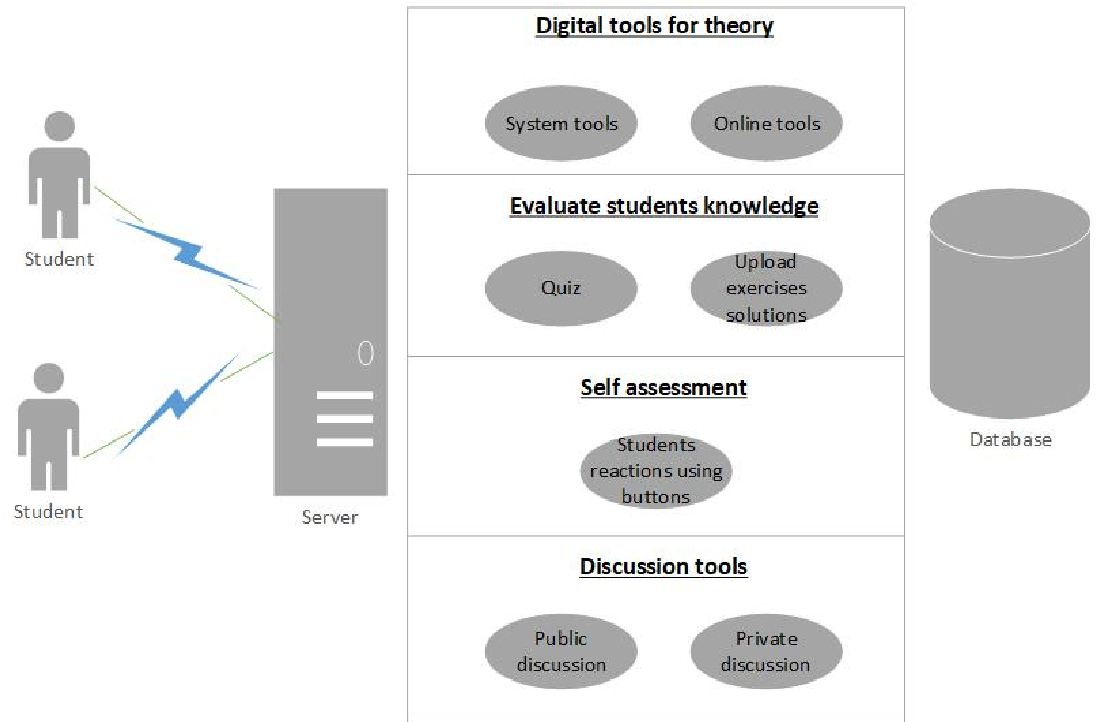 Figure 1: Overview of the e-learning system’s architecture, showcasing the integration of social tools, digital resources, and assessment modules.
Experiments & Results: Mapping Success
The researchers categorized geometry assessment into six distinct styles:
- Remember: Fill-in-the-blanks for definitions.
- Understand: Sorting and classifying triangles.
- Apply: True/False questions regarding equality criteria.
- Analyze: Matching assumptions to conclusions in a proof.
- Evaluate/Create: Solving a full problem and uploading the solution for expert review.
Key Findings:
- Prerequisite Control: Students were forced to pass lower levels before attempting higher ones. This reduced frustration and ensured a solid foundation.
- Agent Feedback: The use of pedagogical agents (happy/sad faces) provided immediate emotional feedback, which is crucial in a self-paced social environment.
- Social Cohesion: Public and private messaging allowed for "Just-in-Time" peer tutoring, where students who mastered a level helped those still struggling.
Critical Insight & Conclusion
The Takeaway
The true value of this work lies in its Instructional Design. It proves that social e-learning is not just about "chatting," but about using social tools to move up the cognitive ladder. By aligning Web 2.0 tools (like Blogs and Wikis) with specific cognitive verbs (Analyze, Evaluate), the system creates a rigorous academic environment within a social shell.
Limitations & Future Work
While the system is robust for Geometry, the Logic Architecture needs testing in less structured domains (like Literature or Social Sciences). The authors plan to expand the domain knowledge and conduct more longitudinal evaluations to measure the long-term retention of these "higher-order" skills compared to traditional methods.
Professional Summary
This paper serves as a blueprint for developers and educators looking to build Intelligent Tutoring Systems (ITS). It moves beyond the "what" of education and focuses on the "how" of thinking, using a time-tested educational taxonomy as its algorithmic backbone.