
Establishing Financial Stability in Decentralized Crowdsourcing: A Hierarchical Approach
Hierarchical Pricing Mechanism With Financial Stability for Decentralized Crowdsourcing: A Smart Contract Approach
This paper introduces a blockchain-enabled hierarchical crowdsourcing platform featuring two dedicated smart contracts for task matching and resource credit. The core contribution is a dynamic, hierarchical pricing mechanism based on heterogeneous agent theory that ensures financial stability in a decentralized market.
TL;DR
Decentralized crowdsourcing often fails due to extreme market volatility. This paper proposes a blockchain-enabled hierarchical pricing mechanism that segments the market based on task difficulty and worker ability. By combining economic modeling with smart contracts, the system ensures that market prices and demand converge to a stable equilibrium, preventing financial "bubbles" while maintaining security through decentralization.
Background: The Price of Decentralization
While blockchain solves the "trust" issue in traditional platforms (like Upwork or Freelancer), it introduces a new problem: Financial Instability. Without a central regulator to stabilize prices, speculative behavior can cause the market to crash or overheat, leading to unpaid workers and failed projects. The authors argue that a decentralized market needs a mathematical "invisible hand" built directly into its smart contracts.
The Core Insight: Heterogeneous Agent Theory
The breakthrough of this paper lies in treating crowdsourcing tasks as heterogeneous goods. Unlike simple data-entry tasks, software engineering tasks vary wildly in complexity.
The system architecture involves:
- Task Matching Contract: Segments users into levels () so that high-complexity tasks are only matched with high-capacity workers.
- Resource Credit Contract: A "lending" mechanism where workers can borrow resources (storage, bandwidth, CPU) to upgrade their level, regulated by a debt-to-income ratio ().
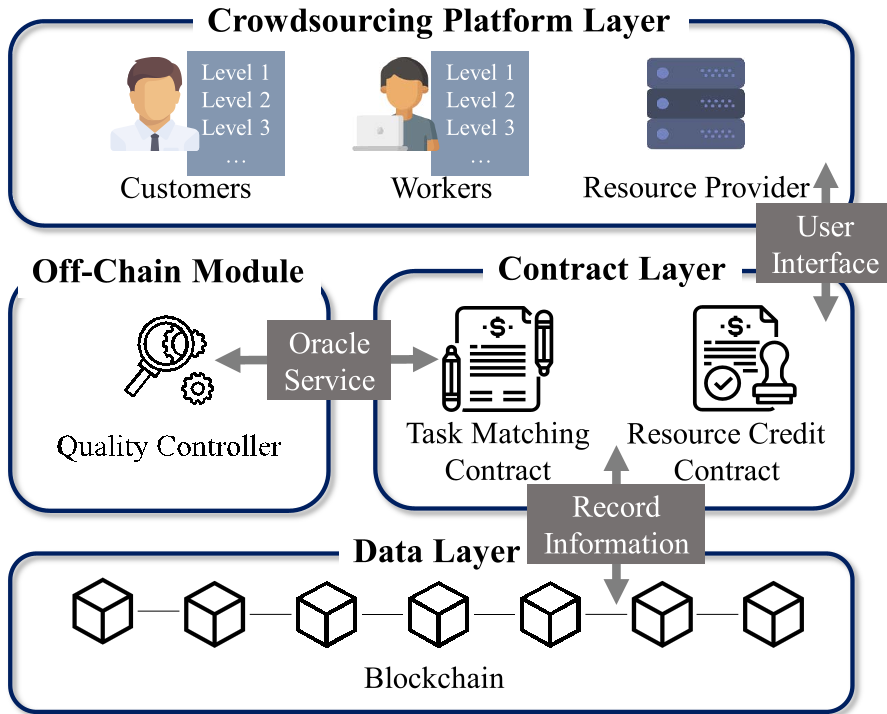 Figure 1: The proposed multi-layer blockchain-enabled framework.
Methodology: The Math of Stability
The authors define the market price at level as the mean of turnovers. To ensure stability, they model the transition of demand () and price () using a second-order nonlinear system:
The paper provides a rigorous mathematical proof (Theorems 1 & 2) that as the number of participants () increases, the random market processes converge toward a deterministic curve. They define an Absolute Regulation condition where if a "bubble" occurs, the platform can adjust coefficients () to cool the market down.
Experimental Results & Performance
The authors implemented the prototype on Ethereum. A key finding was the "Invisible Equilibrium":
- Price Dynamics: As the customer-to-worker ratio () or risk ratio () changes, the market naturally moves toward a new stability point rather than spiraling out of control.
- Gas Efficiency: Most operations (worker registration, task assignment) are extremely affordable (< \0.50$), proving the scalability of the smart contract logic.
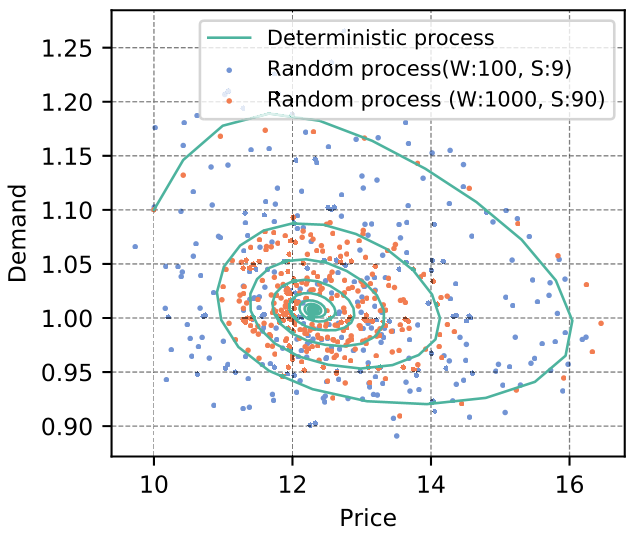 Figure 2: Simulation showing how random price fluctuations (dots) converge to the theoretical stability curve (green line).
Critical Analysis & Takeaways
The unique value of this work is the Resource Credit Contract. By allowing workers to "leverage" their reputation and income to borrow resources, the platform increases the pool of potential workers () for complex tasks, which actually stabilizes the market price.
Key Takeaways for the Industry:
- Segmentation is Key: Treating all workers as equal leads to inefficiency. Level-based segmentation improves task completion rates.
- Stability requires Constraints: Introducing risk ratios () and debt limits in smart contracts is essential for decentralized finance (DeFi) applied to real-world services.
Future Outlook
While the paper solves the stability issue, future research is needed to determine how "Resource Providers" should be incentivized through game-theoretic models to ensure the lending market remains liquid and fair.