
PSC-C: Navigating High-Dimensional Educational Data with Swarm Intelligence
Classification of high dimensional Educational Data using Particle Swarm Classification
This paper introduces Particle Swarm Classification (PSC) to the field of Educational Data Mining (EDM) for the automated categorization of teacher classroom questions into Bloom's Taxonomy cognitive levels. By implementing a PSC variant with a confinement mechanism (PSC-C), the authors achieve a state-of-the-art Macro-Average F1-score of 0.771, outperforming traditional machine learning baselines such as SVM, Naïve Bayes, and kNN in high-dimensional text datasets.
Executive Summary
In the evolving landscape of Educational Data Mining (EDM), the ability to automatically analyze teacher pedagogy is a holy grail for improving classroom outcomes. This paper presents a compelling application of Particle Swarm Classification (PSC) to categorize classroom questions into the six levels of Bloom’s Taxonomy. While traditional wisdom suggested that swarm-based methods struggle with high-dimensional data, this work demonstrates that with a confinement mechanism (PSC-C), these "flocking" algorithms can actually outperform established heavyweights like Support Vector Machines (SVM) and Random Forests.
Problem & Motivation: The Curse of Dimensionality
Text classification in an educational context is notoriously difficult. Teachers' questions are often short, context-dependent, and, when converted into numerical vectors (via TF-IDF), result in high-dimensional sparse matrices.
Previous research indicated a significant trend: as the number of features and classes increases, the performance of PSC usually drops. This created a skepticism: Can an algorithm modeled after bird flocking really find the optimal "centroid" of knowledge in a space with hundreds of dimensions? The authors set out to prove that the failure wasn't in the "swarm" itself, but in how we initialize and confine its movement.
Methodology: The "Flocking" Centroid Search
The core innovation lies in treating classification as an optimization problem. Instead of drawing hyperplanes (like SVM), PSC-C attempts to find the "optimal coordinates" for the center of each Bloom's level (Knowledge, Comprehension, Application, etc.).
The Workflow
- Preprocessing: Traditional NLP pipeline (Tokenization, Porter Stemming, TF-IDF).
- Particle Encoding: Each particle in the swarm represents a potential centroid for a class.
- Confinement Mechanism: Unlike standard PSO where particles start anywhere, PSC-C initializes particles around the mean of the training instances: This ensures the swarm begins its search in a biologically "plausible" region of the data space.
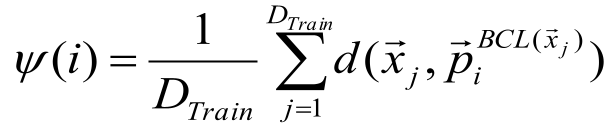 Figure 1: The fitness function used to evaluate how well a particle (centroid) represents its class.
Experiments & Results
The authors tested their model against four classic baselines: k-Nearest Neighbors (kNN), Naïve Bayes (NB), Support Vector Machines (SVM), and Ripple Down Rule Learner (RA).
Key Findings:
- Standard PSC Fails: Without confinement, PSC performed near random (F1 ~0.3).
- PSC-C Dominates: With confinement, the swarm outperformed all baselines. It achieved a Macro-Average F1 of 0.771.
- Scalability: The model remained stable even as the feature count (terms) scaled from 10 to 500, debunking the myth that PSC cannot handle high dimensionality.
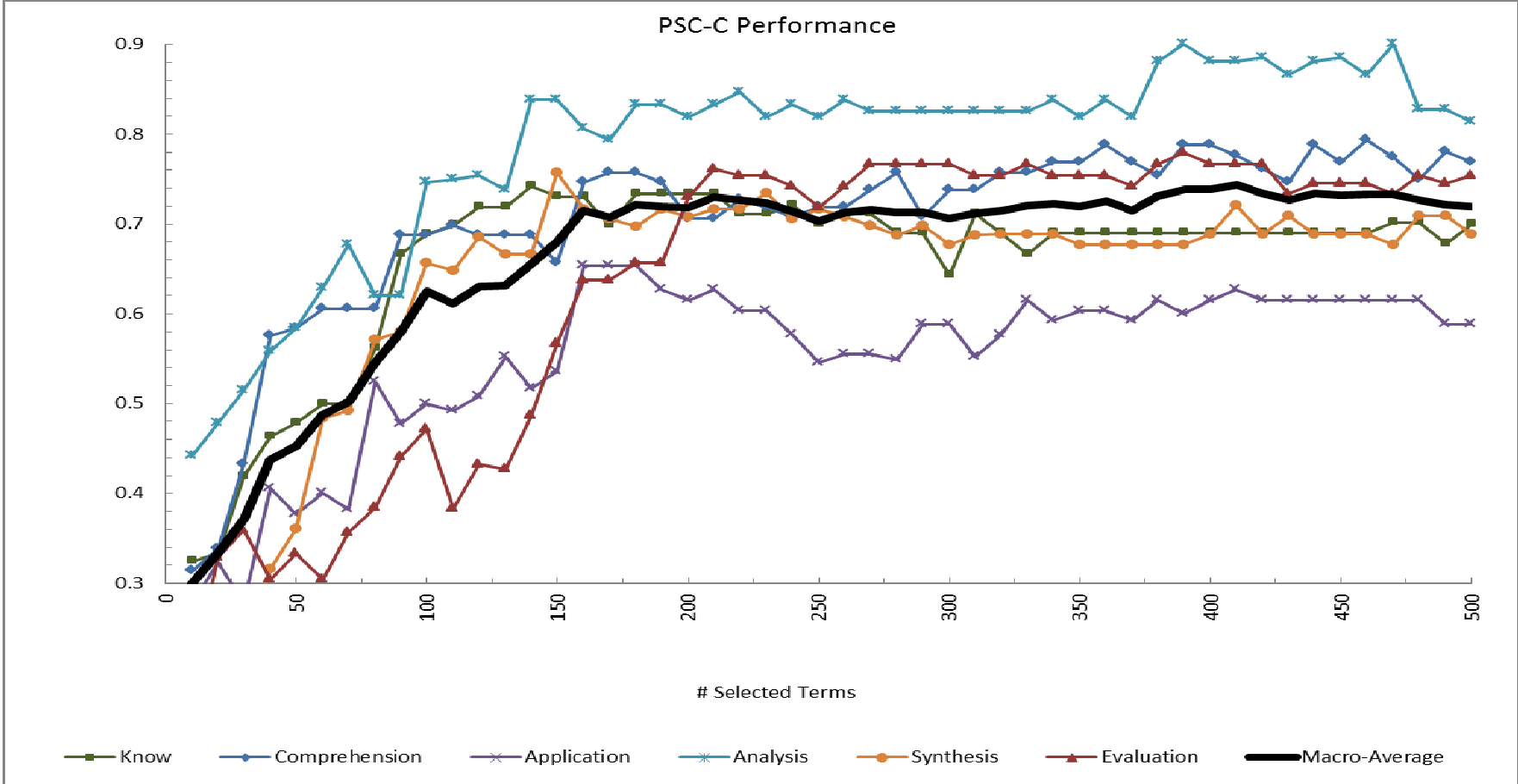 Figure 2: Performance stability across different numbers of terms. Note how Analysis and Comprehension reach high F1 scores quickly.
Comparative Benchmarking
| Algorithm | Macro-Average F1 (Best) | Performance vs. PSC-C |
|---|---|---|
| PSC-C | 0.771 | - |
| SVM | 0.753 | PSC-C wins in 47/50 cases |
| Naïve Bayes | 0.732 | PSC-C wins in 50/50 cases |
| kNN | 0.732 | PSC-C wins in 50/50 cases |
Critical Insight & Conclusion
The success of PSC-C in this study provides a vital takeaway for the AI community: Nature-inspired algorithms are not inherently limited by dimensionality; they are limited by their search initialization. By anchoring the swarm near the statistical center of the data (the mean), the "social" and "cognitive" learning components of the algorithm can fine-tune the classification boundaries much more effectively than a standard geometric approach.
Future Outlook
While this work proves the effectiveness of PSC-C on a 500-dimension dataset, modern NLP often involves 768 to 1536 dimensions (Transformer embeddings). The next frontier will be testing whether swarm intelligence can optimize the latent spaces of LLMs to provide even more granular pedagogical feedback.