
Scaling Face Annotation: How Social Context and Hierarchical Access Solve the OSN Tagging Bottleneck
A High-Efficiency and High-Accuracy Fully Automatic Collaborative Face Annotation System for Distributed Online Social Networks
The paper introduces a fully automatic face annotation system for Distributed Online Social Networks (OSNs) using a Hierarchical Database Access (HDA) architecture and a Fused Face Recognition (FFR) unit. By leveraging social network contexts (recurrence, temporal, and group), it achieves significant state-of-the-art improvements in F-measure and similarity metrics.
TL;DR
Researchers have developed a fully automatic collaborative face annotation system that utilizes the unique structural properties of social networks—who we hang out with and how often—to make face recognition faster and more accurate. By replacing flat database searches with a Hierarchical Database Access (HDA) architecture and fusing classifiers via AdaBoost, the system boosts accuracy by over 60% while slashing processing time by nearly 80%.
Background: The Problem of "Distributed Chaos"
Online Social Networks (OSNs) like Facebook or Google+ are distributed by nature. Thousands of photos are uploaded every second. Traditional Face Recognition (FR) systems face a double-whammy:
- Complexity: Searching a global database of billions of faces is computationally impossible for real-time tagging.
- Variability: Real-world photos have "uncontrolled conditions"—different lighting, blur, and most importantly, varying poses.
Existing SOTA methods often tried to throw more engines at the problem (collaborative FR), but running 90+ recognition engines for one photo is a recipe for a system crash.
Methodology: Pruning the Search Space with "Social Logic"
The core insight of this paper is that identity is not random. If you are looking at a photo uploaded by "User A," the face in that photo is statistically likely to be User A, their family, or their frequent "Group" members.
1. Hierarchical Database Access (HDA)
Instead of one big "Total" database, the authors organized facial data into four prioritized levels:
- Recurrence Context: People who just appeared in the last few photos.
- Temporal Context: "High-interaction" friends based on a novel normalized interaction score.
- Group Context: Members of a specific social circle (e.g., "High School Friends").
- Total Database: The last resort.
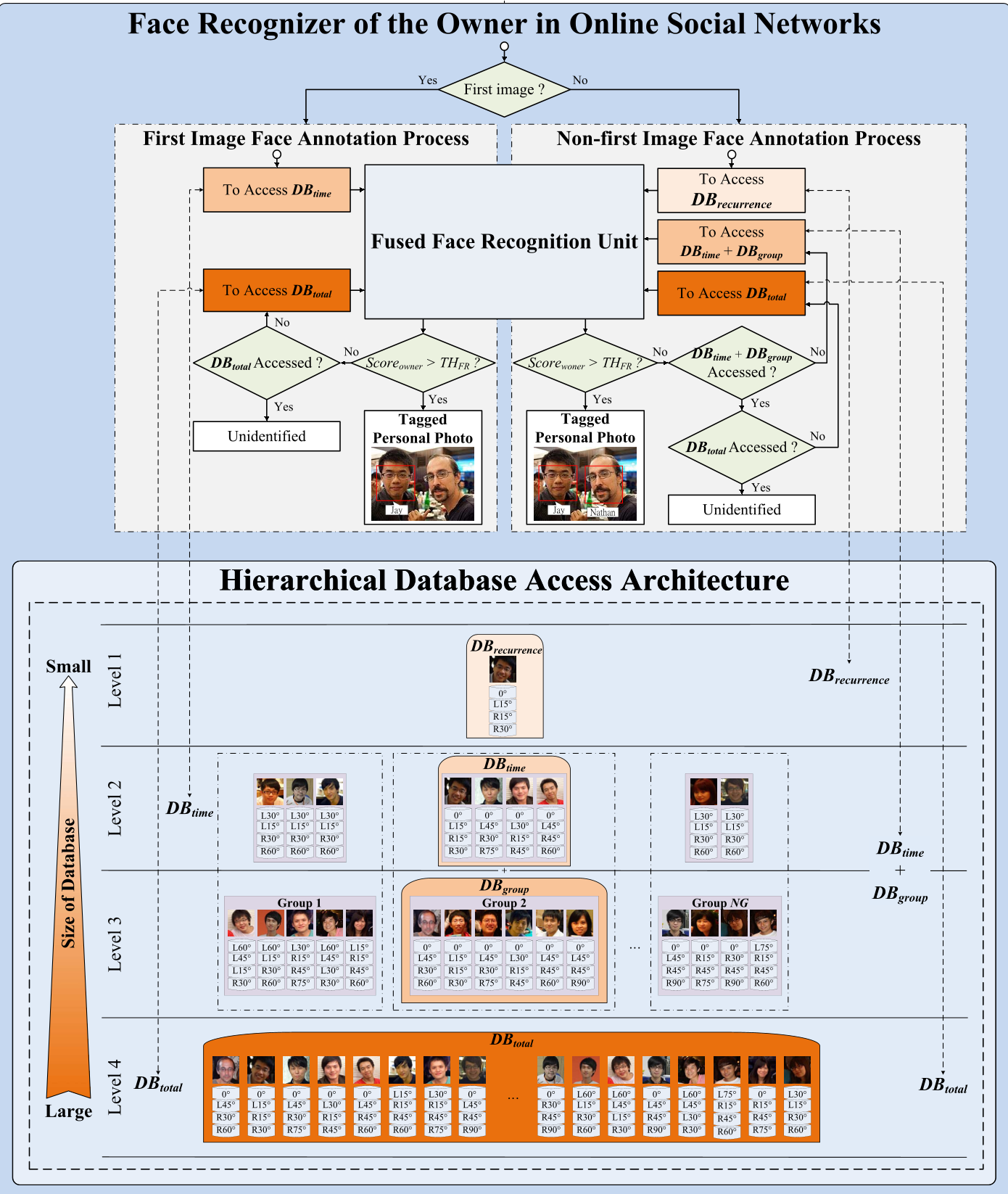
2. The Fused Face Recognition (FFR) Unit
No single algorithm is perfect. The FFR unit uses AdaBoost to combine five different base classifiers: KPCA, KFLD, Bayesian, FLDA, and PCA. AdaBoost assigns weights to these classifiers based on their performance on the owner's specific photo history. This creates a "Personalized Recognizer" that learns the specific visual quirks of your social circle.
Experiments & Results: Speed Meets Precision
The researchers tested their system on real Facebook data across four different "Test Beds."
The Result? The Highest Priority Rule (HPR) strategy—which prioritizes the photo owner’s recognizer—obliterated previous benchmarks.
- Accuracy Boost: Compared to Independent FR, the F-measure was roughly 64% higher.
- Efficiency: The HDA architecture achieved a hit rate of 80.89% in the top three database levels. Because these levels only represent ~31% of the total data usage, the system was 3.5x faster than a non-hierarchical version.
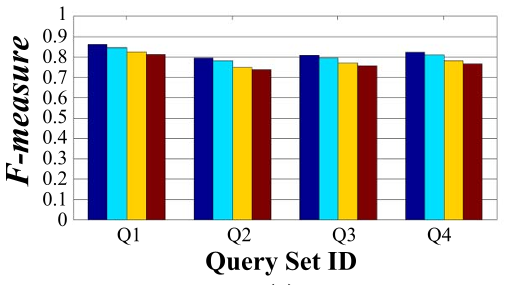
Table: The HPR strategy consistently outperforms centralized and independent baselines across all query sets.
Critical Insight: Why This Works
The brilliance of this paper isn't in a new "Deep Learning" layer (the paper utilizes foundational kernels like KPCA/KFLD), but in the System Engineering of Metadata. Most FR errors happen because the search space is too wide, leading to "False Positives." By using social recurrence and temporal interaction scores, the HDA architecture effectively "filters out" the noise before the math even starts.
Conclusion & Future Look
This system proves that Context is King. In the era of privacy-preserving distributed networks, moving away from centralized "Global Classifiers" toward "Personalized Hierarchical Recognizers" is the only sustainable path for high-load OSN features.
While future iterations might replace the Adaboost base classifiers with modern Vision Transformers (ViT), the Hierarchical Database logic proposed here remains a gold standard for efficient distributed search.