
SVD-G: Solving the Uncertainty Gap in High-Quality Mobile Crowdsourcing
High Quality Participant Recruitment of Mobile Crowdsourcing over Big Data
This paper introduces SVD-G, a participant selection framework for Mobile Crowdsourcing (MCS) that optimizes high-quality recruitment under budget constraints. It combines an improved Singular Value Decomposition (SVD) for predicting participant task completion probabilities with a greedy selection algorithm to maximize the Spatial Coverage Expectation (SCE).
TL;DR
Mobile Crowdsourcing (MCS) often suffers from "unreliable participants" who fail to complete tasks, leading to wasted incentives and poor data coverage. This paper proposes SVD-G, a two-step framework that first predicts the probability of task completion using Singular Value Decomposition (SVD) to handle sparse historical data and then employs a Greedy Algorithm to maximize expected coverage under a fixed budget.
Background & Motivation: The Reality of "Failure"
Most existing Mobile Crowdsourcing recruitment strategies adopt a binary view: either a participant covers a Point of Interest (PoI) or they do not. However, the authors argue that coverage does not equal completion. A participant (e.g., a driver) might pass a PoI but fail to take a high-quality photo due to speed, security, or environmental factors.
The technical challenge is twofold:
- Uncertainty: Individual ability and environmental factors make task success probabilistic.
- Data Sparsity: Recruiter platforms rarely have complete historical data for every participant-PoI pair, making it difficult to estimate that probability accurately.
Methodology: Predictive Recruitment
The SVD-G approach tackles the recruitment problem through a sophisticated pipeline:
1. Latent Factor Modeling (SVD)
To address data sparsity, the paper applies Matrix Factorization. By decomposing the historical success matrix into latent factor vectors for both participants () and PoIs (), the model can predict the "Coverage Possibility" () for pairs with no prior interaction.
The optimization objective uses a regularity item to prevent overfitting:
2. Maximizing Spatial Coverage Expectation (SCE)
Instead of maximizing raw coverage, the authors define Spatial Coverage Expectation (SCE). This metric accounts for the fact that multiple unreliable participants might cover the same PoI, thereby increasing the cumulative probability of at least one success.
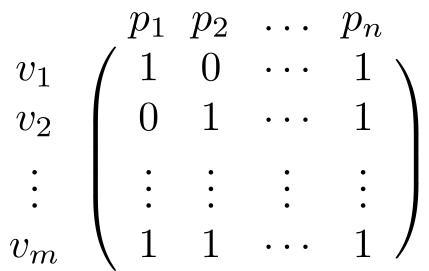 (Note: Above represents the Trajectory Matrix A which serves as the foundation for the SVD estimation)
3. Cost-Effective Greedy Selection
The recruitment is formulated as an optimization problem where the goal is to choose a subset of participants that maximizes SCE subject to . The algorithm iteratively selects the candidate with the highest Cost Effectiveness (CE):
Experimental Validation
The authors tested their model using big data from Dianping (Beijing area), involving 300,000+ users and 5,000+ shops.
Key Findings:
- Superior Coverage: SVD-G consistently achieved higher true coverage than the "Greedy-SC" baseline, which ignores completion probability.
- Robustness to Quality: Even when the pool was injected with "low-quality" participants, SVD-G identified the reliable outliers to maintain system performance.
- Efficiency: SVD-G reaches peak coverage with significantly fewer participants, helping recruiters stay within tight budgets.
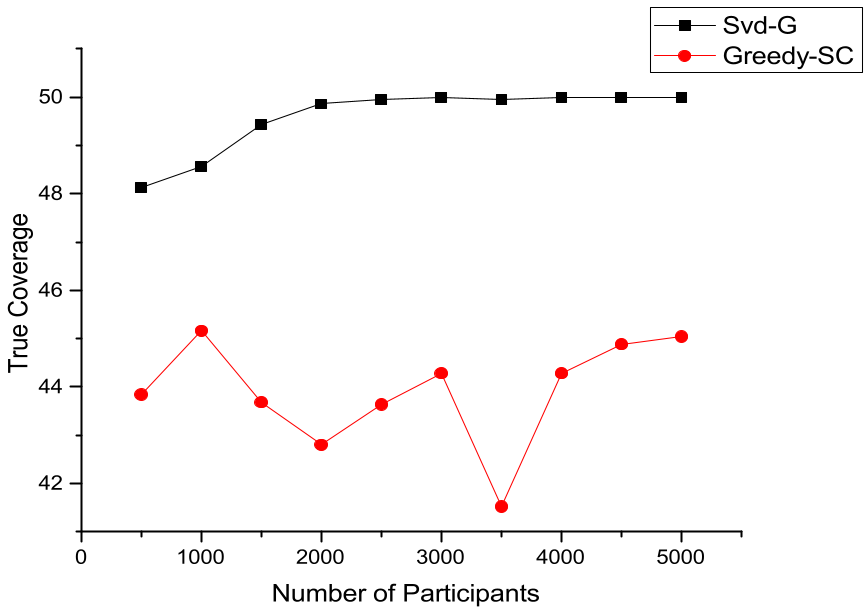 Fig: Performance comparison showing SVD-G reaching optimal coverage faster than baseline methods.
Critical Insight & Conclusion
The core philosophy of this work is the transition from deterministic recruitment to probabilistic recruitment. By leveraging SVD to "fill the gaps" in human behavior data, the system builds an inductive bias that favors historically reliable participants even in new contexts.
Limitations: While powerful, the model relies on the assumption that latent factors are relatively static. In highly dynamic urban environments (e.g., sudden weather changes), the historical SVD-based prediction might require real-time context-aware weights to remain accurate.
Future Directions: Integrating incentive mechanisms directly into the SVD model could provide a holistic "Market-Value" recruitment strategy where the probability of success is a function of the reward offered.