
High-Utility K-Anonymization: Preserving the "Soul" of Social Networks
High utility K-anonymization for social network publishing
The paper introduces a high-utility k-anonymization framework for social network publishing, utilizing community-based graph models (Flat and Hierarchical) to measure utility loss. By preserving edge distributions within and between communities, the method achieves k-degree anonymity while maintaining critical topological properties.
TL;DR
Published social networks often sacrifice structural integrity for privacy. This paper introduces a paradigm shift: instead of just balancing degree counts (which is like counting trees but ignoring the forest), it uses Community-Based Models to ensure that the macro-structure of the network—how groups form and interact—remains intact during k-anonymization. The result? Privacy gains with utility loss often kept under a staggering 1%.
The Problem: The "Degree-Only" Blind Spot
Most prior works on k-anonymity (making every node indistinguishable from at least others) focus on the Degree Sequence. The logic was simple: if an attacker knows Bob has 5 friends, make sure at least people have exactly 5 friends.
However, the authors point out a critical flaw: two graphs can have identical degree sequences but look completely different. One might be a tight-knit cluster (high clustering coefficient), while the other is a sparse line (long path length). By ignoring these "topological truths," traditional anonymization often destroys the very data utility researchers need for social science or marketing analysis.
The Insight: Communities as Utility Anchors
The central thesis of this work is that Community Structure is the "organizing principle" of social networks. Communities represent locally dense clusters of edges. If we can anonymize a graph without shifting the density of edges within and between these communities, we effectively preserve the graph's "DNA," including complex metrics like Betweenness Centrality and Clustering Coefficients.
1. Flat Community Model
This model partitions the graph into disjoint sets. The utility loss is calculated as the distance between the original and anonymized Edge Distribution Sequence (ES)—the percentage of edges falling within or between specific community pairs.
2. Hierarchical Community Model (HRG)
For more complex structures, the authors use a Hierarchical Random Graph. This models the network as a binary tree where internal nodes represent the probability of edges forming between subtrees. This "coarse-to-fine" capture allows the anonymization algorithm to be extremely sensitive to even minor structural disruptions.
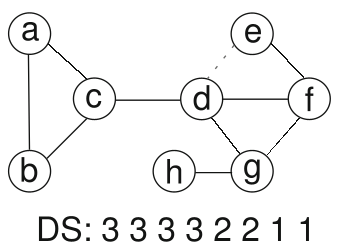 Figure: Even with the same degree sequence changes, different edge operations result in vastly different topological outcomes (APL, CC, etc.).
Methodology: The Greedy Transition Framework
The authors propose a general framework that iteratively transforms an original graph into an anonymous version :
- Estimate Target: Determine the "nearest" k-anonymous degree sequence using dynamic programming.
- Generate Operations: Identify candidate edge operations (Insertion, Deletion, or Edge Shift).
- Prioritize Edge Shifts: A unique contribution is the Edge Shift. By moving an edge's endpoint to another vertex within the same community, the algorithm changes node degrees to satisfy -anonymity without altering the community edge distribution. This results in zero utility loss relative to the community model.
- Refine: Greedily pick the operation with the lowest community utility loss until -anonymity is reached.
Experimental Results: Precision Privacy
The authors tested their approach on DBLP (sparse) and Dogster (dense) datasets.
- Topological Stability: While existing methods (Swap/Probing) showed massive swings in Average Path Length and Betweenness, the HRG-based method stayed nearly flat-lined, preserving the original graph properties with over 99% accuracy.
- The HRG Advantage: The Hierarchical model consistently outperformed the Flat model, proving that capturing the "sub-community" layers is vital for high-fidelity data publishing.
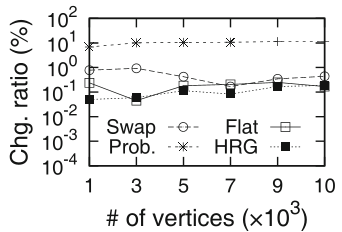 Figure: Our methods (Flat/HRG) show significantly lower change ratios across APL, CC, and BTN compared to traditional baselines.
Critical Analysis & Conclusion
This paper successfully bridges the gap between privacy theory and practical data utility. By moving the optimization objective from "number of edges changed" to "structural distribution preserved," it provides a more nuanced approach to data privacy.
Limitations:
- Computational Cost: Building the HRG model using Markov Chain Monte Carlo (MCMC) is expensive, potentially limiting scalability for billion-node networks without further optimization.
- Dynamic Privacy: The model assumes a static snapshot; real-world social networks are temporal, and maintaining community-based utility over time remains an open challenge.
Future Outlook: The "Edge Shift" logic within community silos is a powerful inductive bias. Future researchers could potentially integrate this with Differential Privacy to provide even stronger mathematical guarantees while leveraging the utility-preserving power of community structures.