
Beyond the Voice: Strategic Dimensionality Reduction for Hindi Emotion Recognition
Emotion Recognition of Speech in Hindi Using Dimensionality Reduction and Machine Learning Techniques
This paper presents a Speech Emotion Recognition (SER) system specifically designed for the Hindi language, utilizing a combination of local and global acoustic features. By employing dimensionality reduction techniques like PCA and LDA, the authors demonstrate that a Naïve Bayes Classifier (NBC) achieves a superior state-of-the-art accuracy of 72.77% on their custom Hindi dataset.
TL;DR
Recognizing human emotions in speech is notoriously difficult due to the high-dimensional nature of audio data. This paper tackles Hindi Speech Emotion Recognition (SER) by combining local and global acoustic features. By applying PCA and LDA for dimensionality reduction and utilizing a Naïve Bayes Classifier, the authors achieved a remarkable 72.77% accuracy, significantly outstripping standard SVM and Decision Tree models which hovered between 29% and 39%.
Background & Motivation: The Hindi Context
Most speech emotion research has historically focused on English and European languages. Hindi presents unique prosodic patterns. The authors identified that existing methods fail because they often utilize features in isolation. Moreover, the lack of an open-access Hindi corpus forced the creation of a custom dataset featuring five core emotions: Anger, Happiness, Neutral, Sadness, and Surprise.
The core insight of this study is that "more data isn't always better." Raw acoustic features are often redundant or noisy; the key to success lies in dimensionality reduction to find the "latent emotion manifold."
Methodology: The Feature Fusion Pipeline
The researchers developed a pipeline that merges multiple signal dimensions:
- Pitch & Energy: Capturing the excitation and intensity of the vocal tract.
- MFCC (Mel Frequency Cepstral Coefficients): 12 coefficients representing the power spectrum—critical for phoneme and emotion discrimination.
- ZCR (Zero Crossing Rate): Helping distinguish between voiced and unvoiced speech segments.
To handle this high-dimensional feature vector, they compared two statistical heavyweights:
- PCA (Principal Component Analysis): Unsupervised reduction focusing on maximum variance.
- LDA (Linear Discriminant Analysis): Supervised reduction focusing on class separability.
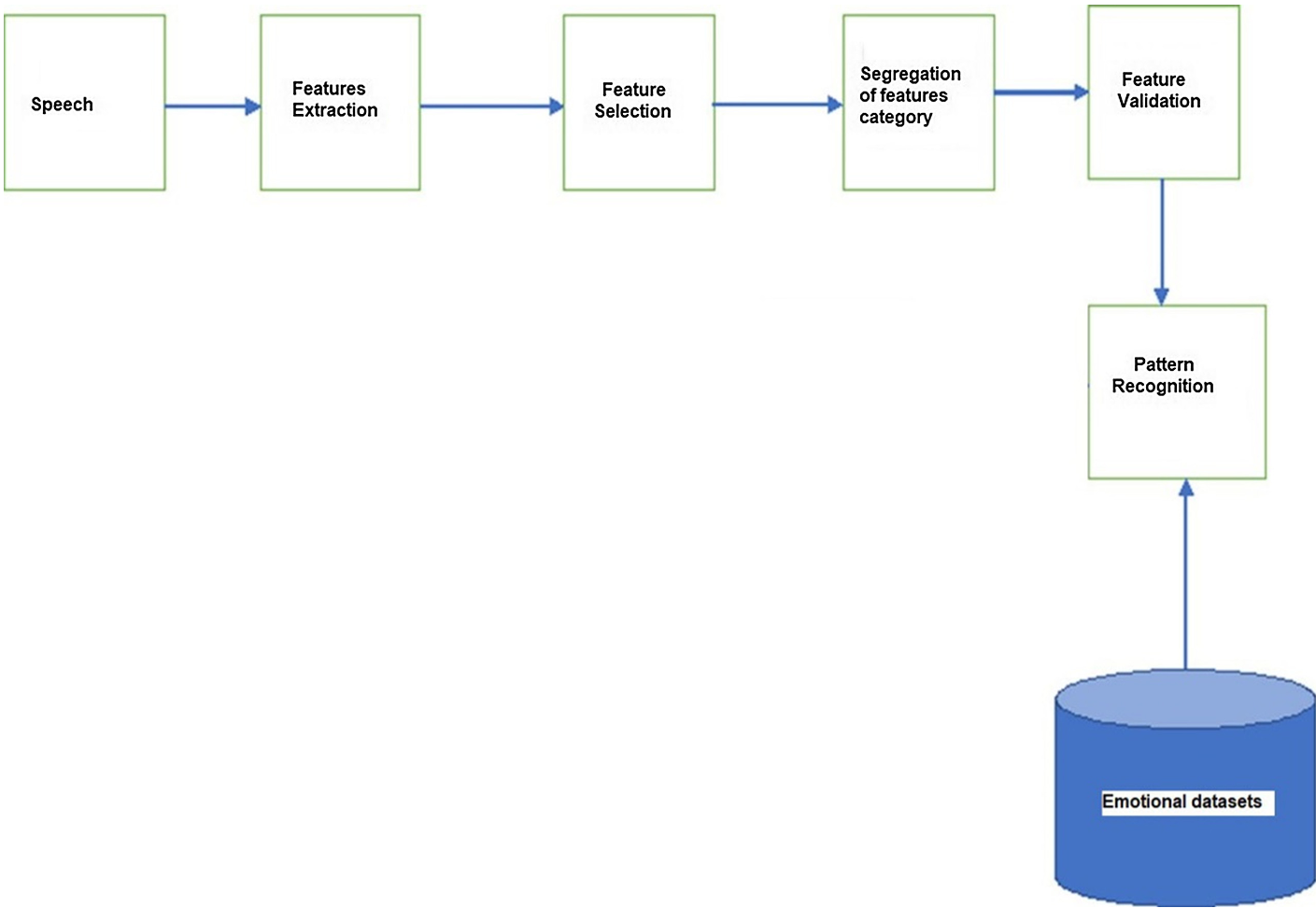 Figure 1: The systemic workflow from speech corpora collection to feature extraction and classification.
Why Naïve Bayes?
In a surprising turn for modern ML enthusiasts, the complex Support Vector Machines (SVM) and Decision Trees (DT) performed poorly. The authors found that when features are reduced and appropriately weighted, the Naïve Bayes Classifier (NBC)—which assumes feature independence—actually captures the statistical distribution of Hindi emotional states more robustly than kernel-based methods.
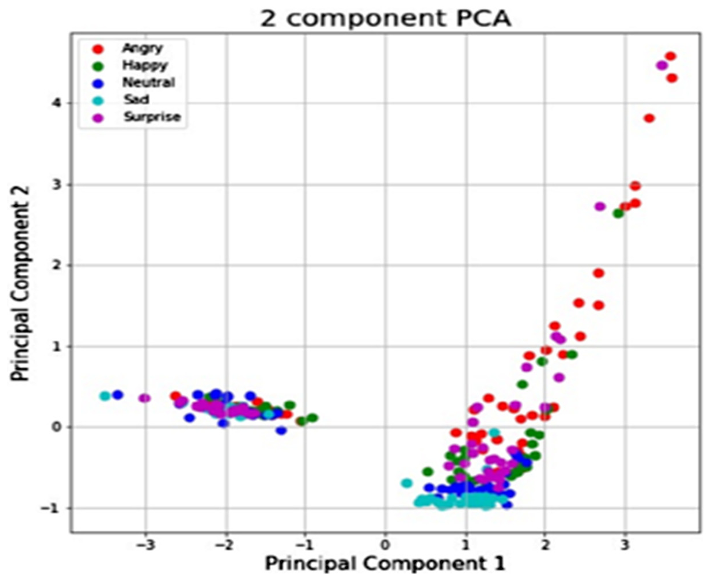 Figure 2: Visual comparison of (a) PCA vs (b) LDA results. Note how PCA clusters the emotional utterances more distinctly.
Experimental Battleground: Results
The final results (summarized in Table 3 of the paper) show a massive gulf in performance:
- Naïve Bayes: 72.77% (Clear Winner)
- SVM: 39.00%
- KNN with PCA: 33.65%
- Decision Tree: 29.99%
The heatmaps generated for the SVM and Decision Tree models revealed a "degree of confusion" between overlapping emotions like Happy and Surprise, a common hurdle in SER.
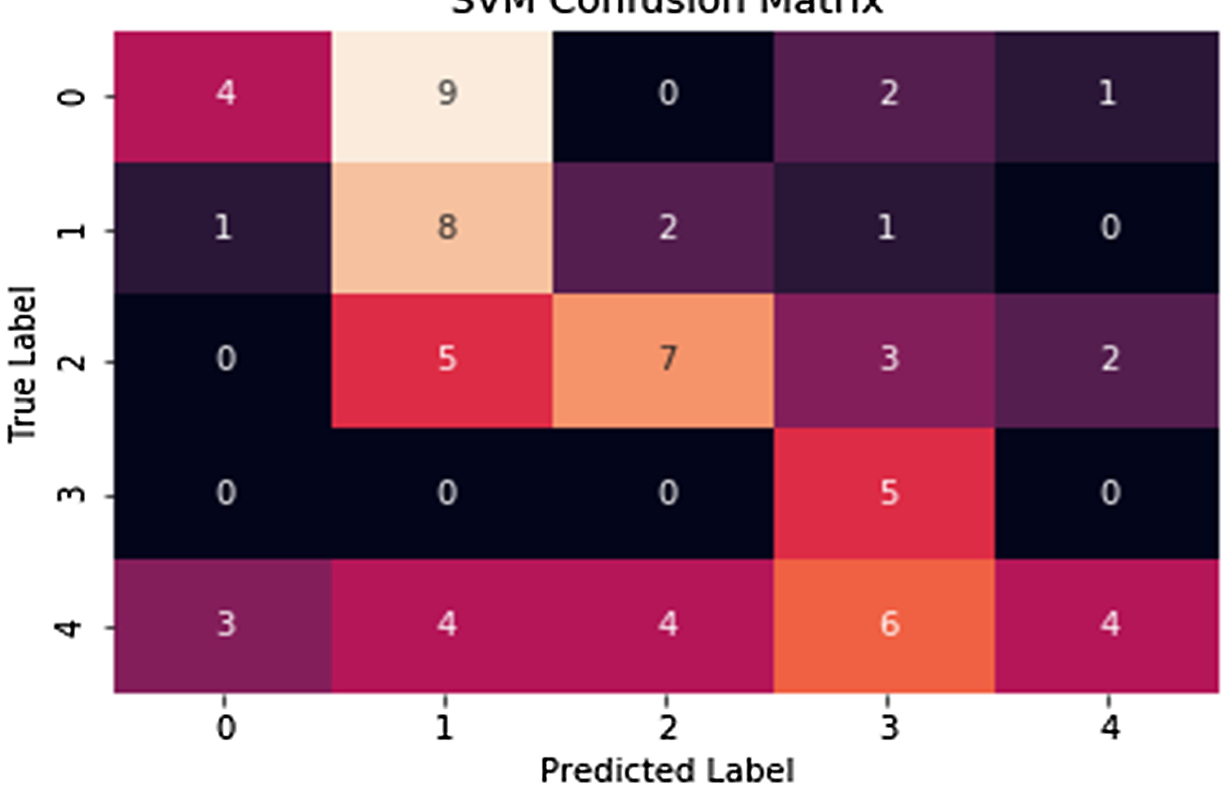 Figure 3: Heatmap representation showing significant misclassification in the SVM model before NBC implementation.
Critical Analysis & Takeaways
The paper highlights a crucial lesson in Academic Tech: The most "sophisticated" algorithm is not always the best. For Hindi SER, the simplicity of Naïve Bayes provided a better inductive bias than the complex margins of SVM.
Limitations: The study used a "non-dramatic actor" corpus (Type 1 dataset). The real challenge for the future is applying this NBC-PCA framework to natural, unscripted conversations (Type 3 datasets), where background noise and overlapping speech make feature extraction significantly more chaotic.
Future Outlook: The authors suggest that moving toward Deep Learning (CNN/LSTMs) and Nature-Inspired algorithms will be the next step to push Hindi SER beyond the 80% accuracy threshold.