
HBVP: Revolutionizing Intra Block Copy for AVS3 Screen Content Coding
History Based Block Vector Predictor for Intra Block Copy
This paper introduces a History-based Block Vector Prediction (HBVP) method for Intra Block Copy (IBC) in the AVS3 video coding standard. By maintaining a lookup table of previously used block vectors (BVs) and introducing SKIP/DIRECT modes for IBC, the method significantly improves Screen Content Coding (SCC) efficiency, specifically achieving up to 12.34% BD-rate reduction.
TL;DR
Researchers from Harbin Institute of Technology and Bytedance have introduced History-based Block Vector Prediction (HBVP) to the AVS3 standard. By leveraging a table of historical block vectors and introducing a SKIP/DIRECT mode for Intra Block Copy (IBC), they achieved a massive 12.34% BD-rate reduction for graphical screen content, addressing the long-standing inefficiency of signaling raw displacement vectors.
Background: The Challenge of Screen Content
Screen content (SCC)—think your desktop, gaming streams, or coding tutorials—contains sharp edges and repetitive patterns like text and icons. Traditional intra-frame prediction (based on neighboring pixels) fails here. The Intra Block Copy (IBC) tool was designed to solve this by treating a frame like an "inter" frame, searching for matching blocks within the same reconstructed picture.
However, the "where" (Block Vector, or BV) was previously signaled as raw data. In a world where every bit counts, signaling a raw 2D vector for every small block is a luxury we can't afford.
The Insight: History Repeats Itself
The core motivation is simple: if a specific vector (e.g., ) worked for a block containing a "Login" button, it’s highly likely the same vector will work for the next "Login" button or similar UI elements nearby.
1. HBVP Table Mechanism
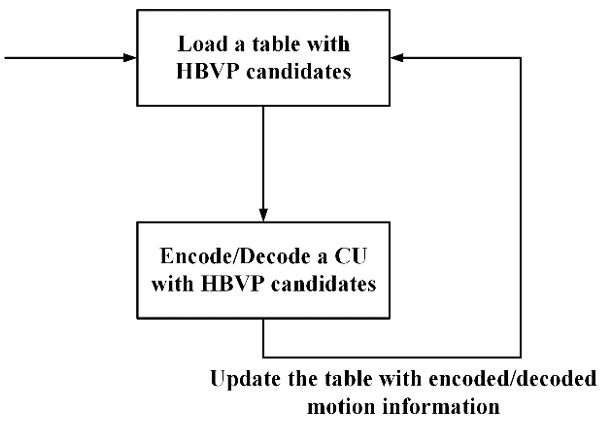
The proposed method maintains a table of the 12 most recent BVs.
- FIFO Update: New BVs are added to the end.
- Redundancy Check: If a new vector is already in the table, the old entry is removed, and the list is shifted to avoid wasting space on duplicates.
- Index Signaling: Instead of the full vector, the encoder often only needs to signal a small index (e.g., 0 to 11).
2. Redefining the Search Window
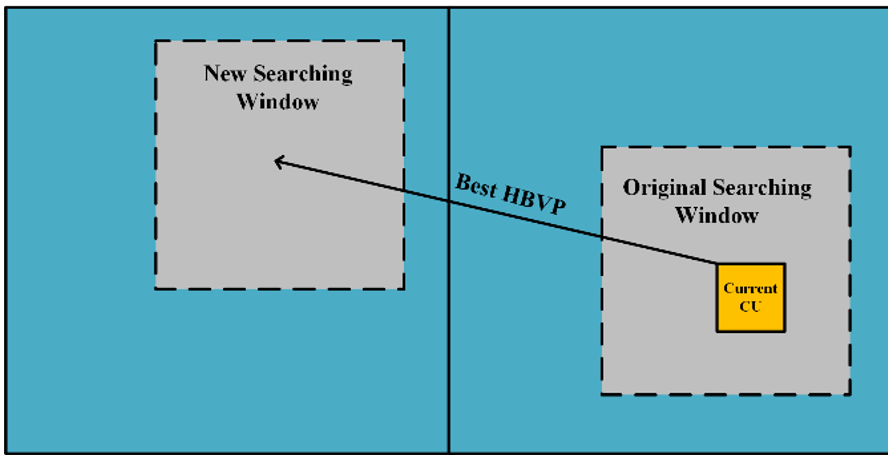
Standard IBC searches in a window centered at the current block's position. But if the "History" tells us the best match is likely 100 pixels to the left, why search around ? The authors re-centered the search window at the position indicated by the best HBVP candidate. This "smart centering" significantly increases the effective search range without adding computational complexity.
Analysis of Results
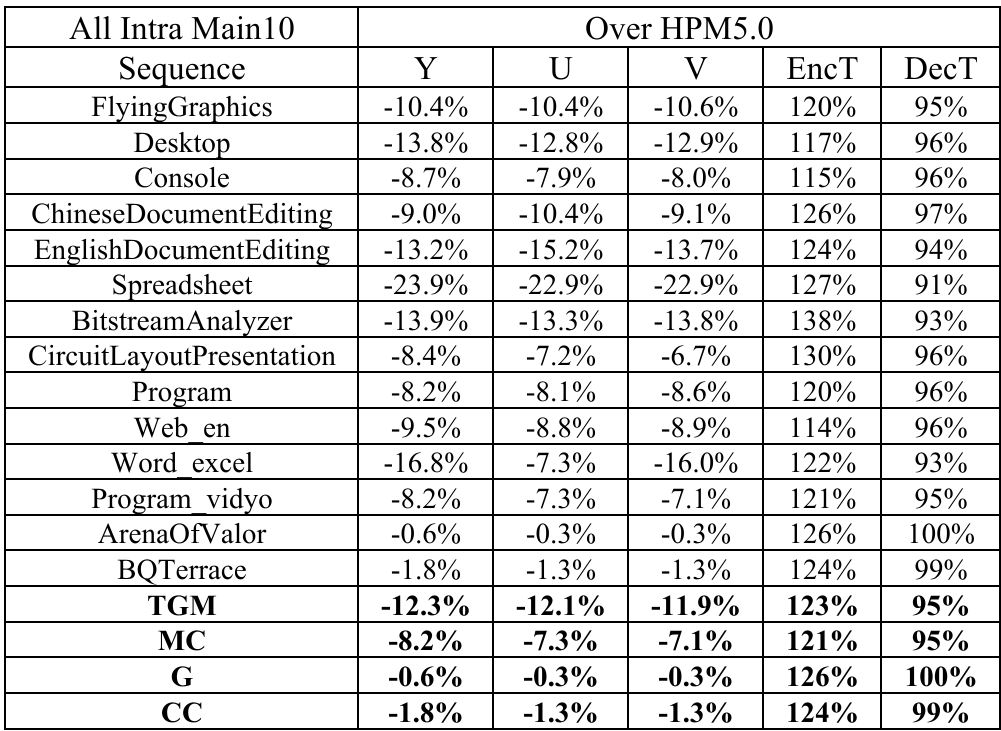
The performance gains are particularly striking in the Text and Graphics with Motion (TGM) category:
- BD-Rate Reduction: -12.34% for TGM sequences.
- Maximum Gain: The "Spreadsheet" sequence saw a staggering -22.0% luma BD-rate saving.
- Efficiency: By reducing the best BV list size from 8 to 1 during local search and optimizing bit-cost calculations, the encoding time increase was kept under control (~10-20% increase for massive gains).
Critical Insight & Conclusion
While the concept of "History-based" prediction isn't new (it exists in Inter coding as HMVP), its application to IBC requires a nuanced understanding of SCC geometry. The most clever part of this paper isn't just the table—it's the Search Window Modification. By moving the search center based on historical priors, the encoder finds better matches with smaller residuals and smaller BVDs, creating a "virtuous cycle" of efficiency.
This work has been partially adopted into AVS3.1, proving its practical value for the next generation of video communication and screen-sharing technologies.