
Turning History into a Data Science: Can Genealogy Make the Past Interesting?
History lessons — Can we make them interesting?
The paper explores the integration of the online social networking tool Geni into history, anthropology, and ethnography education. It demonstrates a methodology for building a "World Family Tree" to make history interactive, logical, and personally relevant for students through genealogical research and statistical analysis.
TL;DR
This research addresses the "boredom" of traditional history by leveraging Geni, a collaborative social networking tool, to build massive genealogical maps. By turning history into a logical, data-driven investigation of one’s own ancestors, the authors bridge the gap between technical-minded students and the humanities, using everything from statistical demographics to complex mathematical formulas for inbreeding.
Background Positioning
While most ICT in schools is used for simple tutorials or resource access, this work positions genealogy at the intersection of History, Anthropology, and Mathematics. It moves beyond "What happened?" to "How are we connected?"—transforming passive memorization into active, record-linked research.
Problem & Motivation: The "Illogical" History
Students today are often more "technically savvy" than their teachers, viewing history as a dry collection of unrelated facts. The authors argue that history feels irrelevant because it lacks logic and personal connection. The challenge is twofold:
- Engagement: How do we make the past visible to a generation raised on social networks?
- Verification: In an age of digital misinformation, how do we teach students to verify historical "data" with the same rigor as a scientific experiment?
Methodology: Mapping the "Big Tree"
The core of the approach is the transition from individual family trees to a "Forest" or a single "Big Tree."
The Geni Framework
Geni utilizes a node-based structure where profiles are linked by relationships. To ensure data integrity, the authors acted as Curators—super-users who clean up duplicates and verify historical accuracy.
Mathematizing Kinship
A standout feature of this research is the application of the Sewall Wright formula to calculate the inbreeding coefficient ():
This allows students to visualize not just names on a page, but the biological and social structure of their ancestors' communities.
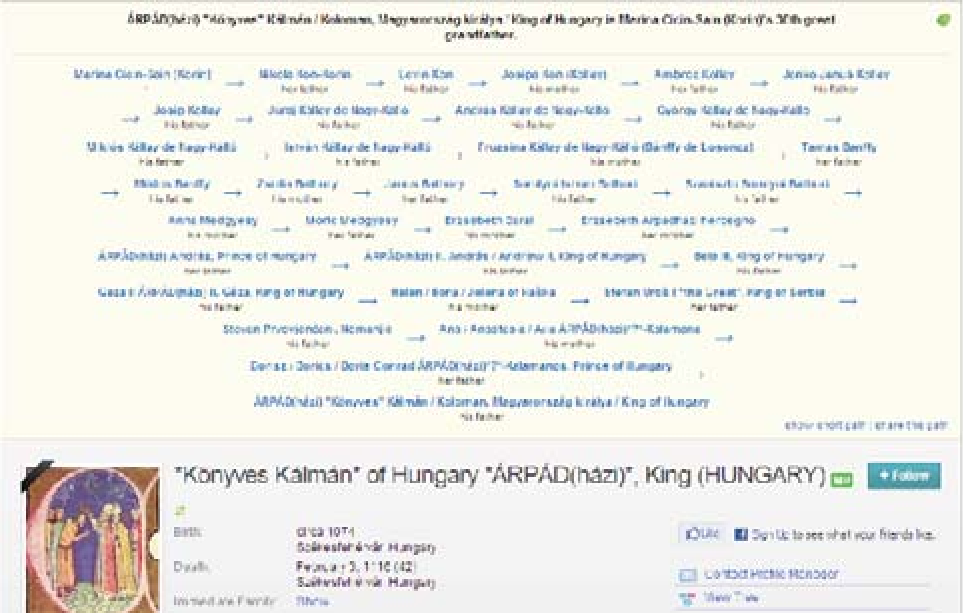 Figure 1: Visualizing historical links between living descendants and ancestors.
Experiments & Results: The Podgora Study
The authors focused on the Makarska Region of Croatia, capturing nearly 500 years of data.
- Demographic Analysis: Students used the tool to test hypotheses such as "People lived shorter lives in the past." By comparing life expectancy charts (Figure 10) with physical grave inscriptions, students engaged in a "real-world" validation of ICT data.
- Global Migration: The project tracked the diaspora of Croatian families to New Zealand and Australia, using the tree to locate modern descendants of historical figures (Figure 5).
- Inbreeding Trends: The study calculated F-values for 30,000 individuals, providing a quantitative look at local kinship patterns over four centuries.
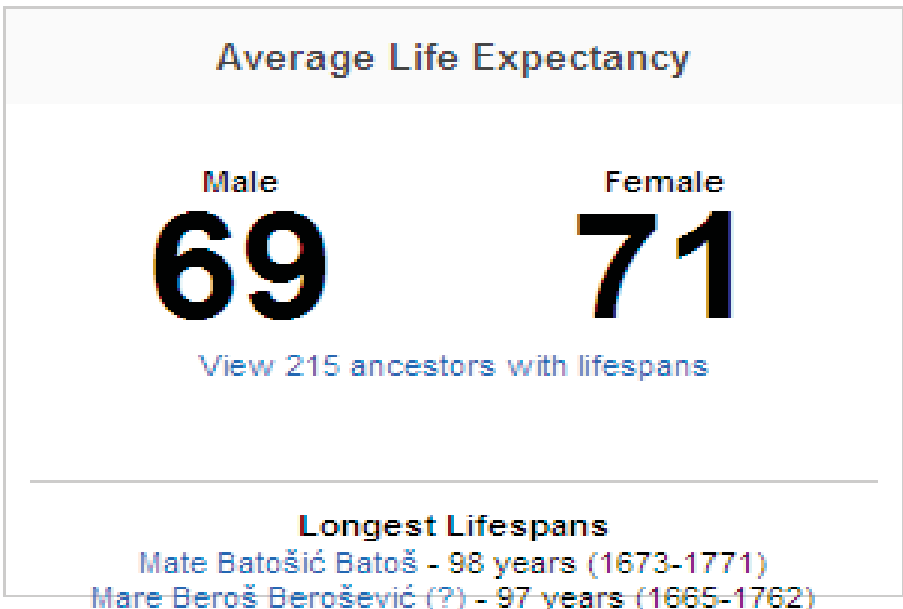 Figure 10: Quantitative analysis of life expectancy generated from genealogical data.
Critical Analysis & Conclusion
Takeaway
The value of this work lies in Personalization. When a student finds their own relative in a WWII refugee camp project (like the El Shatt camp), the historical "fact" becomes a "family memory," driving deep engagement.
Limitations
The primary hurdle is the veracity of information. Collaborative trees are prone to "crowdsourced errors" and duplicates. While the Curator model mitigates this, it requires high-level human intervention that might not be scalable without automated AI-driven verification.
Future Work
The authors envision these tools being standard in history departments, where the focus shifts from "Which king ruled when?" to "What were the demographic and genetic structures of our local community?" This logic-driven approach may be the key to making history a favorite subject for the technical generation.