
Beyond the Artifact: Reclaiming Technology through Ancestral Memory in Rural Colombia
History of technology and humanitarian technologies: A case study regarding the design and deployment of humanitarian technologies among rural communities in Colombia
This paper details a collaborative project between Uniminuto (Colombia) and Algoma (Canada) Universities and the ASOPRICOR grassroots association. It utilizes Participatory Action Research (PAR) to design a technological training program for rural development in the Tequendama and Alto Magdalena regions of Colombia, integrating ancestral knowledge with socio-technical history.
TL;DR
The IEEE motto "Advancing Technology for the Benefit of Humanity" often overlooks a crucial question: Whose technology and which humanity? This paper critiques the traditional "top-down" deployment of humanitarian tech. By using Participatory Action Research in the Colombian regions of Tequendama and Alto Magdalena, researchers found that for technology to be effective, it must be deconstructed through the lens of community history, ancestral wisdom, and the specific socio-political struggles of the peasantry.
The "Apocalyptic" History of Modernization
In the eyes of a Colombian peasant (campesino), "technology" is not a synonym for "progress." Historical memory associates technological shifts with loss:
- The Railroad (1920s): Remembered not as a transport feat, but as the beginning of mass deforestation.
- The Green Revolution (1970s): Hybrid coffee varieties and chemical fertilizers are viewed as "Apocalyptic" forces that destroyed soil stability and traditional shade-grown ecosystems.
- Bogotá River: Once a source of life and food, now a "toxic black bluish" reminder of urban industrial failure.
The authors argue that ignoring these "technological traumas" is why many humanitarian projects fail. Without understanding why a community fears a new tool, an engineer's "solution" is merely a perceived threat.
Methodology: The Socio-Technical Bridge
The researchers didn't arrive with gadgets; they arrived with questions. They utilized Participatory Action Research (PAR), a methodology rooted in the belief that knowledge is a shared creation.
The Core Framework:
- Oral History: Capturing non-institutional memories to contrast with official "development" narratives.
- STS Analysis: Treating technology as a "heterogeneous phenomenon" where humans and objects are entangled in social and symbolic networks.
- Horizontal Dialogue: Acknowledging peasants as "proponent subjects" capable of designing university-level curricula.
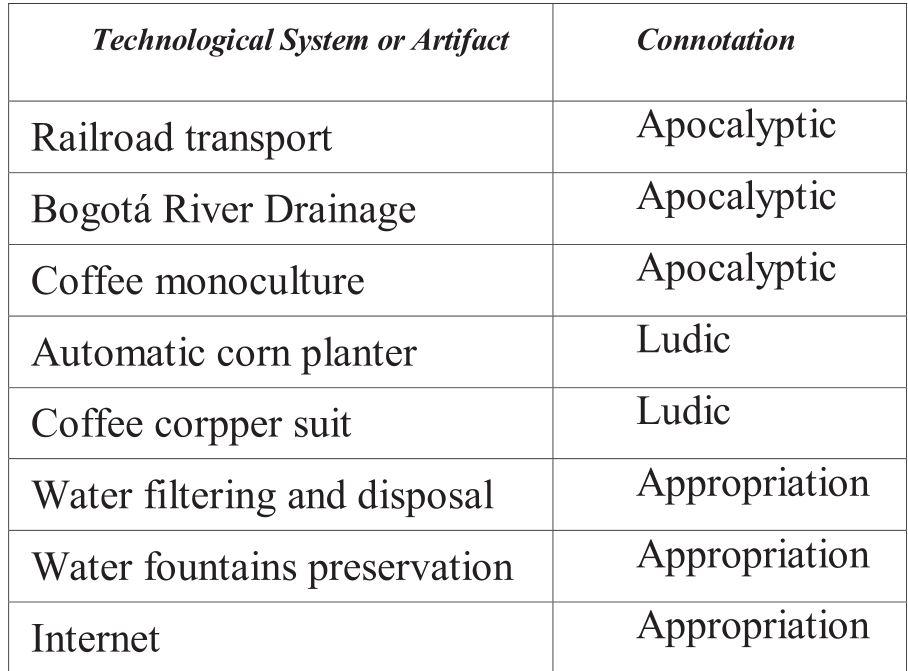 Figure 1: This table from the paper categorizes how different technologies are perceived by the community—ranging from "Apocalyptic" to "Ludic" (playful) to "Appropriation."
Appropriation vs. Imposition
The research highlights a fascinating divide in how different technologies are adopted.
- Failed Tech (The Corn Planter & Coffee Suit): Tools designed by "experts" that failed in the rugged terrain or hot climate of Colombia. These are remembered with humor or frustration—the "Ludic" or "Apocalyptic" categories.
- Successful Tech (The Internet & Water Filters): In a surprising twist, Internet connectivity is viewed as a tool of resistance. It allows grassroots organizations to bypass local silence and connect with global environmental movements. Similarly, decentralized water filtration is "appropriated" because the community adapts the designs to local materials.
From Discussion to Action: The 127-Hectare Success
The most profound result of this socio-technical dialogue was the preservation of the regional aqueduct. Faced with drying water sources, the community did not look for a "better pump" (a purely technical fix). Instead, they organized politically and socially to purchase 127 hectares of land to protect the native flora and natural water fountains.
This illustrates the paper's central thesis: Humanitarian technology is a social process first, and a technical one second.
Critical Insight: The Arrogance of the West
The authors conclude with a stinging critique of Western techno-scientific culture. The biggest obstacle to rural development isn't a lack of broadband or machinery; it is the arrogance that assumes scientists have nothing to learn from peasants.
Takeaways for Modern Engineers:
- Bi-directional Learning: We must ask who is learning more during a project—the community or the researcher?
- Holistic Context: Peasants think holistically. You cannot solve a "water problem" without solving a "land rights" or "deforestation" problem.
- Resistance as a Feature: Technology that empowers a community to resist external threats (like predatory mining or industrial monoculture) has much higher adoption rates than technology meant purely for "efficiency."
Future Outlook
The project has transformed into a long-term partnership. The next phase moves beyond "tech issues" to focus on food self-sufficiency and intergenerational dialogue. The lesson is clear: for technology to benefit humanity, it must first respect the history and the agency of the humans who use it.