
HLGPS: Redefining Geo-Social Positioning via Social Trust and Influence Modeling
HLGPS: A Home Location Global Positioning System in Location-Based Social Networks
This paper introduces HLGPS (Home Location Global Positioning System), a graph-based probabilistic framework for identifying users' home locations in Location-Based Social Networks (LBSNs). By integrating an Influence Model on Edges (IME) with a global iteration algorithm, HLGPS achieves a state-of-the-art accuracy of 92.3% for check-in users and outperforms existing methods by 14.7% overall.
Executive Summary
TL;DR: HLGPS (Home Location Global Positioning System) is a novel framework designed to solve the "Home Location Identification" problem in sparse LBSN datasets. By modeling the network as a heterogeneous graph and introducing a probabilistic influence model (IME) that accounts for Social Trust and Venue Ratings, it achieves a significant 14.7% accuracy boost over prior benchmarks.
Background Positioning: This work represents a major advancement in check-in-based and social-based user profiling. While traditional methods struggled with the "cold start" problem (users with no check-ins), HLGPS leverages the global topology of social trust to "triangulate" home locations across the entire network.
The Sparsity Challenge: Why Profile Mapping is Hard
In the world of Foursquare or Facebook Places, knowing a user's home location is the "Holy Grail" for personalized search and localized advertising. However, researchers face three major hurdles:
- Privacy Concerns: Only ~16% of users self-report city-level data.
- Noise: Check-ins often happen at tourist spots far from home.
- Data Scarcity: A vast majority of users have zero check-in history.
Existing solutions typically treat friendships as binary (friend vs. non-friend) and ignore the intensity of the relationship, leading to suboptimal positioning.
Methodology: The IME Model & Global Iteration
The core innovation is the Influence Model on Edges (IME). Unlike previous models, IME assumes that every node (user or venue) has a specific "influence scope" modeled as a bivariate Gaussian distribution.
1. The Power of Social Trust
The authors introduce Social Trust (), calculated via a sigmoid function on the number of common friends. The intuition: you are more likely to live near someone with whom you share a large mutual circle than a random celebrity you follow.
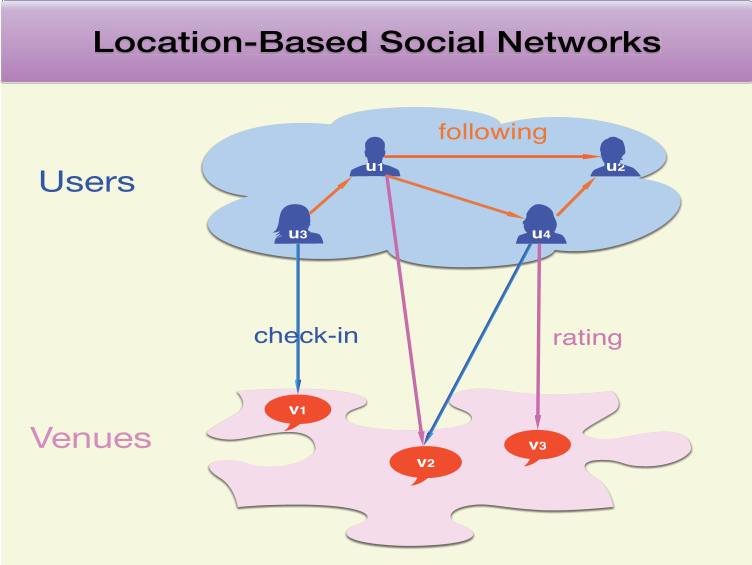
2. Modeling Heterogeneous Edges
HLGPS doesn't just look at who you follow; it integrates:
- Following Edges: Influenced by social trust and distance.
- Check-in Edges: Users visit venues near their home.
- Rating Edges: A "hidden gem" signal—if you rate a venue, you likely live nearby.
3. Two-Stage Optimization
- Stage 1 (LocClustering): For users with data, a single-pass clustering identifies the primary "hub" of their check-ins.
- Stage 2 (Iterative Refinement): For the "silent" majority, the system uses Maximum Likelihood Estimation (MLE) to iteratively solve for latitude () and longitude (), effectively "pulling" unknown users toward their most trusted and proximal influences.
Experimental Proof: Setting a New Standard
The researchers tested HLGPS on a massive Foursquare dataset (836K users, 13M social edges).
Key Performance Metrics:
- Accuracy (within 100 miles): HLGPS reached 92.3% for active users.
- Superiority: It outperformed the UDI model by 14.7%.
- Ablation Success: Removing the "Rating Data" component (HLGPS-r) dropped accuracy by 3.5%, proving that passive interactions are vital signals.
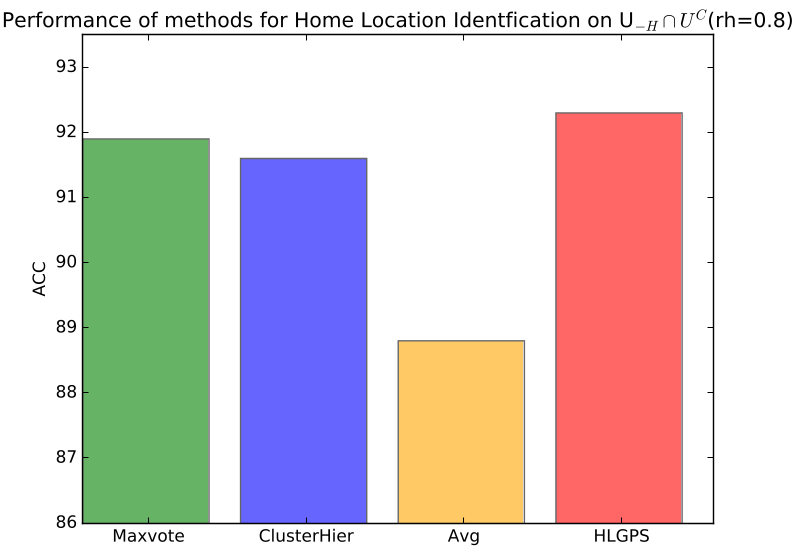
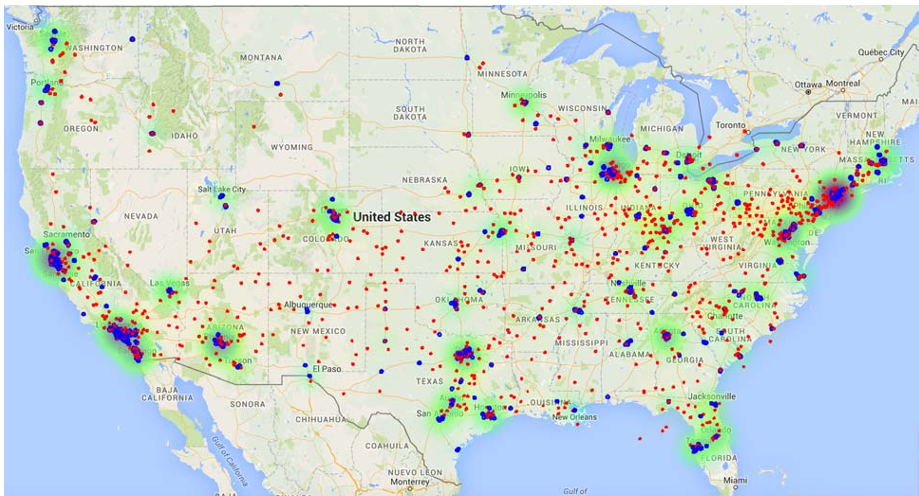
The visualization of predicted vs. true locations (Figure 3 in the paper) shows a remarkably tight alignment across the continental United States, validating the model’s global consistency.
Critical Insight & Conclusion
The success of HLGPS lies in its move from binary social links to probabilistic influence scopes. By recognizing that not all friends are equal and that rating a venue is a strong indicator of local residency, the authors have provided a robust tool for the LBSN industry.
Limitations: The model assumes a static home location. In a world of digital nomads and frequent relocators, incorporating a "temporal weight" (as suggested in Future Work) will be the next frontier for positioning systems.
Final Takeaway: If you want to know where a user lives, don't just look at where they go—look at who they trust and what they value.