
Holiday Syndrome: Decoding WeChat’s Social Pulse During the World’s Largest Human Migration
Holiday syndrome: A measurement study of mobile social network use during holidays
This paper presents a large-scale empirical measurement study of the "holiday syndrome" on WeChat Moments (WM) during the 2016 Chinese Spring Festival. Analyzing data from 137 million users and 329 thousand H5 applications, it characterizes the dynamics of social ties, shifts in user interests towards "Greeting" content, and massive population migration patterns reflected through mobile social network (MSN) usage.
TL;DR
What happens to a billion-user social network during the most significant holiday on earth? This study dives into "Holiday Syndrome" on WeChat Moments (WM), analyzing 1.67 billion views from 137 million users. The researchers reveal how Spring Festival triggers a massive shift in content preference—turning users into "Greeting" machines—and how your physical distance to friends dictates your digital interaction.
Background: The Social Network under the Holiday Lens
In the academic coordinate system, this work occupies a vital spot between Social Computing and Human Mobility. While prior works often focus on static social graphs, this paper treats the Chinese Spring Festival as a "natural experiment" to see how social ties and interests fluctuate under the pressure of tradition and migration.
1. The Social Tie Paradox: Nearer is Dearer
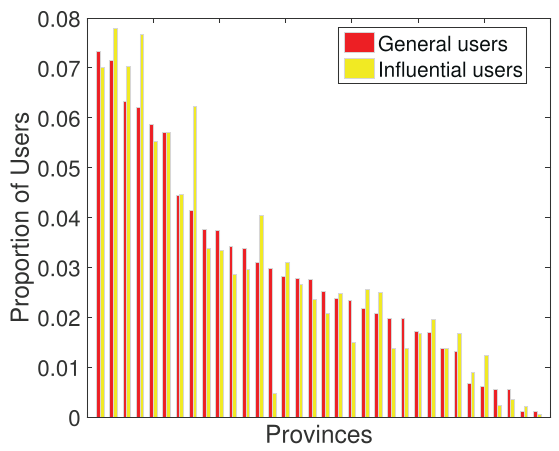
Conventional wisdom suggests the internet makes distance irrelevant. This study proves the opposite. By analyzing contact probabilities across provinces, the authors found:
- Spatial Proximity Matters: Users are significantly more likely to interact with friends located in the same or neighboring provinces during the holiday.
- The Beijing Effect: Despite geographical distance, Beijing acts as a "Social Super-node," with users there having the highest probability of being contacted by friends from across China.
Identifying Influence in a Private Circle
Unlike Sina Weibo or Twitter, where followers equal influence, WeChat is a "Messenger-based MSN." The study used PageRank to find influential users, discovering that "influentials" in WM are not necessarily celebrities or KOLs, but often regular users with high centrality within their private clusters.
2. Methodology: Tracking H5 "WM Applications"
The core methodology relies on H5 (HTML5) applications—interactive decks of pages shared on WeChat. By tracking 329k of these applications, the researchers could measure:
- Browsing Depth: Surprisingly, the 2-page rule dominates. Most users view the cover and exactly one more page.
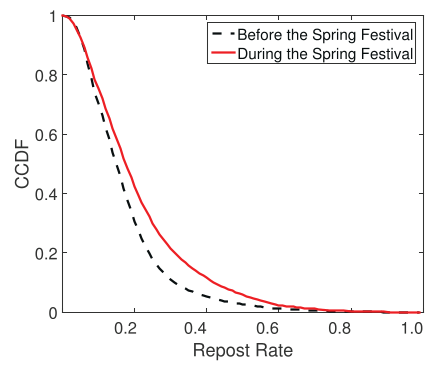
- Micro-Lifetimes: Holiday content is a "flash in the pan." Even though repost rates (the urge to share) are much higher during the holiday, the total volume of content means individual apps die faster as users' attention is spread thin.
3. User Interests: From Utility to Emotion
During the Spring Festival, the "Interest Graph" undergoes a radical transformation.
- The "Greeting" Explosion: Applications categorized as "Greeting" grew from a mere 264 to over 5,500.
- Emotion over Ads: "Emotion" themed applications (praising family, love, or friendship) commanded the highest browsing duration.
- The Marketing Insight: To capture attention, businesses must "cloak" advertisements in emotional or festive greeting templates. Users have near-zero patience for raw advertisements during their family time.
4. Beyond the Screen: Mapping the Great Migration
Perhaps the most fascinating aspect is how digital logs mirror the physical Chunyun (Spring Festival Travel Season).
Diverse Migration Timelines
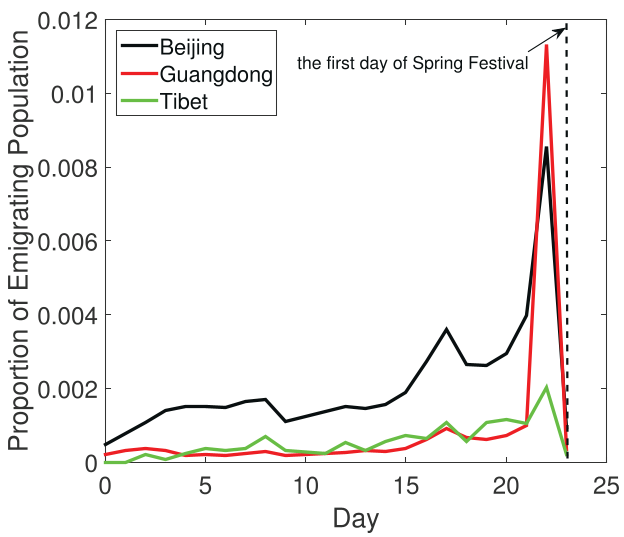
The study identifies three distinct "Migration Profiles":
- The Beijing Surge: A slow rise in departing residents followed by a violent surge right before New Year's Eve.
- The Guangdong Delay: Migration starts much later, with a massive "cliff-edge" departure only 1-2 days before the festival.
- The Tibet Flatline: Regions with lower economic mobility show almost no migration patterns.
Regional Homophily
Using "Regional Homophily," the authors prove that migrants from Northern China predominantly stay within the North, whereas Southern migrants show a slightly more dispersed (though still southern-centric) destination pattern. This "North-stays-North" and "South-stays-South" trend is crucial for regional logistics and localized marketing.
Final Insights: The Business Value of "Syndrome"
The study concludes that the "Holiday Syndrome" isn't just a psychological phenomenon—it's a data-driven reality. For developers and marketers, the takeaways are clear:
- Page 1 & 2 are everything: If your value proposition isn't in the first two swipes, it's gone.
- Timing is Geography-Dependent: Don't run the same campaign schedule in Beijing and Guangdong; their populations move at different rhythms.
- Social Tie Strength: Focus on tools that facilitate "inter-province" greetings, as this is the peak period for maintaining distant social ties.
Limitations: While the data is massive, it is limited to H5 apps and does not capture text-based messaging or direct video calls, which are also core parts of the holiday experience.