
Group Identity as a Shield: Hiding Your Home in Mobile Social Networks
Home Location Protection in Mobile Social Networks: A Community Based Method (Short Paper)
The paper introduces a community-based information sharing scheme for Mobile Social Networks (MSNs) to protect users' home locations from localization attacks. By aggregating check-in data at the community level rather than the individual level, the method effectively obfuscates the spatial and temporal features used by adversaries for prediction.
TL;DR
Researchers have developed a community-based sharing scheme that protects your home address in mobile social networks. By aggregating check-in data across a "community" (like colleagues or classmates), the system makes it mathematically impossible for an adversary to distinguish your home from others in the group, increasing the prediction error from nearly zero to over 4 kilometers.
Background: The Danger of the Digital Breadcrumb
In the era of Location-Based Social Networks (LBSNs) like Foursquare or Instagram, every check-in is a digital breadcrumb. While sharing a photo at a trendy cafe seems harmless, the cumulative data—especially night-time check-ins—allows adversaries to pinpoint sensitive locations like your home and office with over 90% accuracy.
The authors identify a critical gap: while we have plenty of ways to find people, we have very few effective ways to hide sensitive static locations without losing the social aspect of these platforms.
The Core Insight: Spatial Obfuscation via Aggregation
Existing attacks rely on a fundamental observation: individual mobility follows a power-law distribution centered around a "home" base. If an attacker sees 50 check-ins in a small radius at 11 PM, they’ve found your house.
The authors propose a Community-Based Information Sharing Scheme. Instead of "User A" posting a location, the post is tagged as "A Member of Community X" for the public.
- To Friends: You are still "User A."
- To the Public/Adversaries: You are an anonymous member of a group.
Methodology: Breaking the Spatial Feature
The spatial distribution of check-ins for an individual follows: By aggregating everyone in a community, the distribution becomes a convolution of individual mobility and the distance between community members' homes. This "flattens" the curve, making the signal too noisy for standard prediction algorithms.
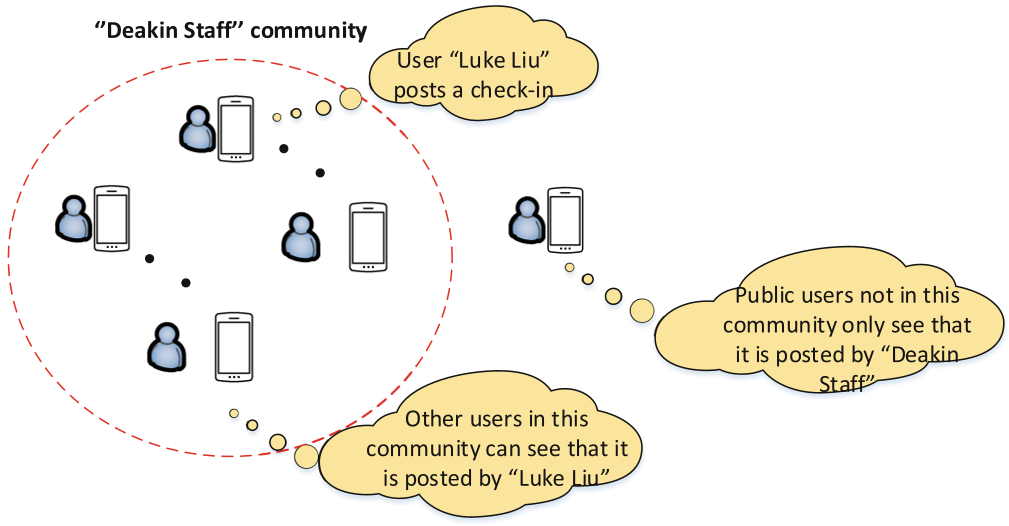 Fig 1: Illustration of the proposed information sharing scheme where public users only see the community identity.
Battle-Testing against SOTA Attacks
The researchers tested their defense against two primary attack vectors using real-world Gowalla data from New York:
- Cell-based Prediction: Dividing the world into a grid and finding the cell with the most activity.
- Clustering-based Prediction: Using hierarchical clustering to group night-time check-ins.
Results: From Precision to Confusion
The results were stark. When the community scheme was applied, the spatial features changed dramatically (measured by the shift in and parameters).
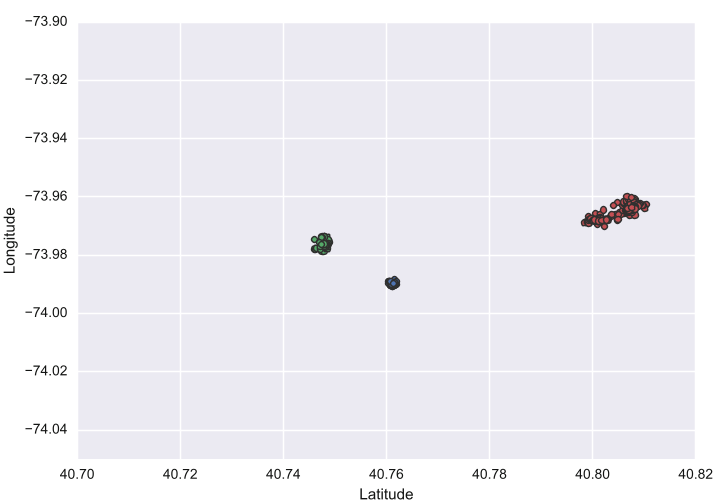 Fig 2: Visualization of how the scheme displaces the predicted "Home" (Red dots) far from the original prediction (Green dot).
The "Correctness" metric—essentially the error distance of the attacker—jumped significantly:
- Algorithm 1 Error: ~1,942 meters.
- Algorithm 2 Error: ~4,345 meters.
A 4-kilometer error margin in an urban environment like New York is the difference between identifying a specific apartment building and identifying an entire neighborhood, providing a massive boost to user privacy.
Critical Analysis & Conclusion
This paper offers an elegant, "socially-aware" solution to privacy. Instead of using raw noise (which breaks the utility of the app), it uses the naturally occurring structure of communities to hide individuals in plain sight.
Limitations: The study is a "Short Paper" and uses 2011-era Gowalla data. Modern LBSNs are more complex, often using continuous GPS streams rather than discrete "check-ins." Additionally, the effectiveness of the scheme depends on the size and density of the community; a community of 2 people provides virtually no protection.
The Takeaway: Privacy isn't just about encryption; it's about context. By shifting the "unit of sharing" from the individual to the community, we can maintain the "social" in social networks without surrendering our most private locations.