
Matrix-Based Homomorphic Hashing: Secure Smart Grid Authentication for Resource-Constrained Devices
Device authentication protocol for smart grid systems using homomorphic hash
This paper proposes an efficient mutual authentication protocol for smart grid Advanced Metering Infrastructure (AMI) using a matrix-based Homomorphic Hash Function (HHF). The method achieves lightweight communication between Smart Meters (SM) and Management Servers (MDMS), significantly outperforming ECDSA in execution speed for resource-constrained devices.
TL;DR
As the Smart Grid evolves, Advanced Metering Infrastructure (AMI) requires robust security that doesn't melt the modest "brains" of Smart Meters (SM). This paper introduces a mutual authentication protocol using matrix-based homomorphic hashes. By replacing heavy elliptic curve operations with linear algebra, it achieves faster-than-ECDSA performance while maintaining a security level suitable for sensitive energy data.
The Bottleneck: Why Your Smart Meter Can't Do RSA
A typical smart meter (like the MSP430F471) is a computational lightweight, often sporting a 16 MHz CPU and a mere 8 kB of RAM. Standard Public Key Infrastructure (PKI) solutions like RSA or ECDSA are "heavyweight" because they rely on expensive exponential operations or point multiplications.
While symmetric keys are fast, they often lack the structural flexibility needed for complex mutual authentication. Previous attempts to bridge this gap, such as HORS (Hash to Obtain Random Subset), suffer from "key bloat," requiring massive key chains that quickly exhaust a meter's limited flash memory.
The Core Insight: Exploiting Linear Map One-Wayness
The authors shift the cryptographic battlefield from exponentiation to linear algebra. Their approach relies on the properties of a Homomorphic Hash Function (HHF) defined by a non-square matrix :
Why is this secure?
- One-Wayness: Since is non-square (), it represents an under-determined system. Finding the original vector from the hash is computationally difficult because there are many possible solutions, and without the private basis (the "Seed"), an attacker cannot determine which one is correct.
- Homomorphism: This allows for mathematical verification of the hash without revealing the underlying secrets.
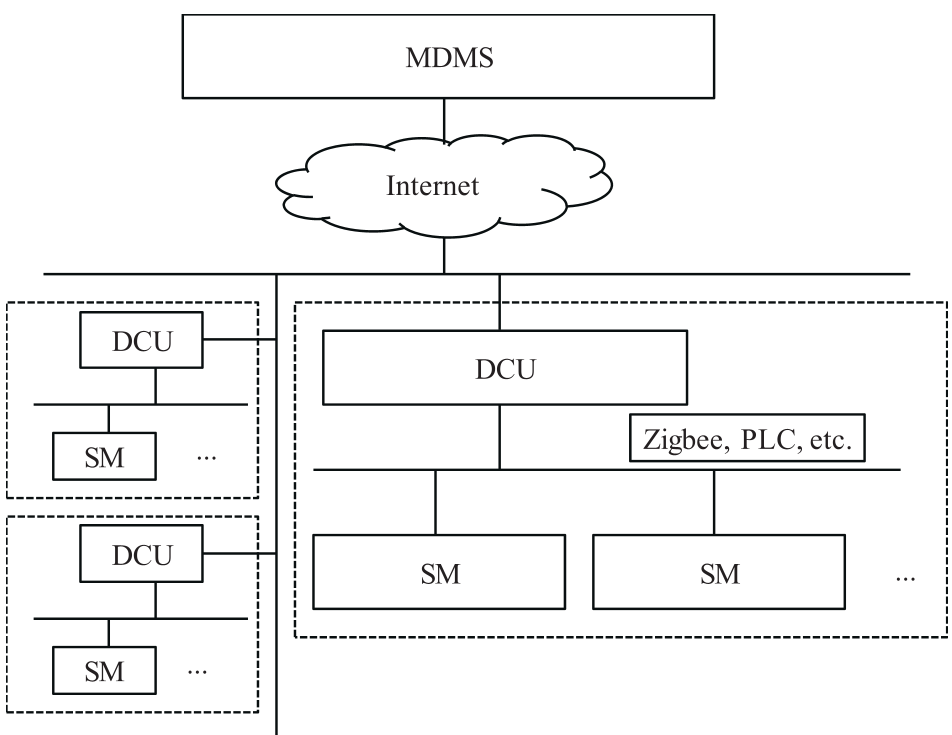 Figure 1: The AMI environment requiring secure, low-latency communication.
Methodology: Mutual Authentication Protocols
The paper proposes two protocols: Commitment and Challenge-Response. The highlight is the use of the Extract Coefficients Function (ECF).
In the Challenge-Response protocol, the server (MDMS) and the meter (SM) share a secret key . Authentication happens not by sending the key, but by proving that both parties can solve a linear combination of the shared basis to match a randomly generated challenge.
Maximizing Security through Parameters
The security depends on three parameters: (a large prime), (vector dimensions), and (hash dimensions). The authors mathematically prove that the "sweet spot" for maximum security occurs when: This balance ensures that neither the coefficient extraction nor the hash value collision becomes a weak link in the chain.
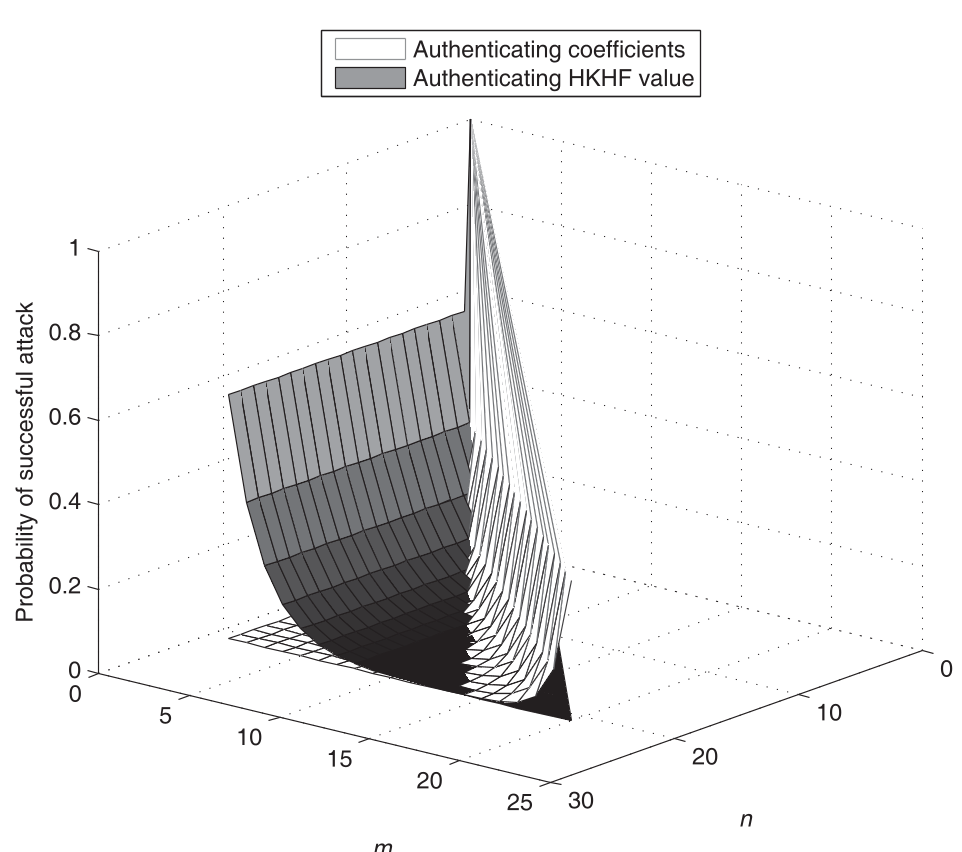 Figure 2: Analysis of success probability of attacks relative to parameters n and m.
Experiments: Speed vs. Memory
The performance evaluation highlights a clear trade-off. While the proposed method uses more memory than ECDSA (approx. 1920 bits for S&K vs. 1176 bits), it is drastically faster.
| Algorithm | Auth Generation (ms) | Auth Verification (ms) |
|---|---|---|
| ECDSA | 40.28 | 55.18 |
| HORS (One-time) | 0.61 | 1.43 |
| Ours (HKHF) | 0.65 | 0.65 |
While HORS is slightly faster, our matrix-based method avoids the "one-time" limitation, meaning devices don't need to constantly update and store massive key chains.
Critical Insight & Conclusion
This work demonstrates that for specific IoT use cases like the Smart Grid, structural properties of mathematics (homomorphism) are often more valuable than raw cryptographic "strength" if the latter comes at the cost of unusable latency.
Limitations: The security relies heavily on the secrecy of the seed and key distribution. If an attacker recovers enough challenge-response pairs, the matrix could eventually be solved via Gaussian elimination. However, for real-time authentication in a grid, the rotation of keys and the sheer scale of the system make this a robust alternative to aging PKI standards.
Future Outlook: We expect to see this "Linear Map Cryptography" expand into other areas of the "Internet of Energy," particularly for real-time power control where every millisecond of latency correlates to grid stability.