
Am I More Similar to My Followers or Followees? Deciphering Homophily in Directed Networks
Am I More Similar to My Followers or Followees? Analyzing Homophily Effect in Directed Social Networks
This paper investigates the homophily effect in directed social networks by analyzing whether a user’s personal preferences are more similar to their followers or followees. Using a massive dataset of 5 million Facebook fan pages, the study employs a homophily-based relational learning approach to predict attributes like political orientation and page category.
TL;DR
The adage "birds of a feather flock together" is a cornerstone of social science known as homophily. However, in the era of directed social media (where I can follow you without you following me back), the "flock" is asymmetric. This paper explores a fascinating question: If we want to guess your secrets, should we look at the people you follow (followees) or the people following you (followers)? Using 5 million Facebook fan pages, the authors find that while both are revealing, the "followees" list is generally a 4% more accurate crystal ball for your political leanings.
The "Directionality" Problem
Most research on social influence assumes a "friendship" model (undirected), where two people mutually agree to connect. But in platforms like Twitter or Facebook Pages, a link is often just a "one-way street."
The authors identify a critical gap: Does the "Similarity" effect hold when the relationship is unilateral? For example, a fan might feel similar to a famous author they follow, but the author likely doesn't share much in common with a random follower among millions.
Methodology: Measuring the Invisible Thread
The researchers used a two-pronged mathematical approach:
- Homophily Calculation: Using a Kronecker delta-based similarity index (), they measured the overlap of attributes between a user and their neighbors, then divided this by the expected similarity of two random users ().
- Relational Learning: They used a Weighted Majority Vote algorithm. To predict a user's political orientation, the model "asks" all their neighbors and picks the most common answer.
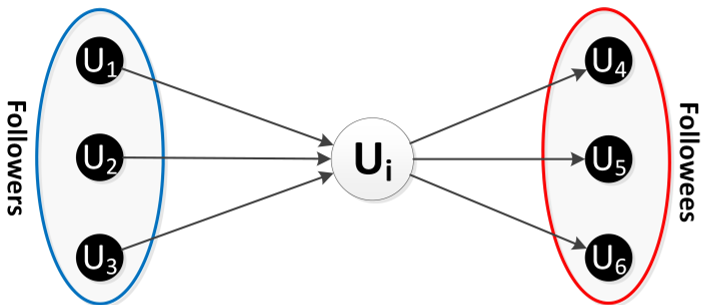 Figure 1: Distinguishing between outgoing links (Followees) and incoming links (Followers) in preference prediction.
Key Insight: The Popularity Paradox
One of the most profound findings is how popularity changes the "source of truth."
- For "Normal" Users (Non-popular): They are actually more similar to their followers. Why? Because followers usually have a very specific reason to follow a low-profile account, whereas the account owner might follow a wide, diverse range of celebrities/pages.
- For "Celebrities" (Popular): They are more similar to their followees. Popular users are very selective about who they follow, making their "Following" list a high-quality reflection of their personal tastes.
 Table 1: Percentage of political orientation similarity across different popularity levels.
Experimental Results
The study focused on two main attributes: Political Orientation and Page Category.
- Political Prediction: Using only "Followees" yielded 77% accuracy. Including both followers and followees actually drilled down the accuracy slightly (to 74%), suggesting that "Followers" can sometimes act as noise in the prediction for high-profile accounts.
- Diversity and Entropy: The authors found that "Followees" tend to be more diverse (higher entropy) than "Followers," yet they remain a more accurate predictor of the target user's identity.
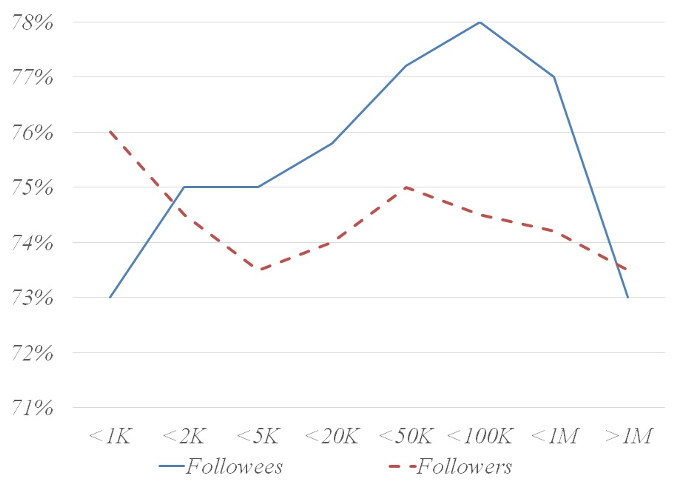 Figure 2: Analysis of neighbor diversity using entropy.
Critical Perspective & Conclusion
This paper serves as a stark warning for digital privacy. It proves that a user's identity is not an island; it is defined by the edges of the network. Even if you hide your profile, the "collective intelligence" of your social circle—those you look up to and those who look up to you—provides enough signal for algorithms to map your preferences with high precision.
Limitations: The study is based on 2014-era Facebook data. Today’s algorithmic feeds (like TikTok’s "For You" page) might introduce even more noise or different homophily dynamics that weren't present in static "following" architectures.
Takeaway: If you are a casual user, your followers know you better. If you are a social media star, your followees are the true reflection of your soul.