
Beyond "Birds of a Feather": How Homophily Evolves in Online Student Networks
Homophily Evolution in Online Networks: Who Is a Good Friend and When?
This paper investigates the temporal evolution of homophily in a student online friendship network on Vkontakte. It utilizes the assortativity index and CUG-tests to demonstrate how tie-formation mechanisms shift from individual attributes (gender, academic scores) to institutional affiliations (study groups) as the network matures.
TL;DR
Is a "good friend" someone like you, or someone in your class? This study reveals that the answer changes depending on when you ask. By tracking university freshmen on Vkontakte, researchers found that students pivot from choosing friends based on gender and talent to choosing them based on study group proximity as they face the "information shock" of starting university.
Background: Static vs. Dynamic Homophily
Homophily—the tendency to associate with similar others—is the "gravity" of social science. While we know that demographics (race, age) drive connections, most research treats these as static constants. This paper argues that homophily is not a fixed state but a dynamic strategy. In a new social environment, the "optimal" type of similarity shifts to serve different functional needs.
The "Strategy" of Friendship: Comfortable vs. Informational
The authors propose a fascinating two-stage logic for network growth:
- The Comfortable Environment: Before classes start, students seek "look-alikes" (gender, high exam scores) to lower the social friction of the unknown.
- The Information Environment: Once the term begins, the need for survival information (exam dates, seminar notes) overrides personal preference, driving a massive surge in group-based connections.
Methodology: High-Frequency Snapshots
The researchers tracked 97 Economics students across 13 waves (roughly weekly) using the Vkminer tool to pull API data. This high granularity allowed them to capture the exact moment the network "exploded" in density.
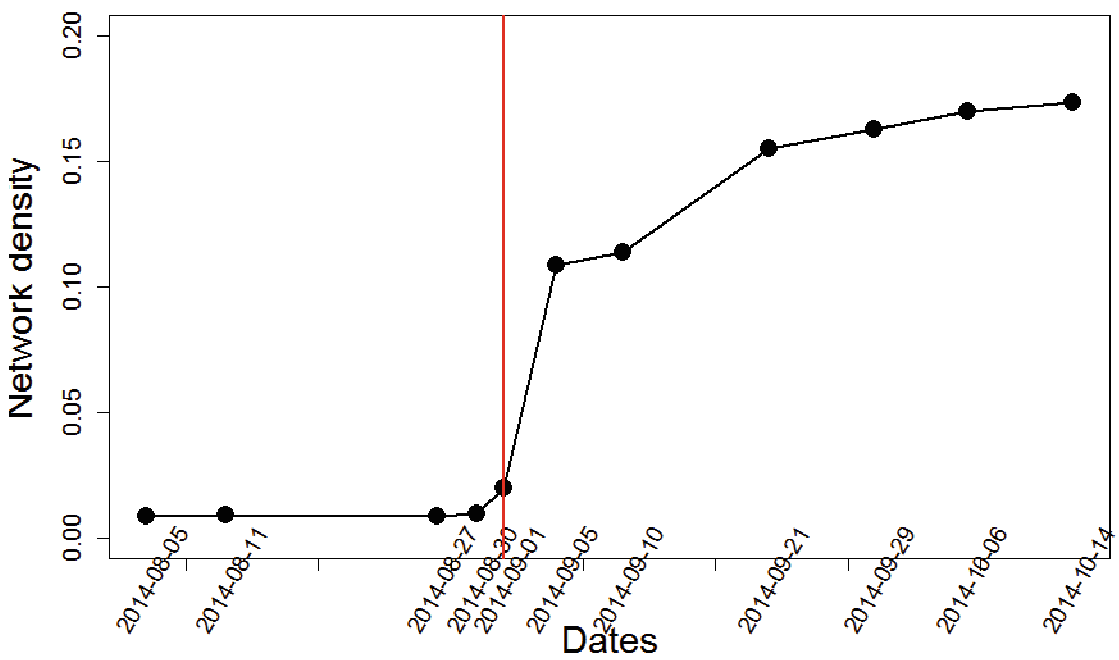 The figure illustrates the dramatic spike in network density starting September 1st, the official beginning of the school year.
To quantify similarity, they used the Assortativity Index (): Positive values indicate that "like links with like."
Key Results: The "Group Spike"
The data revealed a striking reversal of priorities:
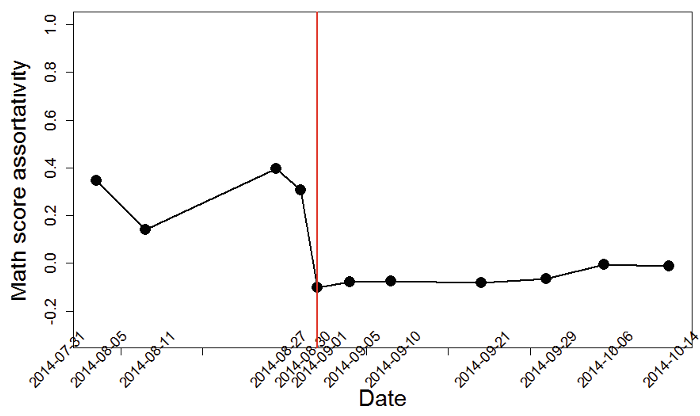
- Pre-September 1st: Gender homophily was high. Students were essentially reaching out to people who felt "safe."
- Post-September 1st: As seen in the chart below, Group Assortativity (similarity in study group) skyrocketed. Simultaneously, gender and exam-score homophily dipped, suggesting that students were willing to bridge demographic gaps to gain access to their immediate academic circle.
 Note the sharp climb in Group Assortativity (Fig 4) as the school year begins, overshadowing individual traits.
Critical Insights & Takeaways
- Rationality in Networking: Freshmen exhibit "rational network behavior." They prioritize information exchange channels (study groups) when the environment is new and uncertain.
- Functional Redundancy: The study suggests that once an information environment is established (by mid-October), students return to seeking "comfortable" similarity. The group homophily levels off because the necessary channels have already been built.
- Limitations: The sample is small (97 students) and limited to a single department. Future work should investigate if these "bursts" of homophily occur in more diverse, non-academic environments like new workplaces or online gaming communities.
Conclusion
This work challenges the idea that homophily is a stable trait of a social system. Instead, it frames friendship as a tool for navigation. We don't just befriend people because they are like us; we befriend them because, at that specific moment in time, they are the "right" people to help us navigate our world.