
HSCA: Bridging Homophily and Content for Superior Network Embeddings
Homophily, Structure, and Content Augmented Network Representation Learning
The paper introduces HSCA (Homophily, Structure, and Content Augmented NRL), a novel network representation learning framework that integrates three vital information sources: social homophily, global structural context, and node content. It utilizes a regularized matrix factorization objective to outperform SOTA methods in multi-class node classification, particularly in sparse labeling scenarios.
TL;DR
HSCA (Homophily, Structure, and Content Augmented) is a next-generation NRL algorithm that doesn't just look at who is connected to whom. By mathematically enforcing the "birds of a feather flock together" principle (homophily) alongside rich node text and global topology, it sets a new benchmark for node classification, especially when labeled data is extremely scarce.
The "Missing Link" in Network Embedding
In the world of Information Networks (citation graphs, social media), we usually have three streams of data:
- Homophily: Local relational ties between similar individuals.
- Structural Context: Global roles and community memberships.
- Node Content: The actual data (text, attributes) within each node.
Previous SOTA methods like DeepWalk focus on the global structure (random walks), while TADW adds text features. However, they neglect the explicit enforcement of homophily in the learned space. The authors of HSCA argue that if two nodes are connected, they must stay close in the embedding space, not just because of shared neighbors, but because the connection itself is a signal of similarity.
Methodology: The HSCA Framework
HSCA builds on the insight that DeepWalk is equivalent to Matrix Factorization (MF). The authors reformulate NRL as an MF problem but add a critical Laplacian Regularization term.
1. The Core Objective Function
The objective function minimizes the gap between the target proximity matrix and the factored product , while simultaneously penalizing the distance between connected nodes in the projected space.
2. Strategic Interplay
By solving for (structure) and (content weight) iteratively, the model ensures that:
- Nodes with similar structural context are close.
- Nodes with similar content are close.
- Crucially: Connected nodes are forced to be close via the term .
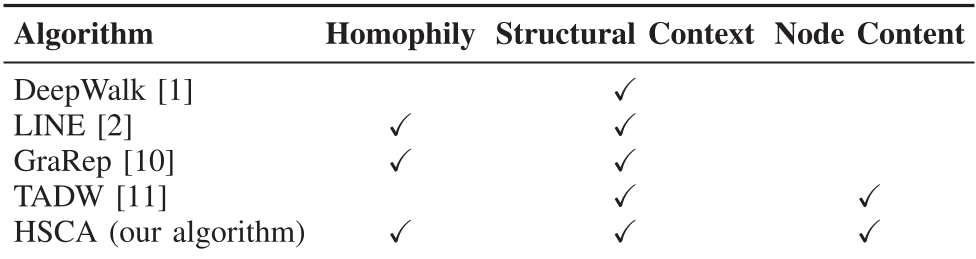 Table 1: How HSCA stacks up against prior work by integrating all three information sources.
Performance in Sparsity
One of the most impressive feats of HSCA is its resilience to sparse labeling. In experiments where only 1% to 10% of the nodes were labeled, HSCA outperformed baseline models like LINE and GraRep by significant margins.
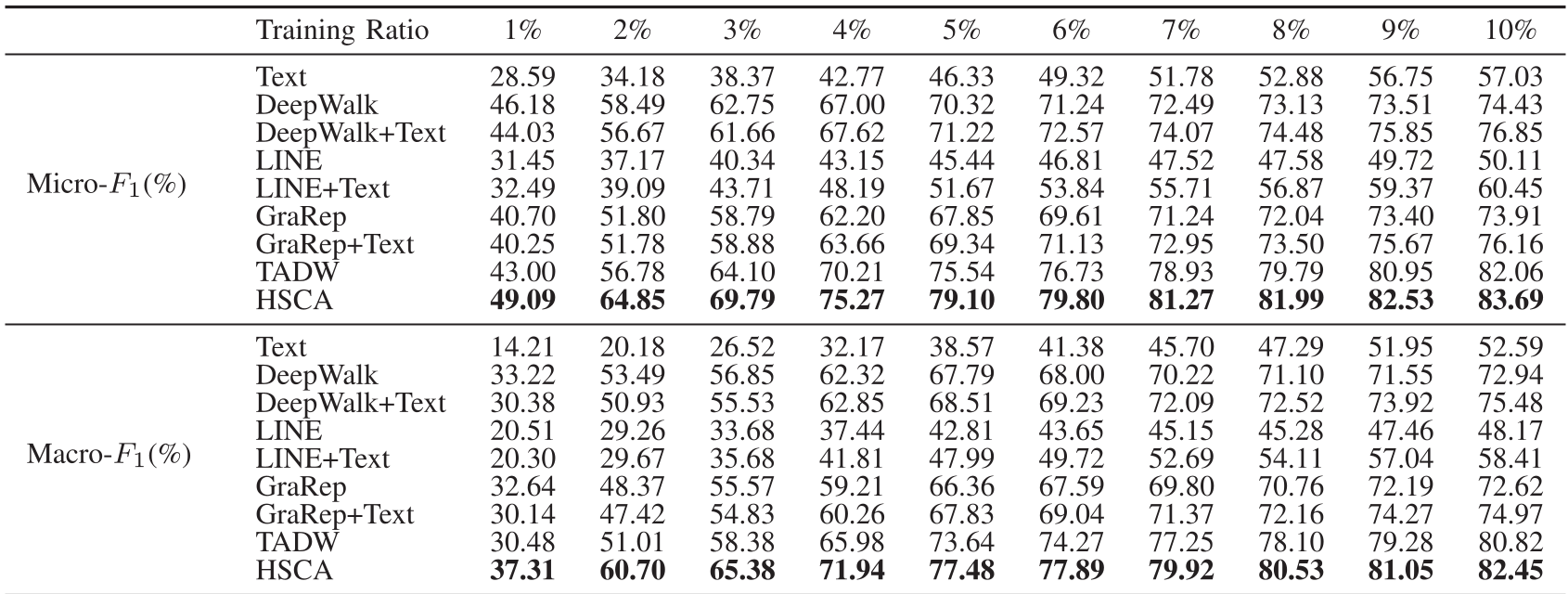 Experimental results showing HSCA (bottom row) achieving the highest Micro-F1 and Macro-F1 across different training ratios.
Visualizing the Advantage
Using t-SNE to project the high-dimensional embeddings into 2D, the difference becomes clear. While DeepWalk creates loose clusters and TADW improves separation using text, HSCA creates tight, highly discriminative clusters.
 Visual comparison: (a) DeepWalk, (b) TADW, and (c) HSCA. Note how HSCA achieves much clearer class separation.
Efficiency and Convergence
Despite the added complexity of the homophily regularization, the authors derived an efficient solution using Conjugate Gradient (CG) methods. The algorithm converges remarkably fast, usually within 5 iterations, making it practical for large-scale networks like PubMed (~20k nodes).
Conclusion
HSCA proves that for Network Representation Learning, the whole is greater than the sum of its parts. By explicitly modeling the interplay between homophily, structure, and content, it provides a more nuanced and powerful representation. For practitioners working with sparse graphs or limited labels, HSCA offers a robust architectural template that moves beyond simple topology.