
HorNet: Reclaiming Social Media through Contributory Decentralization
HorNet: Microblogging for a Contributory Social Network
HorNet is a decentralized microblogging platform built on the CoDeS middleware, utilizing user-contributed computing resources to eliminate central control. It achieves scalability and high availability by decomposing social networking functions into small, replicated services managed via a structured overlay network.
TL;DR
HorNet is a decentralized microblogging architecture that replaces central servers with the collective, underutilized power of its users' home computers. By utilizing the CoDeS middleware, it breaks down a social network into small, replicated services, ensuring that your feed stays online even when individual nodes drop out—requiring as little as 0.31 Kbps of bandwidth from participants.
Background & Motivation: The Centralization Trap
Modern social discourse is held hostage by centralized platforms. Whether it is algorithmic censorship, governmental bans, or the mass harvesting of private data for third-party profiling, the "single point of control" model is inherently fragile.
The authors argue that the scientific community's volunteer computing model (like SETI@home) proves that users are willing to contribute idle CPU and bandwidth. HorNet applies this logic to social networking, addressing the primary flaw of earlier P2P social networks: availability. In traditional P2P, if the user who posted a message goes offline, the message disappears. HorNet ensures the network outlives its individual parts.
Methodology: The Three-Tier Architecture
HorNet’s brilliance lies in its decomposition. Instead of treating a user's profile as a single block of data, it treats the network as a set of distributed services.
1. The Layered Design
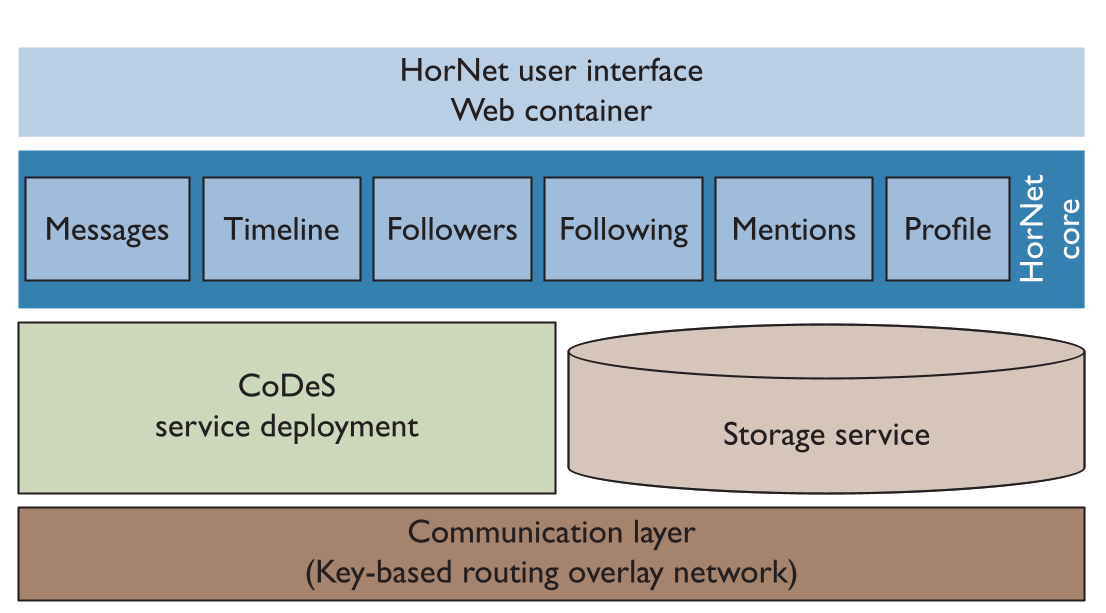
The system is organized into three distinct layers:
- Communication Layer: Uses Key-Based Routing (KBR) and Distributed Hash Tables (DHT) to connect heterogeneous domestic computers.
- Middle Layer (CoDeS): This is the "brain" that manages service deployment, monitoring, and automatic replication when nodes leave the network.
- Upper Layer (HorNet Services): For every user, six specific services (Messages, Timeline, Followers, Following, Mentions, and Profile) are deployed across the community.
2. Ensuring Availability via CoDeS
To solve the "churn" problem (domestic computers frequently logging on and off), HorNet calculates a replication factor based on the desired system availability (e.g., 99.99%) and the average uptime of participant hosts. If a Service Manager (SM) node fails, the DHT layer automatically redirects responsibilities to a neighbor node, ensuring near-instant recovery.
Experiments: Beyond "Proof of Concept"
The authors didn't just build a prototype; they stress-tested the math behind the community’s resources.
Performance Benchmarks
In a simulated environment, HorNet achieves speeds comparable to centralized Web 2.0 apps:
- Message Delivery: 3.66s (99th percentile).
- Feed Retrieval: 1.9s for the last 20 messages.
The "Greenpeace" Stress Test
The study analyzes a high-demand scenario where an organization with millions of followers needs to broadcast. Interestingly, even in this extreme case, the required upload rate for a message service is only ~30.9 Kbps—well within the limits of standard 2010s-era home broadband.
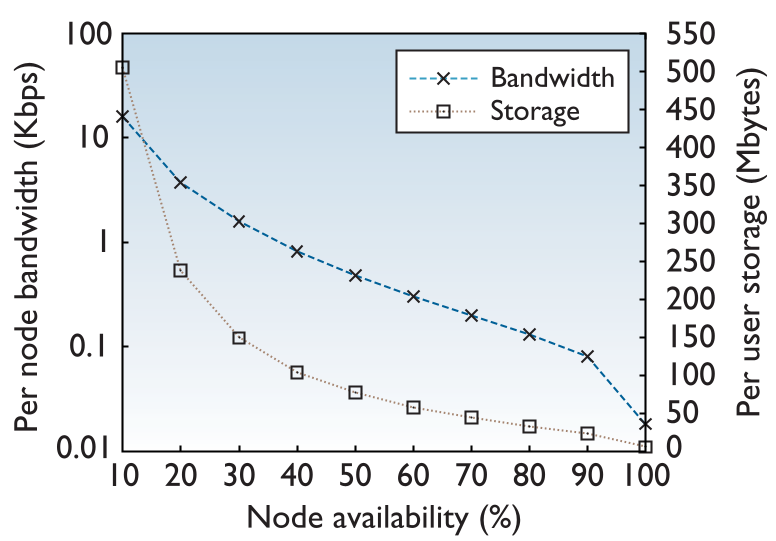 Figure: Disk and bandwidth requirements scale predictably with host availability, proving that a contributory network is physically feasible with modern infrastructure.
Critical Analysis & Conclusion
Takeaway
HorNet proves that we don't need "Big Tech" server farms to run a global social network. By leveraging the same idle resources used for web browsing, we can maintain a censorship-resistant, privacy-preserving microblogging service.
Limitations
- Cold Start & Bootstrapping: The system requires a "minimal user commitment" to maintain a baseline of resources. A small community might suffer from high latency.
- Storage Sophistication: The current implementation uses simple file-based storage. Future iterations would need robust, encrypted distributed databases to handle truly massive scale.
- Incentives: While the paper assumes "contributory" altruism, real-world protocols (like those in the Web3 space) may need tokenized incentives to ensure nodes stay online.
Future Outlook
As privacy becomes a premium commodity and centralized platforms continue to fragment, architectures like HorNet offer a roadmap for "community-owned" infrastructure. The transition from Java-based prototypes to lightweight mobile and browser-based nodes could make this the foundation for the next generation of social media.