
Predictive-Social: Re-imagining Hot Set Identification for the Social Media Era
Hotsetidentificationforsocialnetworkapplications
The paper introduces a novel approach for "Hot Set Identification" in social networks using a hybrid algorithm called Predictive-Social (PS). It combines time-series forecasting (EWMA) with social graph metrics (user connection degrees) to identify resources likely to receive the most traffic.
Executive Summary
TL;DR: This paper tackles the challenge of identifying "Hot Sets"—the small group of resources that attract the majority of user requests—within the volatile environment of social networks. The authors propose a hybrid Predictive-Social algorithm that integrates historical access forecasting with social influence metrics, achieving a 30% accuracy boost over traditional methods and maintaining exceptional robustness against rapid workload fluctuations.
Context: This work transitions hot set identification from traditional static Web patterns to the dynamic, relationship-driven world of modern social platforms like Flickr, YouTube, and blogs.
Problem & Motivation: The Failure of Traditional Caching
In traditional Web systems, popularity changes slowly. You could simply look at what was popular yesterday to guess what will be popular today. However, social networks break this logic:
- High Churn: Thousands of new uploads every hour create a "short lifespan" for content.
- Social Vectors: Users don't just browse; they follow social links. A video's popularity is often a function of who posted it rather than just its content.
- High Variability: Traffic surges can happen minutes after an upload, making purely reactive statistics (Existing Algorithms) obsolete and "noisy."
Methodology: Fusing Time and Influence
The core innovation lies in the Predictive-Social (PS) class of algorithms. The researchers realized that neither history nor social rank is sufficient on its own.
1. The Predictive Pillar (Temporal)
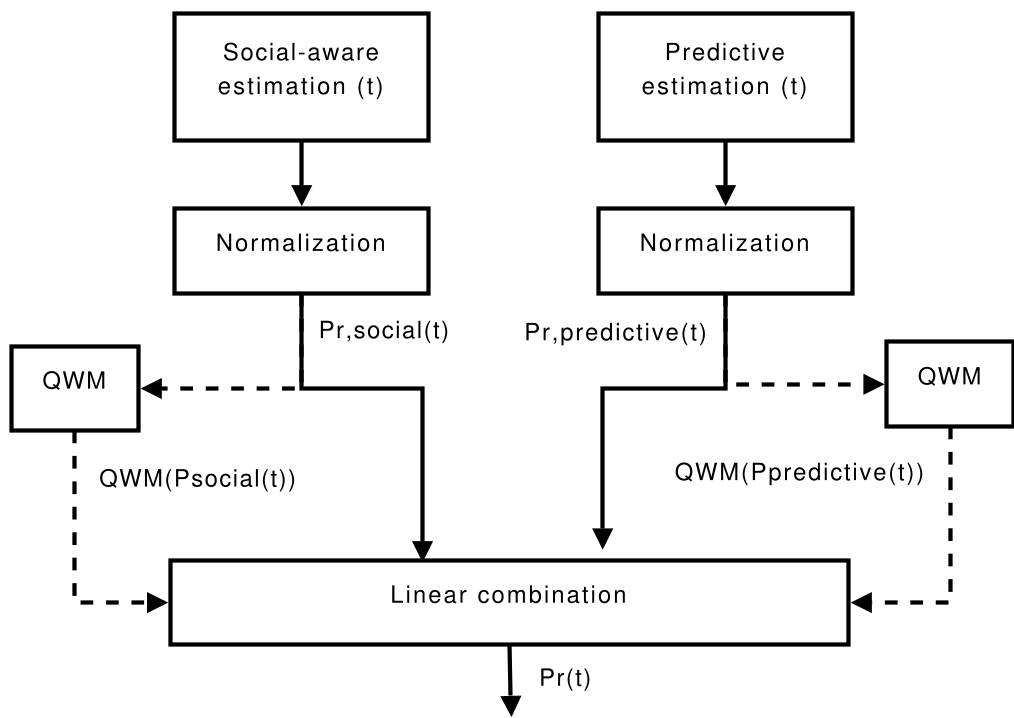
Instead of just counting past hits, they treat accesses as a time series. Using Exponential Weighted Moving Average (EWMA), the model gives more weight to recent data while retaining a "memory" of older observations to filter out random spikes.
2. The Social Pillar (Structural)
They introduce a Social-aware metric based on the "Connection Degree" (number of reverse contacts) of the user who uploaded the resource. The intuition is simple: resources from high-influence users are statistically more likely to go viral.
3. The Fusion: PS-Quartile
The real magic happens in the fusion. Because access counts and social degrees follow different heavy-tailed distributions, simple averaging doesn't work. The authors use the Two-sided Quartile-Weighted Median (QWM) to normalize and weigh these metrics dynamically.
Experiments & Results
The authors used the Omnet++ framework to simulate a social system with 20,000 users and varying "upload percentages" (representing interactivity).
SOTA Comparison
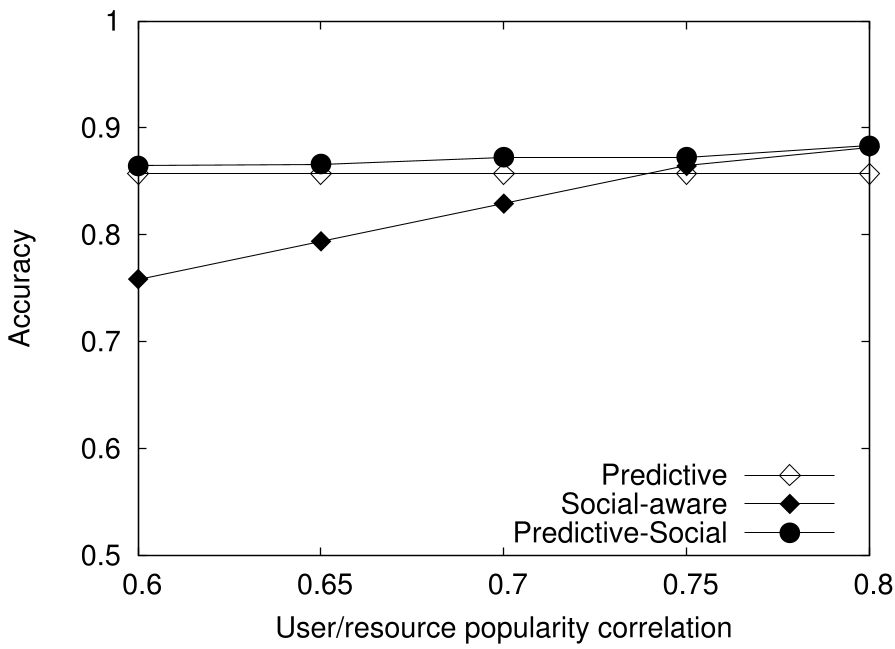
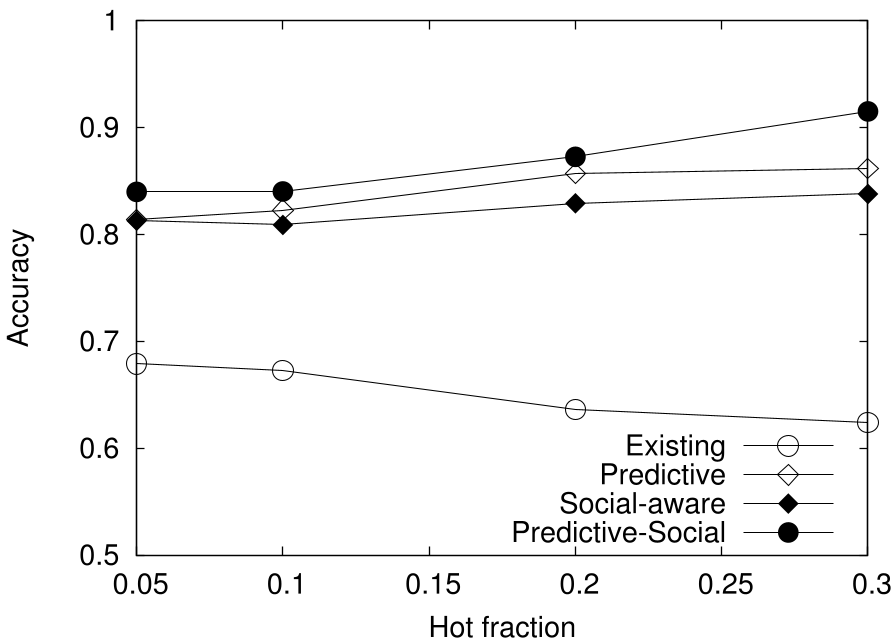
As shown in the performance charts, the Predictive-Social algorithm consistently outperforms both standalone Predictive and standalone Social models across all hot set sizes (Hot Fractions).
Robustness to Upload Surges
One of the most impressive findings is the algorithm's stability. While traditional "Existing" algorithms see their accuracy plummet as the number of user uploads increases (due to high noise), the Predictive-Social approach remains nearly flat, proving its resilience to the "noise" of a highly interactive social platform.
Critical Analysis & Conclusion
Takeaway
The Predictive-Social approach demonstrates that context is king. By understanding the social graph (the source of the content), the system can "look around the corner" and predict hits before the first request even arrives.
Limitations
- Data Privacy: Social-aware algorithms require access to user connection data, which might raise privacy concerns or be restricted by platform APIs.
- Computational Overload: While EWMA is light, calculating the connection degree for every uploader in real-time across billions of users might require secondary indexing or approximation in a production-scale environment (e.g., Facebook or X/Twitter).
Future Outlook
This work lays the foundation for "Context-Aware CDNs." Future iterations could potentially include Sentiment Analysis or Topic Trends from the content itself to further refine the hot set, moving closer to a 100% accurate "Crystal Ball" for web resources.