
The Economics of Attention: Optimizing Information Flow in Social Networks
How to Optimally Allocate Your Budget of Attention in Social Networks
This paper investigates information propagation in social networks where users have a limited "attention budget" for pulling content from neighbors. It characterizes the efficiency of selfish attention allocation versus socially optimal strategies across various topologies, utilizing average propagation delay as the primary metric.
TL;DR
In our digital age, attention is the scarcest resource. This paper explores a fundamental trade-off: when users selfishly decide how to allocate their limited "pull" frequency (how often they check friends for updates), does the whole network suffer? By analyzing different graph structures, the authors reveal that while well-connected cliques handle selfishness well, tree-like structures collapse into inefficiency—unless a "Plus-One" incentive system is introduced to align individual actions with the common good.
The Attention Bottleneck: Why Selfishness Fails
Most classical models of "rumor spreading" treat nodes as passive entities. This paper flips the script by introducing the Budget of Attention. Imagine you can only check your social feeds 10 times an hour. If you have 50 friends, how do you split those 10 "checks"?
The authors find that users generally minimize their own delay. However, what is good for the individual is often catastrophic for the network's global speed (the Price of Stability). The core problem is that a selfish user doesn't care if they are a vital bridge for others; they only care about how fast they get the news themselves.
Methodology: From Cliques to Trees
The study categorizes networks into three distinct archetypes based on their efficiency:
- Efficient (Cliques & Expanders): High connectivity means many paths exist. Even a uniform or selfish allocation results in fast propagation.
- Inefficient Amenable (k-ary Trees): Sparse but structured. Selfishness leads to massive delays, but the potential for efficiency is there if nodes cooperate.
- Inefficient Suboptimal (Lines & Chained Stars): These "stretched" topologies are doomed by their geometry; even the best possible allocation results in high delays.
Theoretical Framework
The authors define the social cost as the average expected delay for all content to reach all users. They mathematically derive the optimal allocation and compare it to the Nash Equilibrium .

The "Plus-One" Solution
To fix the "Inefficient Amenable" networks, the authors propose the Plus-One mechanism.
- The Logic: Every time you receive a "useful" (first-arrival) piece of info, you send a virtual "+1" back to the neighbor you got it from.
- The Result: This +1 propagates back to the source. Nodes that receive many +1s realize they are "critical relays" and receive an incentive to allocate more attention to that path.
This mechanism effectively implements a Distributed Stochastic Gradient Descent. Users adjust their attention rates based on these incentives, moving the network toward the global social optimum.
Experimental Validation
The simulations confirm the theory with striking clarity.
 In a ternary tree, the Plus-One mechanism (bottom curves) converges to the social optimum, whereas selfish optimization (middle curve) remains significantly higher.
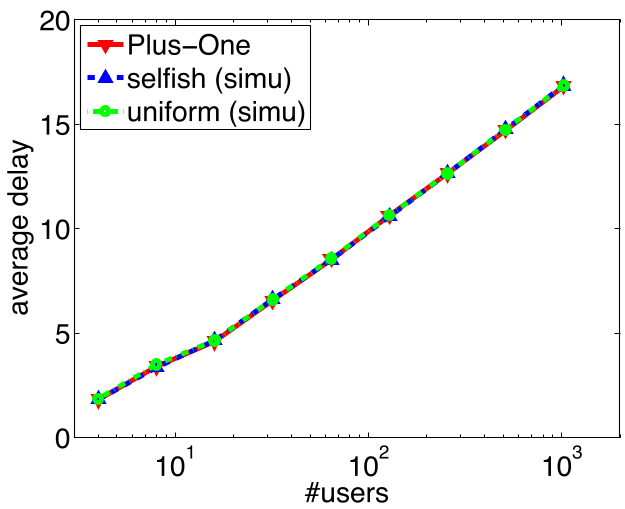
In the Line network, the delay grows linearly with size, confirming its status as "suboptimal." Conversely, in a 3-regular random network (an Expander), the differences between selfish, uniform, and Plus-One strategies are negligible—the topology itself enforces efficiency.
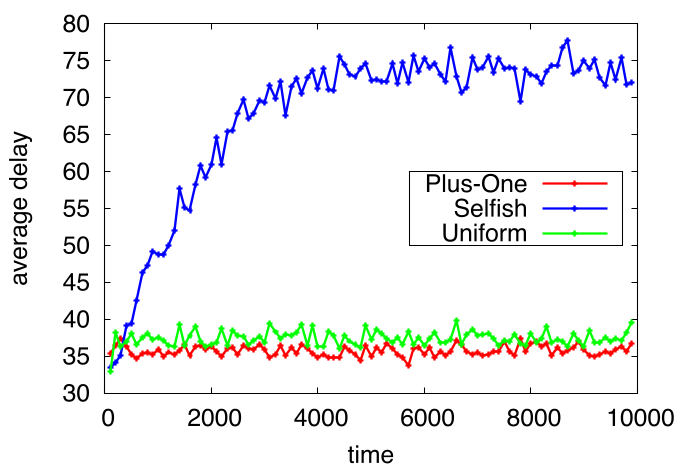 Fig 3 highlights the gap in tree networks: Selfish behavior (triangles) scales much worse than the Plus-One incentive (circles).
Critical Analysis & Future Outlook
The beauty of this work lies in its classification of "amenability." It suggests that as network architects, we don't always need to change the rules—sometimes we just need to change the links.
Limitations: The model assumes everyone wants all information. In reality, interest is heterogeneous. Future work should explore how "communities of interest" change the attention budget dynamics.
Takeaway: If your network is a "tree," you need incentives (like Klout scores or reputation). If your network is a "clique," you can let users be as selfish as they want; the math will handle the rest.