
EDL-LBCNN: Capturing the Nuance of Mixed Human Emotions through Label Distribution Learning
Human Emotion Distribution Learning from Face Images using CNN and LBC Features
The paper introduces EDL-LBCNN, a deep learning framework for Label Distribution Learning (LDL) in human emotion recognition. It combines a 4-layer CNN with a Local Binary Convolutional (LBC) layer to capture both global spatial features and local texture information, achieving SOTA results on the s-JAFFE dataset.
TL;DR
Most AI models try to force a human face into a single "box" like Happy or Sad. However, real emotions are a cocktail of intensities. This paper presents EDL-LBCNN, a framework that uses Label Distribution Learning (LDL) and Local Binary Convolutional (LBC) layers to map facial expressions to a full probability distribution of emotions, achieving superior accuracy and generalization over previous statistical methods.
The Problem: Emotions aren't "Pure"
In the realm of computer vision, we usually treat classification as a winner-takes-all game (Single-Label Learning). But as the authors point out, there is no such thing as a "pure" emotion. An expression can be 70% "Surprise" and 30% "Happiness" simultaneously.
Previous attempts at solving this via Label Distribution Learning (LDL) suffered from two main flaws:
- The Generalization Gap: They relied on Maximum Entropy models that imposed strict hypotheses on the data distribution, which often failed on unseen samples.
- Ignoring Texture: They focused heavily on label correlations but ignored the fine-grained texture (like micro-wrinkles or skin tension) that signals emotional intensity.
Methodology: Fusing Global Context with Local Texture
The core innovation of EDL-LBCNN (Emotion Distribution Learning by LBC and CNN) lies in its two-stream architecture. Instead of relying solely on standard Convolutional Neural Networks (CNNs), the authors integrated a set of non-trainable, fixed filters.
1. The LBC Stream (The Texture Expert)
The LBC layer is inspired by Local Binary Patterns (LBP). It uses eight fixed 3×3 filters that compute the difference between a central pixel and its neighbors.
- Why this works: By using fixed weights (), the model captures fundamental texture patterns without the risk of overfitting during the early stages of training. It then uses a small set of learnable parameters (1x1 convolutions) to merge these patterns into 32 distinct feature maps.
2. The CNN Stream (The Spatial Expert)
A 4-layer traditional CNN extracts high-level spatial features. These are combined with the LBC texture maps to provide a holistic view of the face.
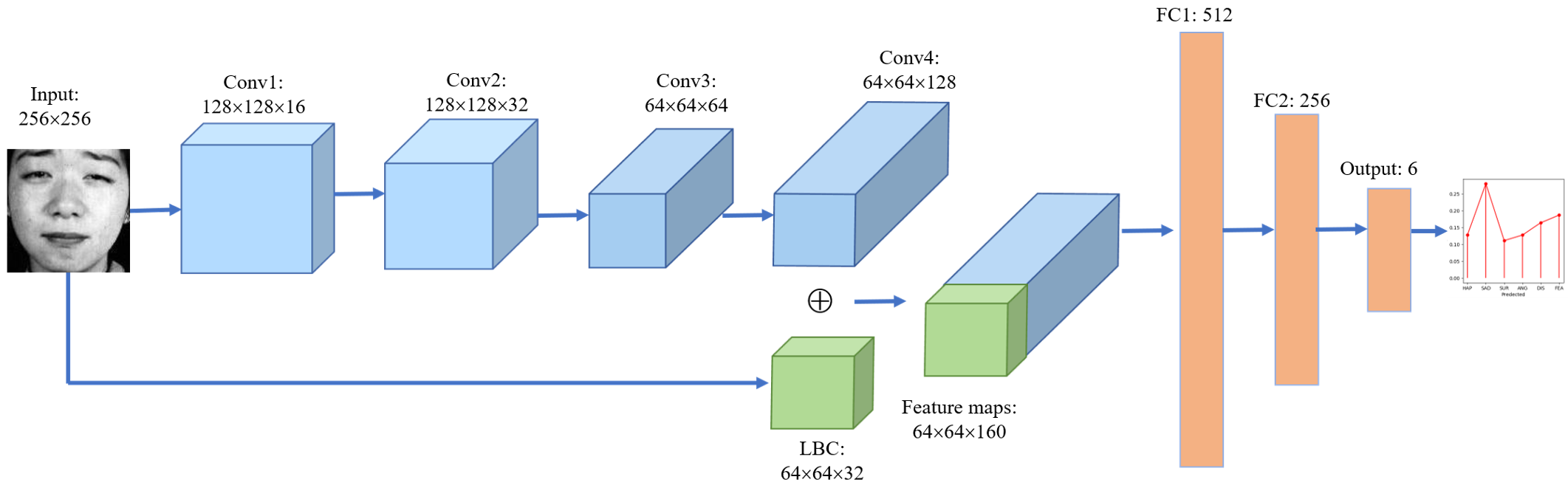
3. The Objective Function
The network is trained using KL Divergence as the loss function. This ensures that the distance between the predicted emotion vector and the human-labeled ground truth distribution is minimized.
Experimental Results: Setting New Benchmarks
The researchers tested the model on the s-JAFFE dataset—a version of the classic Japanese Female Facial Expression dataset specifically re-annotated for distribution learning.
SOTA Comparison
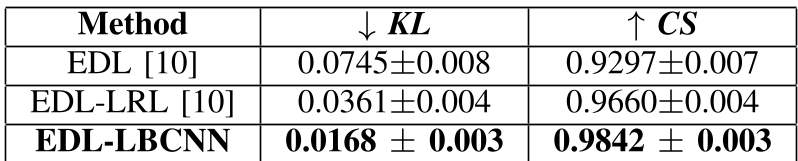
Compared to the previous state-of-the-art method (EDL-LRL), the EDL-LBCNN achieved a massive performance jump:
- KL Divergence (Lower is better): Dropped from 0.0361 to 0.0168 (a >50% improvement).
- Cosine Similarity (Higher is better): Increased to 0.9842.
Insight: The Role of Facial Landmarks
Interestingly, the authors found that while facial landmarks (geometric points) help in tasks like facial attractiveness estimation, they actually hindered performance slightly in emotion distribution learning (as seen in Table I: Architecture 4 vs. Architecture 3). This suggests that for emotions, raw texture and spatial features are more informative than rigid geometric points.
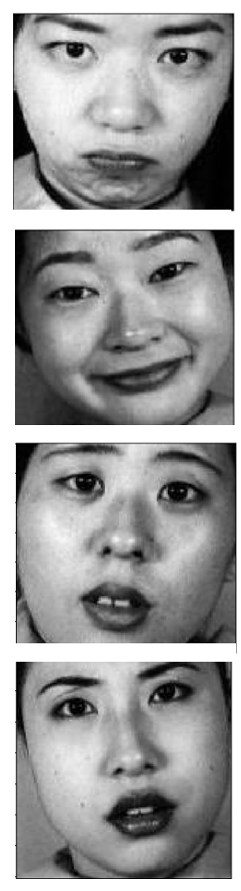 Figure: The model excels at clear expressions (a, b) but struggles slightly with neutral or ambiguous faces (g, h).
Critical Analysis & Conclusion
The EDL-LBCNN framework proves that Label Distribution Learning is a far more natural fit for human-centric AI than simple classification. By incorporating LBC layers, the authors successfully balanced the need for complex feature extraction with the need for computational efficiency and generalization.
Takeaway: If you are working on ambiguous or subjective datasets (emotions, aesthetics, age), moving from "labels" to "distributions" while favoring texture-based features could be your key to the next performance breakthrough.
Limitations: The model still faces challenges with "neutral" expressions where the emotion distribution is nearly uniform. Future work might benefit from combining this approach with Temporal/Video data to see how these distributions shift over time.