
The Architecture of Trust: A Theory of Adjustable Social Autonomy
10684_The human in the loop of a delegated agent the theory of adjustable social autonomy.
The paper introduces the "Theory of Adjustable Social Autonomy," a framework for dynamic task allocation in Multi-Agent Systems (MAS). It defines autonomy not as a static property, but as a flexible variable adjusted through delegation, help, and trust, establishing the core foundations for Human-In-The-Loop (HITL) and agent-agent collaboration.
TL;DR
This seminal work by Rino Falcone and Cristiano Castelfranchi moves beyond seeing autonomy as a simple dial. They present a rigorous cognitive framework where autonomy is dynamically negotiated through Delegation and Adoption. By viewing the agent-user relationship through the lens of trust and control, the paper explains not just how agents can be autonomous, but why and when that autonomy should expand or contract.
Background: The Paradox of Autonomy
Modern AI aims for intelligent collaborators, not just tools. However, a "passively obedient" agent is limited by the user's localized knowledge, while a fully autonomous agent is a "risky" liability. The authors argue that the solution lies in Adjustable Social Autonomy, allowing for run-time shifts in who decides what, governed by a "Human-in-the-Loop" architecture.
Problem & Motivation: Why Static Delegation Fails
Traditional Multi-Agent Systems (MAS) often view delegation as a "one-and-done" command. In reality, collaboration is fluid.
- Expertise Gap: Often, the delegee (agent) has better local information/reactivity than the delegator (user).
- Cognitive Reliance: A user relies on an agent because they cannot or do not want to perform the task themselves.
- Trust Crisis: Misunderstandings or environmental shifts require immediate adjustments to the "leash" length of the agent.
Methodology: The Three Dimensions of Delegation
The core of the paper is a three-dimensional Cartesian space where autonomy increases as you move toward the origin.
1. Interaction-Based Strength
- Weak Delegation (Exploitation): Exploiting an agent's behavior without its knowledge.
- Mild Delegation (Induction): Influencing an agent to do something.
- Strong Delegation (Agreement): Explicit social commitment between parties.
2. Specification-Based Openness
- Close Delegation: The agent follows a strict script (low autonomy).
- Open Delegation: The agent is given a goal/result and must plan the path (high-realization autonomy).
3. Control-Based Monitoring
Autonomy is inversely proportional to control. The authors define control as Feedback (Monitoring) + Intervention.
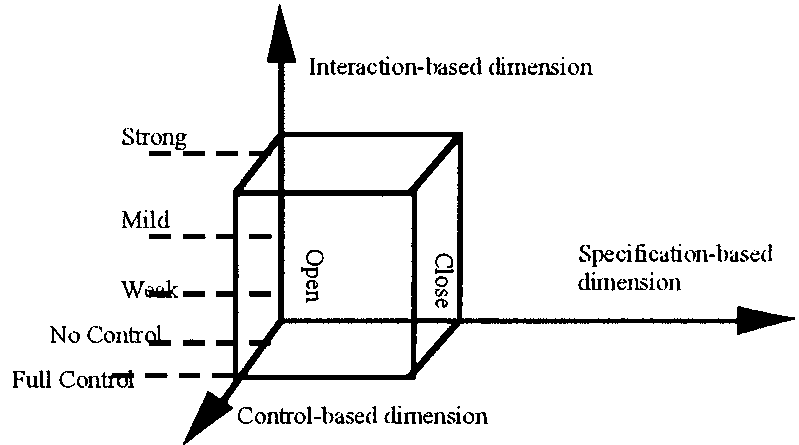 Figure 1: The solid volume represents the space where delegation and autonomy vary across Interaction, Control, and Specification.
The Bilateral Nature of Adjustment
A breakthrough insight in this paper is that adjustment is bilateral. It is not just the human "master" curbing the agent; the agent itself can take initiative:
- Extension of Help: The agent does more than asked because it sees a better way to achieve the user's goal.
- Critical Help: The agent realizes the user's request is flawed and changes the plan to better serve the user's actual interests (Hypercritical Help).
Mechanics of Interaction
The paper outlines specific protocols for how this interaction happens, categorized into "Praxis" (direct action) and "Communication" (messages).
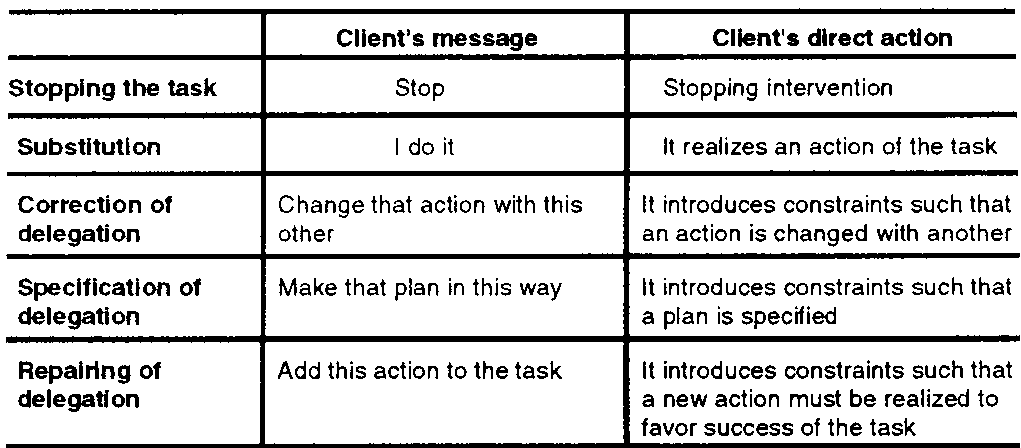 Table 1: Mapping intervention types (Stop, Substitution, Correction) to communicative and direct actions.
Experiments & Results: Trust as the Cognitive Basis
The behavior of the system is governed by a Trust Function (). The authors argue that a delegator’s decision to adjust autonomy is a reaction to a "crisis of trust."
Trust is decomposed into:
- Competence: Can the agent do it?
- Disposition: Is the agent willing?
- Practical Opportunity: Does the environment allow it?
When these variables change (due to environmental noise or agent errors), the system triggers an autonomy adjustment—either "Closening" the delegation to restrict the agent or "Opening" it to exploit the agent's intelligence.
Critical Insight: The Role of Meta-Autonomy
The paper distinguishes between Realization Autonomy (how to do a task) and Meta-Autonomy (the ability to negotiate the delegation itself). For an AI to be a true partner, it must have the meta-autonomous right to say, "I should take more control because the current environment is too complex for your manual instructions."
Limitations
- The "Obedient Slave" Problem: The authors acknowledge that users might find high-autonomy agents (especially hypercritical help) distressing or unpredictable.
- Complexity: Implementing a full BDI (Belief-Desire-Intention) model for every agent remains computationally expensive.
Conclusion
Falcone and Castelfranchi provide a roadmap for the future of AI collaboration. By formalizing delegation and trust, they move AI away from "tools that follow instructions" toward "social entities that negotiate value." This framework is increasingly relevant today as we design autonomous vehicles and LLM-based agents that must decide in milliseconds when to hand back the "steering wheel" to the human user.