
Decision Support 2.0: Orchestrating Human-Machine Collective Intelligence
Decision Support Based on Human-Machine Collective Intelligence: Major Challenges
The paper proposes a novel Decision Support System (DSS) framework that leverages Human-Machine Collective Intelligence (HMCI). It introduces a self-organizing environment where humans and software agents dynamically coordinate without rigid, pre-defined workflows to solve complex, uncertain problems.
TL;DR
Modern complexity has outpaced the rigid workflows of traditional decision support. This paper introduces a vision for Human-Machine Collective Intelligence (HMCI)—an environment donde humans and AI don't just follow a script, but self-organize dynamically. By treating AI as an organizational catalyst and humans as creative problem solvers, the framework aims to tackle "wicked problems" in business and governance that fixed algorithms cannot touch.
The "Algorithmic Cage" Problem
Existing human-computation systems, such as Amazon Mechanical Turk or standard crowdsourcing, suffer from a fundamental flaw: rigidity. The system designer defines a workflow, and the human is relegated to a "human-task" service—a mere cog in a machine.
The authors argue that in complex domains—like environmental crises or high-level business strategy—the "correct" workflow is often unknown until a solution begins to emerge. When the context shifts, a pre-defined workflow becomes a bottleneck rather than a benefit.
Methodology: The Pillars of HMCI
To move beyond the "algorithmic cage," the authors propose three core mechanisms:
1. Convergence of AI and Collective Intelligence
Instead of viewing AI and Human Intelligence as competitors, the paper outlines a symbiotic relationship.
- AI as the Manager: Using AI to profile experts and distribute tasks efficiently.
- Human as the Moral Compass: Using humans to verify if AI-generated results comply with social norms and unformalized ethical principles.
2. Multi-Aspect Ontologies for Interoperability
The biggest hurdle in mixed collectives is Semantic Interoperability. How does a machine understand a human expert’s intuition? The paper suggests Multi-aspect Ontologies, which provide different "views" of a problem area for different participants. This avoids the impossible task of creating a "Universal Common Ontology" while still allowing services to collaborate meaningfully.
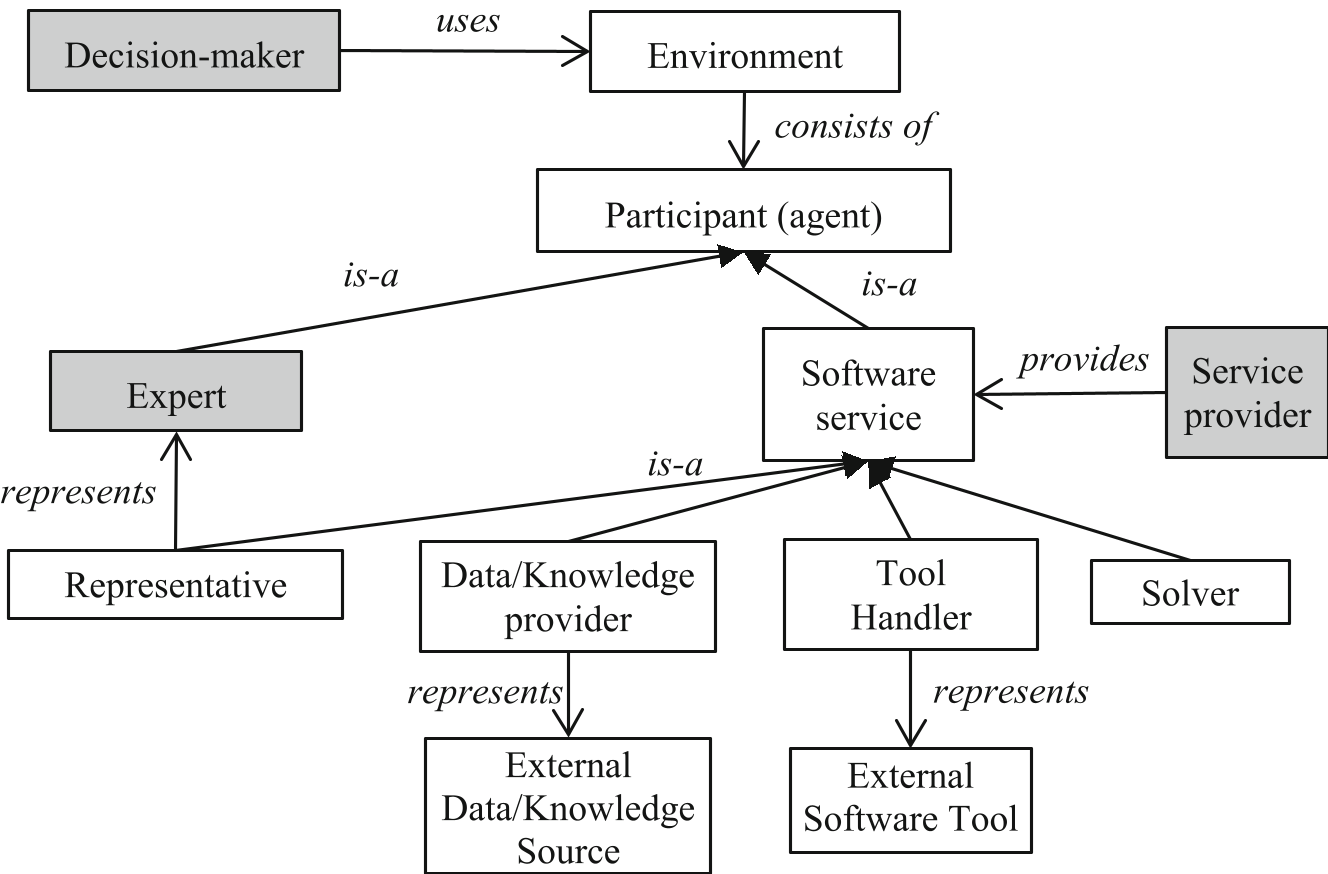 The four types of intelligent software services that bridge the gap between data, tools, and human experts.
3. Socio-Inspired Self-Organization
Instead of bio-inspired models (like ant colony optimization), which are too primitive for human behavior, the authors advocate for Socially-inspired protocols. These protocols respect human autonomy and use market-based incentives to allow agents to "negotiate" their roles in real-time.
The HMCI Ecosystem
The proposed environment identifies three key roles:
- Decision-makers: High-level managers who post the "wicked problem."
- Experts: Individuals who provide domain-specific judgements and ad-hoc procedures.
- Service Providers: Entities that maintain the software tools and datasets.
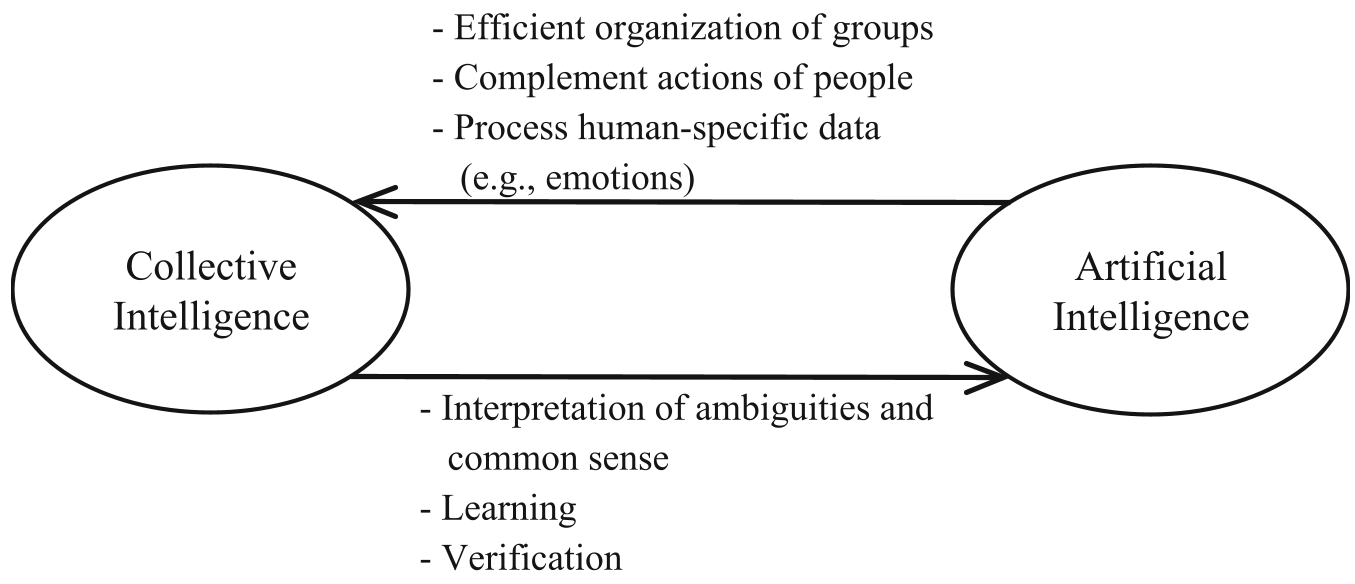 The interaction layers showing how Collective Intelligence and Artificial Intelligence complement each other at both meta-levels and processing levels.
Critical Insight: Why This Matters
The move toward Flash Organizations—temporary, expert-dense groups that assemble and dissolve for specific tasks—is the future of work. This paper provides the theoretical scaffolding to make these organizations "computable" without killing the human creativity that makes them valuable.
However, a notable limitation is the complexity of the negotiation protocols. As the number of agents increases, the "negotiation overhead" could potentially negate the speed gains of self-organization. Future research must find the "Goldilocks zone" between total anarchy and over-regulation.
Conclusion
This work signals a shift from Decision Automation to Decision Support. By building environments that support natural self-organization, we can leverage the speed of AI and the nuanced judgment of humans to navigate an increasingly complex global landscape.