
The Physics of Reddit: Why Popularity Breeds Disproportionate Negativity
Human Psychology of Common Appraisal: The Reddit Score
This paper models the Reddit score as a general random walk with a random maximum boundary. It identifies that while Reddit scores exhibit exponential tails, they also feature an intermediate power-law region driven by a surprising correlation where downvotes increase faster than upvotes.
TL;DR
By modeling Reddit scores as a General Random Walk, this paper reveals the hidden dynamics of collective appraisal. It shows that while upvotes follow "preferential attachment," downvotes follow a surprising power-law related to upvotes: the more popular a story becomes, the faster its downvotes accumulate relative to its upvotes.
Problem & Motivation: The Open Voting Paradox
In "closed" voting, users express opinions in a vacuum. On Reddit, voting is "open"—users see the current score before acting. This creates a feedback loop. Existing research (like studies on Digg.com) often focused on purely positive growth. However, Reddit's inclusion of a downvote button adds a layer of complexity: a negative transition that could potentially stabilize or tank a story's visibility.
The author's intuition was to move beyond simple lognormal distributions and ask: What is the specific mathematical relationship between the "pro" and "anti" sentiment in a community?
Methodology: The Score as a Random Walk
The core of the paper treats the Reddit score as a state in a General Random Walk. At each step, a user can:
- Upvote (): Score increases.
- Downvote (): Score decreases.
- Abstain: Score remains the same.
The author defines the steady-state probability of a score by incorporating the randomness of the total possible voters .
The "Tall Trees" Discovery
The most striking part of the methodology isn't the calculus, but the empirical fit of upvotes () vs. downvotes (). The paper finds:
Because the exponent () is greater than , downvotes grow faster than upvotes.
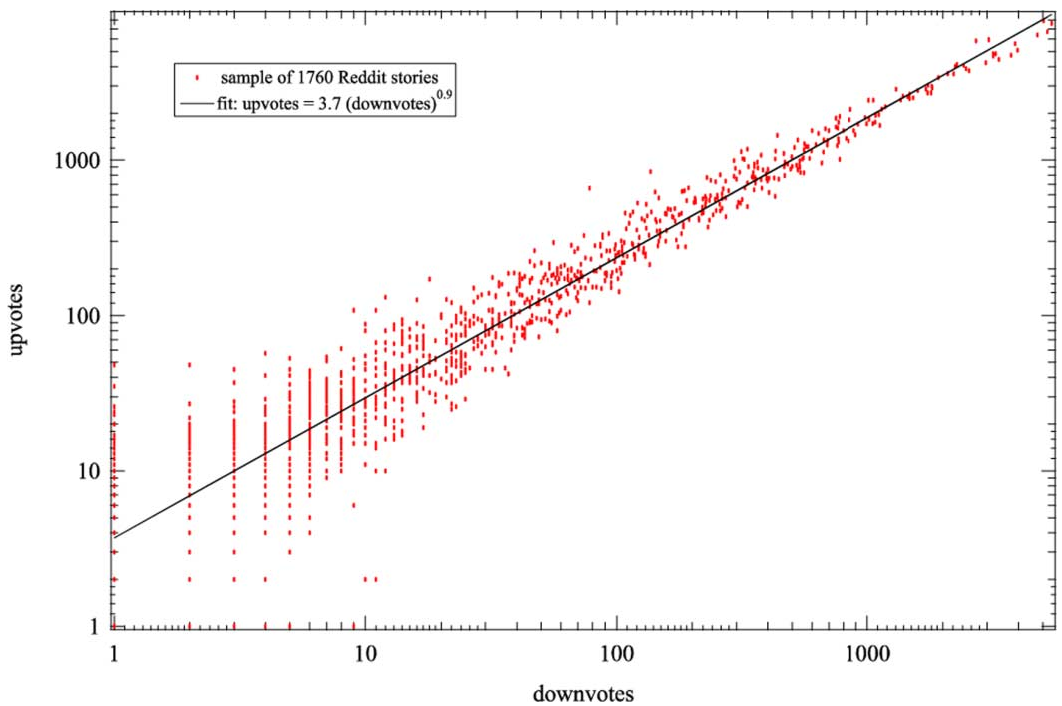 Fig 1: Scatter plot showing the power-law relationship between upvotes and downvotes.
Experiments & Results
The author tested the model on 1.7 million Reddit stories.
- Tail Behavior: The distribution of scores shows an exponential decay in the tails, meaning extremely high scores are exponentially rarer.
- Sensitivity: The model is incredibly sensitive to the ratio of upvote/downvote probabilities () and the scaling factor (). Small shifts in user psychology can flip the distribution from power-law-like to purely exponential.
- Intermediate Power Laws: The "power-law-like" region often seen in social data is shown here to be an intermediate phase of the random walk, rather than a fundamental law of the entire system.
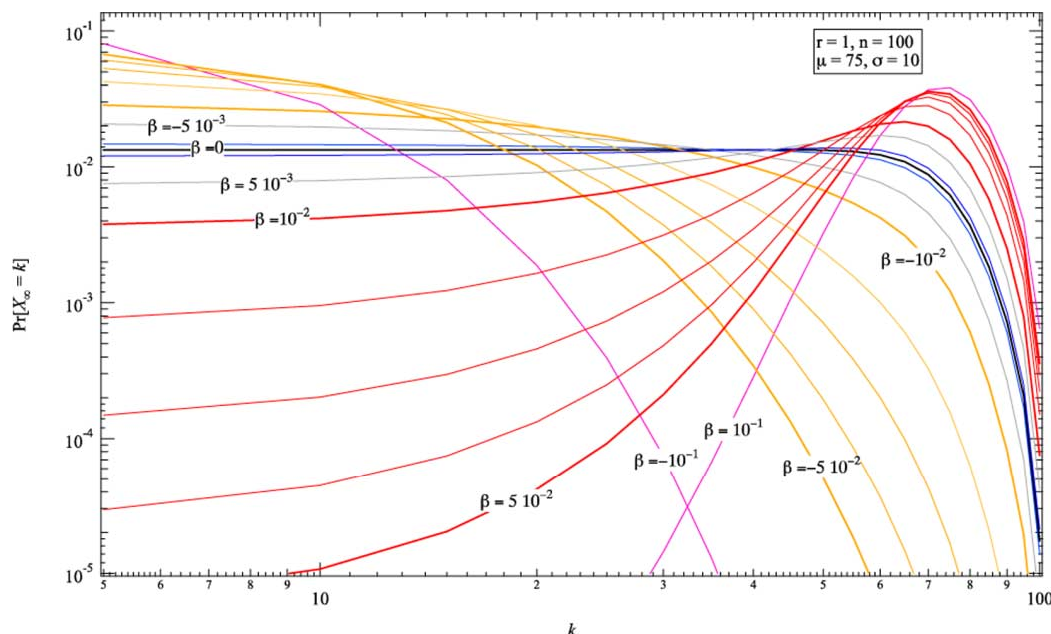 Fig 2: PDF of Reddit scores showing sensitivity to the parameters r and β.
Critical Analysis & Conclusion
Takeaway
The Reddit score isn't just a measure of quality; it's a trace of a dynamic competition between viral growth and community resistance. The "power law" of downvotes suggests a socio-psychological law: Popularity triggers an adversarial response.
Limitations
The model assumes the total number of potential voters is independent of the score . In reality, Reddit's ranking algorithm makes highly dependent on (higher scores lead to more visibility, thus a larger ), creating a "rich-get-richer" effect that this model simplifies to maintain analytical tractability.
Future Outlook
This research opens a door for "Sentiment Physics"—using random walk parameters to quantify the "toxicity" or "controversy" of different sub-communities based on their and values.