
HAO: Bridging the Gap Between Social Media Chaos and Humanitarian Standards
17104_Humanitarian Assistance Ontology for Emergency Disaster Response.
The paper introduces the Humanitarian Assistance Ontology (HAO), a framework for the automatic extraction and mapping of crisis needs from unstructured social media and web data. By merging a static global ontology with a dynamic local ontology, it provides real-time humanitarian response recommendations aligned with international standards like The Sphere Handbook.
TL;DR
In the wake of a disaster, information is not the problem—filtering it is. This paper presents the Humanitarian Assistance Ontology (HAO), a system that automatically digests unstructured web data (blogs, tweets, news) to identify urgent human needs. By aligning raw data with the global Sphere Handbook standards, HAO doesn't just tell you what happened; it tells you exactly how many liters of water and what type of aid are required for specific locations.
The Information Overload Problem
When the 2011 Japan earthquake struck, mobile networks failed but social media exploded. Emergency responders found themselves "data rich but insight poor." The challenge is two-fold:
- Unstructured Format: Raw text meant for human readability is hard for machines to categorize.
- Semantic Gap: A tweet saying "we have no water in Cancun" needs to be translated into a formal humanitarian "Need" that triggers a specific "Response" (e.g., 15 liters per person per day).
Methodology: The Static-Dynamic Dual Ontology
The authors propose a clever architecture that balances stability with real-time adaptability. The HAO framework consists of two main components:
1. The Global Ontology (Static Knowledge)
Built before the crisis using DBpedia and The Sphere Handbook, this serves as the "Rulebook." it defines what a "need" is (e.g., water, hygiene, debris removal) and what the minimum response standards are.
2. The Local Ontology (Dynamic Context)
This is the "Live Feed." It uses Named Entity Recognition (NER) and the C-value algorithm to extract terms from current reports.
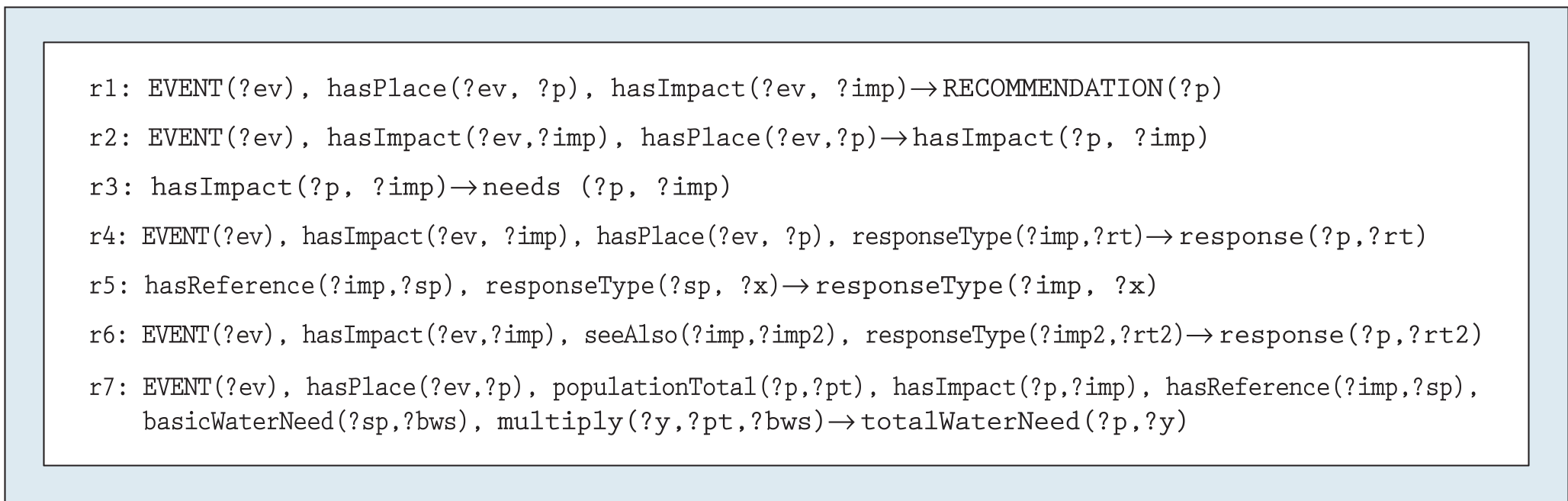
The Inference Engine
The core "magic" happens in the mapping. The system calculates a match between extracted terms and ontological concepts using a context-matching formula:
match(di, O) = ∑ match(xp, cn)
This allows the system to recognize that "no toilets" in a blog post maps to the "Excreta Disposal" requirement in the Sphere standards.
Experimental Results: Hurricane Wilma Case Study
The researchers tested HAO against Hurricane Wilma (2005) data, including 125 textual reports. They compared HAO against simple keyword matching and the then-industry standard, AlchemyAPI.
| Method | Recall | Precision | F-score |
|---|---|---|---|
| HAO | 0.897 | 0.530 | 0.666 |
| Keywords | 0.744 | 0.483 | 0.585 |
| AlchemyAPI | 0.051 | 0.333 | 0.089 |
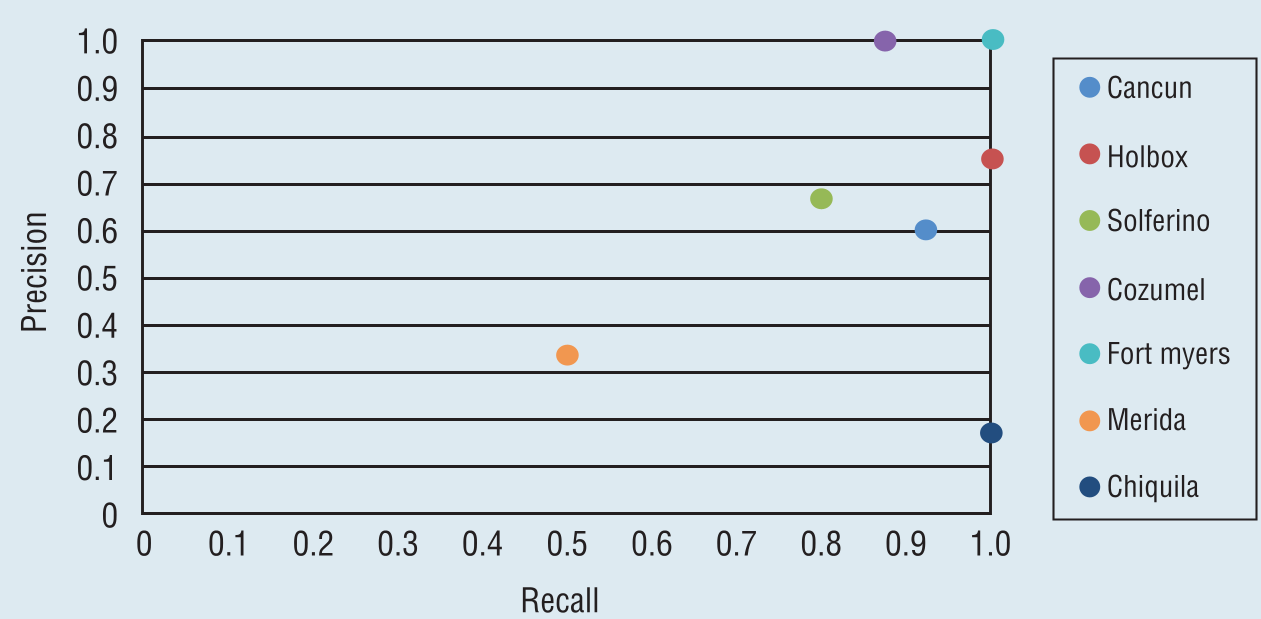
Key Finding: While all methods struggle with precision (due to the noise in social media), HAO's Recall is significantly higher. In disaster response, a high recall is vital—it is better to flag a potential need for verification than to miss a localized crisis entirely.
Deep Insight: Why This Matters
The brilliance of HAO lies in its Inference Logic. For example, by identifying "Cancun" as an affected place and knowing its population from DBpedia, Rule r6 can automatically calculate:
Total Water Need = Population × 15 Liters/Day.
This transforms a vague cry for help into a concrete logistics target. It bridges the gap between the social layer of a crisis and the operational layer of humanitarian aid.
Conclusion & Limitations
The HAO system is a major step toward "Smart Humanitarianism." However, the authors note that its precision is still limited by the inherent ambiguity of natural language. Future work will likely involve expanding these ontologies to cover a wider variety of disaster types (e.g., pandemics vs. earthquakes) and integrating more diverse data streams.
By codifying the "Minium Standards" of human dignity (The Sphere Handbook) into a machine-readable format, the HAO project ensures that even in the chaos of a disaster, help is guided by logic and international consensus.