
From Text to Affect: Giving the NAO Robot an Emotional Voice and Body
14237_A System to Convey the Emotional Content of Text Using a Humanoid Robot.
This paper introduces a real-time affective text-to-robot system that maps ASCII text to the multimodal expressive capabilities of a NAO humanoid robot. By utilizing the Natural Language Toolkit (NLTK) for sentiment extraction and Russell’s circumplex model of affect, the system achieves synchronized emotional speech (prosody) and body movement (kinesics).
TL;DR
The dream of anthropomorphic assistants moving beyond "Alexa-like" monotony is getting closer. This research presents a pipeline that converts raw text into an emotional performance by a NAO robot. By analyzing text sentiment, the system automatically adjusts the robot’s voice pitch, speed, eye colors, and gestures, transforming a static recital into a socially believable interaction.
The Problem: The "Uncanny Valley" of Robotic Speech
While robots can technically "read" text, they usually lack Affect Display—the facial, vocal, and gestural behaviors that indicate emotion. When a robot delivers tragic news in a cheerful robotic tone, or vice versa, the "social friction" makes the robot feel broken or unsettling. The challenge lies in translating the abstract sentiment of words into a high-dimensional space of physical actions (Prosody and Kinesics) in real-time.
Methodology: Mapping Emotions to the 2D Affect Space
The authors break down the problem into two distinct processes: Inference and Expression.
1. Sentiment Extraction (Inference)
Using the Natural Language Toolkit (NLTK), the system performs a sentiment analysis to determine the "Valence" (the degree of positivity or negativity). Crucially, they also calculate "Arousal" (excitement level) based on sentence length, word length, exclamation points, and capitalization.
2. The Emotional Bridge: Russell's Circumplex Model
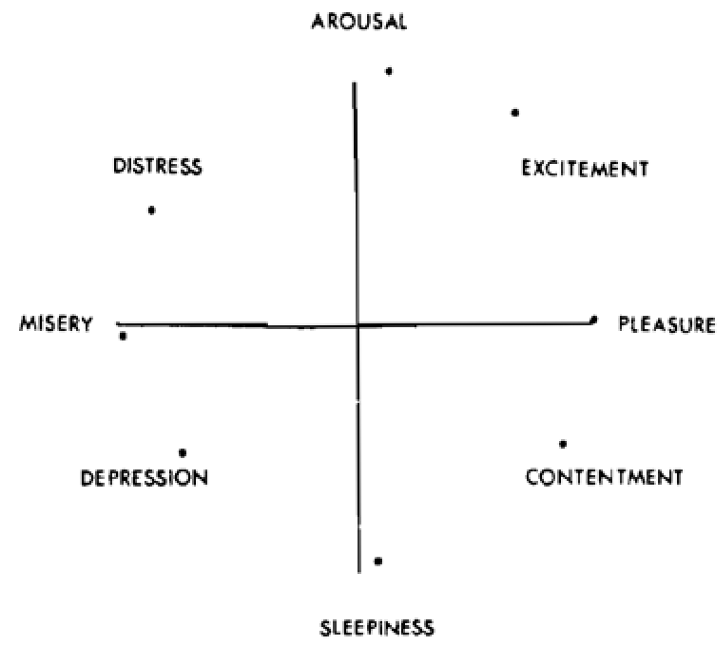
To connect text to movement, the authors use Russell’s Circumplex Model. This 2D plane (Valence vs. Arousal) serves as the coordinate system for the robot's "mood." For instance:
- High Valence + High Arousal = Excitement (Bright Yellow LEDs).
- Low Valence + Low Arousal = Sadness (Dim Blue LEDs).
3. Actuation (Expression)
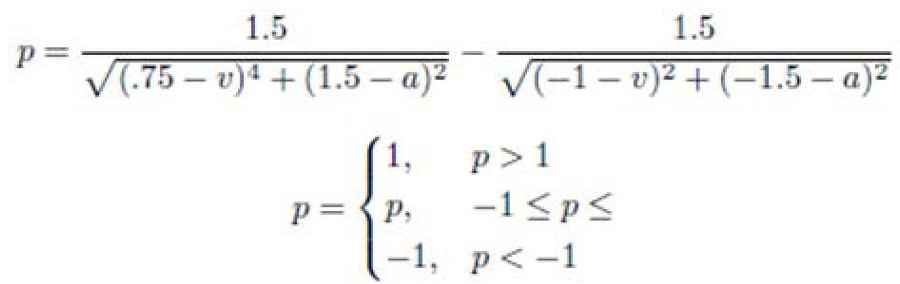
The coordinates are then fed into mathematical functions to determine robot parameters:
- Prosody: Pitch, speed, and volume.
- Kinesics: Eye LEDs (RGB mixing), head yaw/pitch, and arm amplitude.
Experiments: Making NAO "Feel" the News
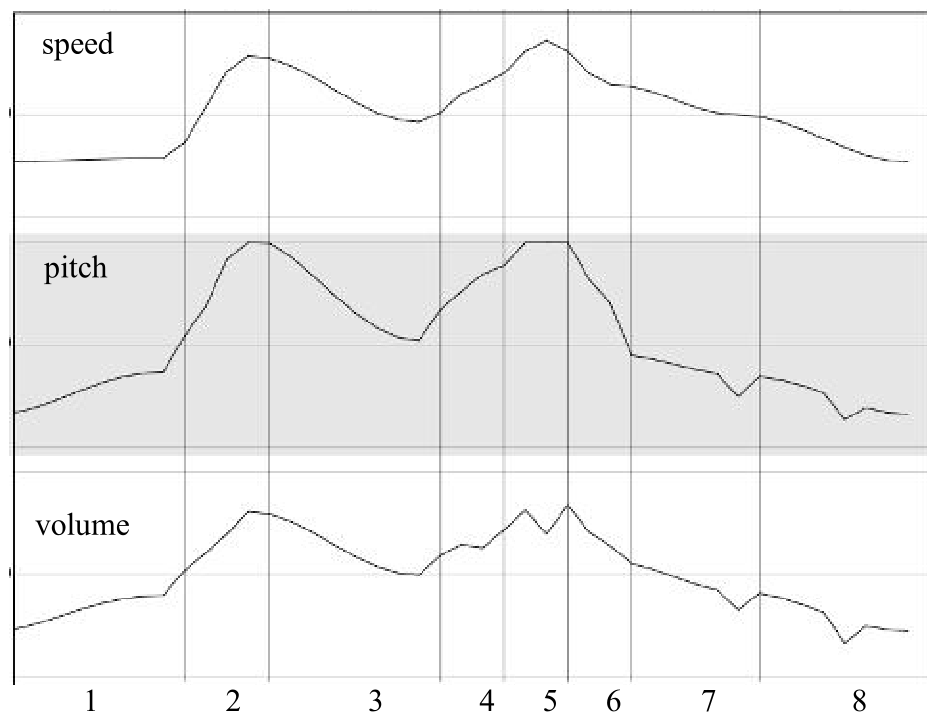
The researchers tested the system with a script that shifts from "Good News" (getting a job) to "Bad News" (a pet passing away).
The results, visualized in the plot below, show how the robot's vocal parameters (Pitch, Speed, Volume) dynamically shift. During the "Happy" segments (Sentences 2-5), the pitch is elevated. As the news turns "Sad" (Sentences 7-8), the parameters drop sharply to convey a somber tone.
Key Observations:
- Smooth Transitions: The use of sigmoid functions prevents the robot from "snapping" between emotions, making the movement feel organic.
- Inductive Bias of Humans: Interestingly, the researchers noted that even in "neutral" mode, humans tend to project emotions onto the robot's face, a phenomenon called pareidolia.
Critical Analysis & Future Outlook
The system's greatest strength is its simplicity and modularity. By using a 2D emotion space, it avoids the messiness of categorical "labels" (Happy, Sad, Angry) and allows for a continuum of expression.
Limitations: However, the NLP component (NLTK) is relatively basic. It struggled with sarcasm or nuanced phrases like "Oh yes, it's a winning ticket!" when it was actually a fake. Modern Large Language Models (LLMs) would significantly improve the "Arousal" estimation by understanding sarcasm and context.
Future Work: The next step involves physiological testing: measuring the heart rate and skin conductance of humans interacting with the robot to see if the robot's "emotions" are truly contagious.
Takeaway: Effective human-robot interaction doesn't require "true" artificial consciousness—it requires the precise, synchronized mimicry of human expressive prosody.