
Hustling Online: How Nairobi’s Slum Dwellers Turn Facebook into an Economic Engine
Hustling online: understanding consolidated facebook use in an informal settlement in Nairobi
The paper investigates Facebook usage in Viwandani, an informal settlement in Nairobi, Kenya, identifying a unique behavior termed "consolidated use." It demonstrates how low-income users leverage Facebook as a primary gateway to the internet to support income generation, job seeking, and entrepreneurial marketing, achieving success in navigating extreme economic constraints.
TL;DR
In the informal settlement of Viwandani, Nairobi, Facebook is not just a social network—it is the entire internet. This paper explores "consolidated use," where young adults under extreme financial pressure use Facebook to find jobs, market music, and seek financial "boosts" (remittances), transforming a western social tool into a vital platform for survival and upward mobility.
Background: Beyond the Digital Divide
Nairobi is a city of sharp contrasts, where more than half the population lives in slums. In Viwandani, residents live without piped water or sanitation, yet they are increasingly "online." This research moves beyond the simple "haves vs. have-nots" narrative to ask: How do the urban poor actually use social media when every megabyte costs a meal?
The "Consolidated Use" Insight
The researchers identified a phenomenon they call Consolidated Use. Because of the high cost of data (1 cent per minute is significant when earning $1.50 a day) and slow connection speeds, users do not jump between apps. Instead, they treat Facebook as a "Swiss Army Knife."
- Chat as a Replacement: Facebook Chat replaces expensive SMS and voice calls.
- The Global Village: Users see the Facebook "f" logo as a ticket to a global economy, seeking ties with international NGOs and "random foreigners."
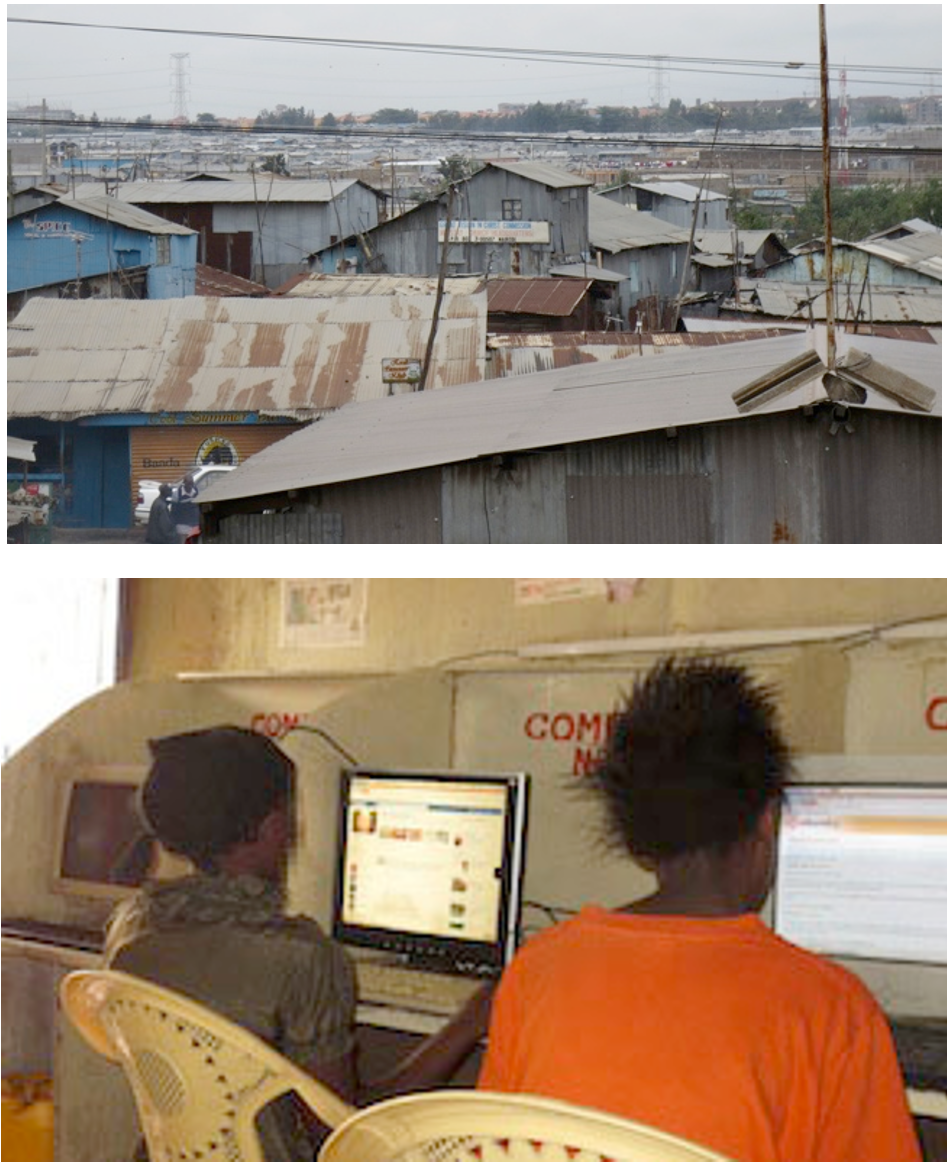 Figure 1: The harsh physical reality of Viwandani contrasted with the digital aspirations found in local cyber cafés.
Methodology: The Hustle on the Screen
The authors categorize the economic activities into three main "hustles":
1. The Employment Search
While westerners use LinkedIn, Viwandani residents use Facebook. Users like "Dida" used their profiles to project a professional image (passport photos, English posts) to attract the attention of NGO workers and bank recruiters.
2. Digital Entrepreneurship
Local artists and musicians (e.g., "Love-e") use the platform for "marketing" and "advertising." This isn't just vanity; it results in record deals and art sales to foreigners. However, the lack of PayPal or formal addresses creates a "bottleneck" where users have the product and the customer but no way to safely move the money.
3. Seeking Remittances
Using the "Weak Ties" theory, residents use Facebook to find the "Kenyan Diaspora." They look for a "boost"—small cash transfers for medical emergencies—leveraging social capital that would be impossible to maintain without the platform.
Critical Results: The Success Gap
The study highlights a internal "digital divide" within the settlement:
- The Top 10%: Well-educated, smartphone-owning men who successfully found jobs via Facebook.
- The Majority: Users who remain hopeful but are limited by "China-make" feature phones and the inability to perform complex tasks like uploading a CV.
- The Gender Gap: Women were significantly less present in cyber cafés, often restricted by household duties, highlighting a need for gender-sensitive design.
Future Outlook: Design for Existing Behavior
The authors conclude with a powerful critique of "Colonial Impulse" in tech design: western researchers often try to build "new" apps for the poor.
The Takeaway? Don't build a new job app for Africa; figure out how to let a Viwandani resident upload a resume to Facebook using a $20 Nokia. The future of ICTD (Information and Communication Technologies for Development) lies in grounding interventions in existing practices rather than imposing unfamiliar ones.
Summary
"Hustling Online" proves that the urban poor are not passive consumers of technology; they are ingenious innovators who "consolidate" limited resources to create opportunities. For the HCI community, the mission is clear: bridge the gap between digital aspiration and infrastructure reality.