
HYP: Balancing Privacy and Utility in Social Network Publishing through Hybrid Anonymization
A Hybrid Algorithm for Privacy Preserving Social Network Publication
The paper proposes a Hybrid Privacy-Preserving Algorithm (HYP) for social network data publishing. It combines k-anonymity with randomization to prevent identity disclosure through structural (degree) attacks while minimizing information loss.
TL;DR
In the era of big data, publishing social network datasets is essential for research but carries massive privacy risks. This paper introduces a Hybrid Privacy-Preserving (HYP) algorithm that merges the structural grouping of k-anonymity with the stochastic protection of randomization. By only perturbing nodes that are "exposed," it keeps the graph's structural integrity (like clustering) intact while guaranteeing a specific confidence level against identity attacks.
The "Naive" Trap: Why Removing Names Isn't Enough
The central motivation of this research is the failure of Naive Anonymization. Most people assume that by replacing names with IDs, privacy is safe. However, social networks are rich in Structural Characteristics.
If an attacker knows that "Tim" has exactly 4 friends in a specific network, they can scan the anonymized graph for any node with a degree of 4. If only one such node exists, Tim's entire link structure and sensitive attributes are leaked. This is the identity disclosure problem.
Methodology: The Hybrid Insight
The authors observe that social networks naturally contain many nodes that already look alike (e.g., many users have exactly 1 or 2 friends). These nodes are "inherently anonymous." The problem lies in the "outliers"—users with unique connection counts.
The 5-Step HYP Workflow:
- Direct Indexing: Remove PII and assign integer labels.
- Set Partitioning: Split nodes into the Anonymized Set () and the Unanonymized Set ().
- Initial Perturbation: Randomly add or delete edges within the unanonymized set.
- Verification: Identify which nodes in still retain their original unique signatures.
- Targeted Correction: Forced edge modification for the remaining exposed nodes to ensure they no longer match their original degree.
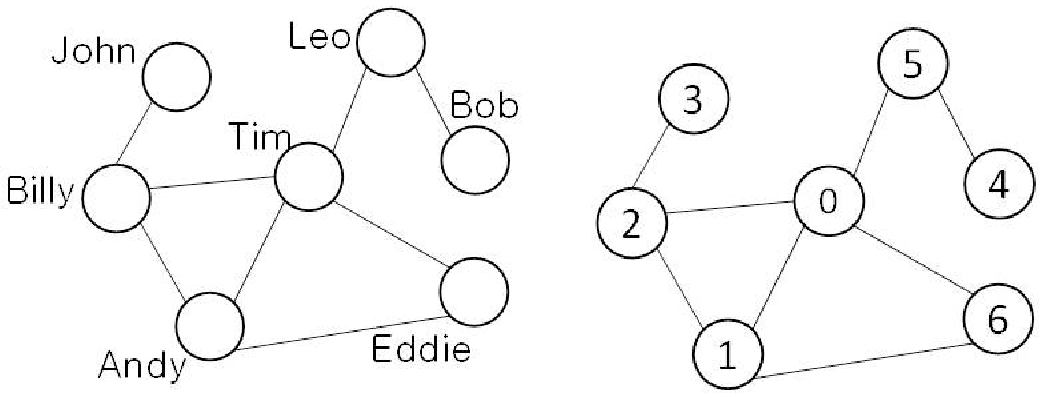 In the figure above, (a) shows the original graph. (b) shows the naive version where "Tim" is still easily identified by his degree of 4.
Mathematizing the Risk
The paper defines the Posterior Disclosing Risk as the probability an attacker can correctly map a vertex back to an individual. The HYP algorithm ensures: Where is the anonymity threshold. This provides a formal guarantee of privacy with confidence .
Experiments & Results
The researchers tested HYP against three real-world datasets: Facebook (dense), Citation (sparse), and Movies (large-scale).
1. Information Loss (IL)
Information Loss measures the count of edges modified. As the confidence (privacy requirement) increases, IL naturally goes up. However, the HYP algorithm (often referred to as the "stable" line in the results) shows a much shallower growth curve than traditional k-anonymity, especially at high confidence levels.
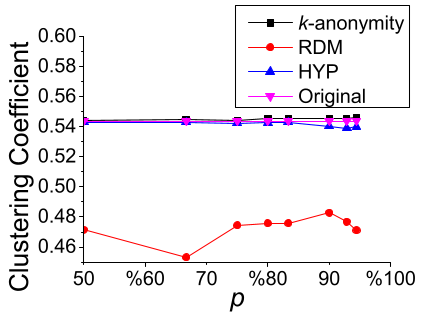 Fig 3: HYP maintains lower IL compared to pure random and pure k-anonymity methods as confidence requirements tighten.
2. Preserving Network "Feel" (Clustering Coefficient)
One of the biggest failures of pure Randomization is that it destroys the "Small World" property of social networks—specifically the Clustering Coefficient (CC). By focusing modifications only on a subset of nodes (), HYP maintains a CC that is much closer to the original graph than random methods.
Critical Analysis & Conclusion
Takeaway
The hybrid approach proves that we don't need to "break" the whole graph to protect it. By identifying which nodes are structurally unique and only modifying them, we can preserve the global utility of the data for third-party analysts.
Limitations
The current model focuses primarily on Degree Attacks. In the real world, an adversary might know more than just a node's degree; they might know the structure of their neighbors' neighbors (Neighborhood Attacks). The paper acknowledges this as a future research direction.
Future Outlook
This work lays the groundwork for more sophisticated "Partial Perturbation" models. As social data becomes more complex, the ability to selectively apply privacy techniques based on local graph topology will be the key to high-utility data publishing.