
JRC: Scaling Online Recruitment via Conceptual Classification and Hybrid Semantic Ranking
A Hybrid Approach to Conceptual Classification and Ranking of Resumes and Their Corresponding Job Posts
This paper introduces a hybrid recruitment system named JRC (Job Resume Classifier) that combines rule-based segmentation, conceptual classification using multiple knowledge bases (DICE and O*NET), and semantic ranking. By categorizing resumes and job posts into occupational categories before matching, the system significantly reduces search space and improves matching precision.
TL;DR
The exponential growth of online job portals has made manual screening impossible and global automated search computationally expensive. This paper presents JRC (Job Resume Classifier), a hybrid system that segments resumes into structured data and classifies them into occupational categories using an integrated knowledge base (DICE + O*NET). By only matching within relevant categories, JRC achieves a 6x speedup in execution time while improving precision over state-of-the-art semantic systems.
Background & Motivation: The Global Search Bottleneck
In the current recruitment landscape, a single vacancy can attract thousands of applicants. Most automated systems approach this as a "Global Search" problem: comparing one job post against every resume in the database.
The authors identify two critical flaws in existing SOTA (State Of The Art) methods:
- Computational Inefficiency: Running complex semantic comparisons across a 1M+ resume database for every job is unsustainable.
- Knowledge Gaps: Standard classification schemes like the Dictionary of Occupational Titles (DOT) are outdated, failing to capture modern ICT roles or specific technical acronyms (e.g., JPA, J2ME).
Methodology: The Hybrid Architecture
The JRC system operates through a multi-stage pipeline designed to transition from unstructured text to a ranked shortlist.
1. Section-Based Segmentation
Instead of treating a resume as a "bag of words," the system uses NLP (N-gram tokenization, POS tagging) and regular expressions to extract structured blocks: Personal Information, Education, Experience, and Skills.

2. Integrated Knowledge Base (DICE + O*NET)
The paper's "Secret Sauce" lies in its dual-resource approach.
- DICE is used for modern ICT/Software roles where ONET often misclassifies terms (e.g., ONET classifies "JPA" under Accountants).
- O*NET is utilized for Medical and Artistic fields where DICE lacks coverage.
3. Weighted Scoring & Loyalty Feature
The final ranking isn't just about skills. The authors propose a specific scoring formula (): The Loyalty Parameter is particularly insightful—it calculates the ratio of employment years to the number of companies, penalizing "job-hopping" behavior to find more stable candidates.
Experimental Results
The authors validated JRC using a massive dataset of 2,000 resumes and 10,000 job posts.
Efficiency Gains
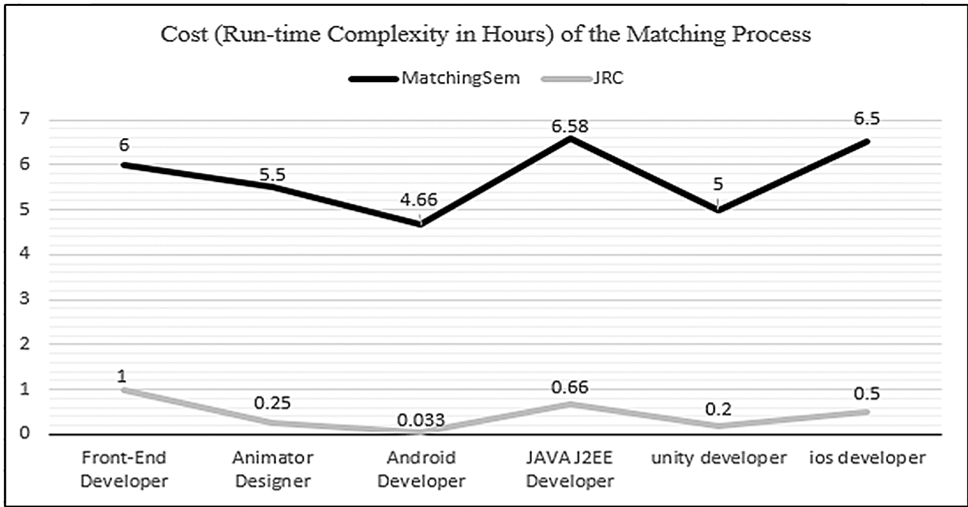
By implementing classification before matching, the search space is drastically pruned. For a "Front-End Developer" post, JRC only searches the "Web Development" category.
- Baseline (MatchingSem): 6 Hours
- JRC (Proposed): 1 Hour
- Improvement: 83% reduction in latency.
Precision Advantage
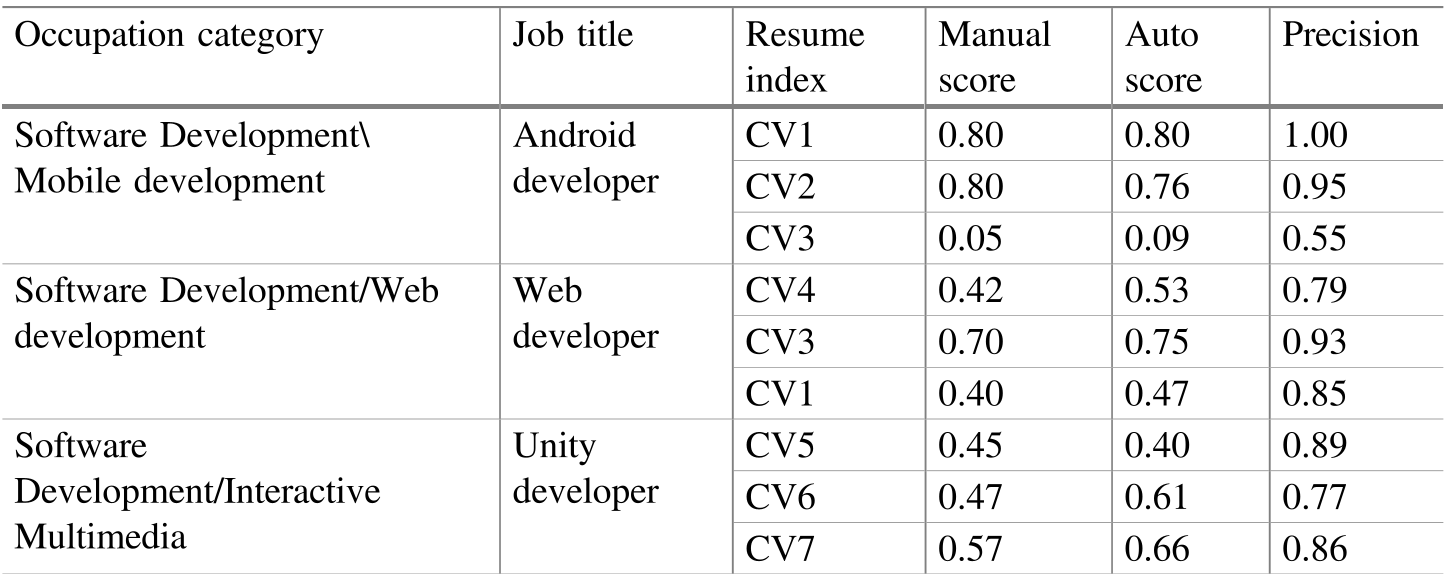
The precision results highlight that JRC outperforms keyword-heavy semantic models because it filters out "noisy" matches across different domains. As shown in the comparison table, JRC consistently achieved higher precision scores ( vs for Android developers) by effectively segmenting and weighting candidate attributes.
Critical Insight & Conclusion
The hybrid approach of this paper demonstrates that domain-specific ontologies are still superior to "one-size-fits-all" machine learning models in high-stakes fields like HR. By combining the strengths of DICE and O*NET, the authors solved the "out-of-vocabulary" problem for technical skills.
Future Outlook: While JRC is highly effective, the current reliance on rule-based segmentation might struggle with unconventional resume layouts (e.g., creative/graphic resumes). The next frontier for this work will likely involve using Graph Neural Networks (GNNs) to model the relationship between different occupational categories and skills dynamically.
Takeaway for Practitioners: If you are building a matching engine, classify first, match second. Localized ranking is the only way to scale.