
Hybrid Ontology Learning: Bridging Global Statistics and Local Semantics
A Hybrid Approach to Ontology Relationship Learning
This paper introduces a hybrid ontology relationship learning framework that extracts non-taxonomic links from text. It combines a data-driven "Co-occurrence approach" using Association Rules with a linguistic "Definitional approach" using semantic Concept Profiles and cosine similarity.
TL;DR
Ontology engineering is moving away from purely manual labor. This paper presents a breakthrough hybrid approach that merges Association Rules (data mining) with Concept Profiles (linguistic analysis). By intersecting these two perspectives, the system achieves a staggering 97% accuracy in identifying valid relationships between domain concepts, effectively filtering out the "noise" that plagues single-method systems.
Problem & Motivation: The "Relationship" Hurdle
In the world of the Semantic Web, identifying concepts (like "Project Manager" or "Budget") is relatively easy. The real challenge is the relationships—the logical threads that bind them.
Current tools usually fall into two traps:
- The Co-occurrence Trap: Methods like Association Rules see that "Milk" and "Bread" appear together often, but they don't understand why. They miss subtle semantics and focus only on high-level, frequent pairs.
- The Definitional Trap: Linguistic methods focus on how words are used in sentences. They are precise but often lack the statistical evidence needed to prove a relationship is significant across a whole library of documents.
The authors' insight was simple yet powerful: Validation through intersection. A relationship is only truly robust if it is both statistically significant across documents and semantically similar in local context.
Methodology: The Dual-Chain Architecture
The system operates via two parallel analysis pipelines, as shown in the architecture below:
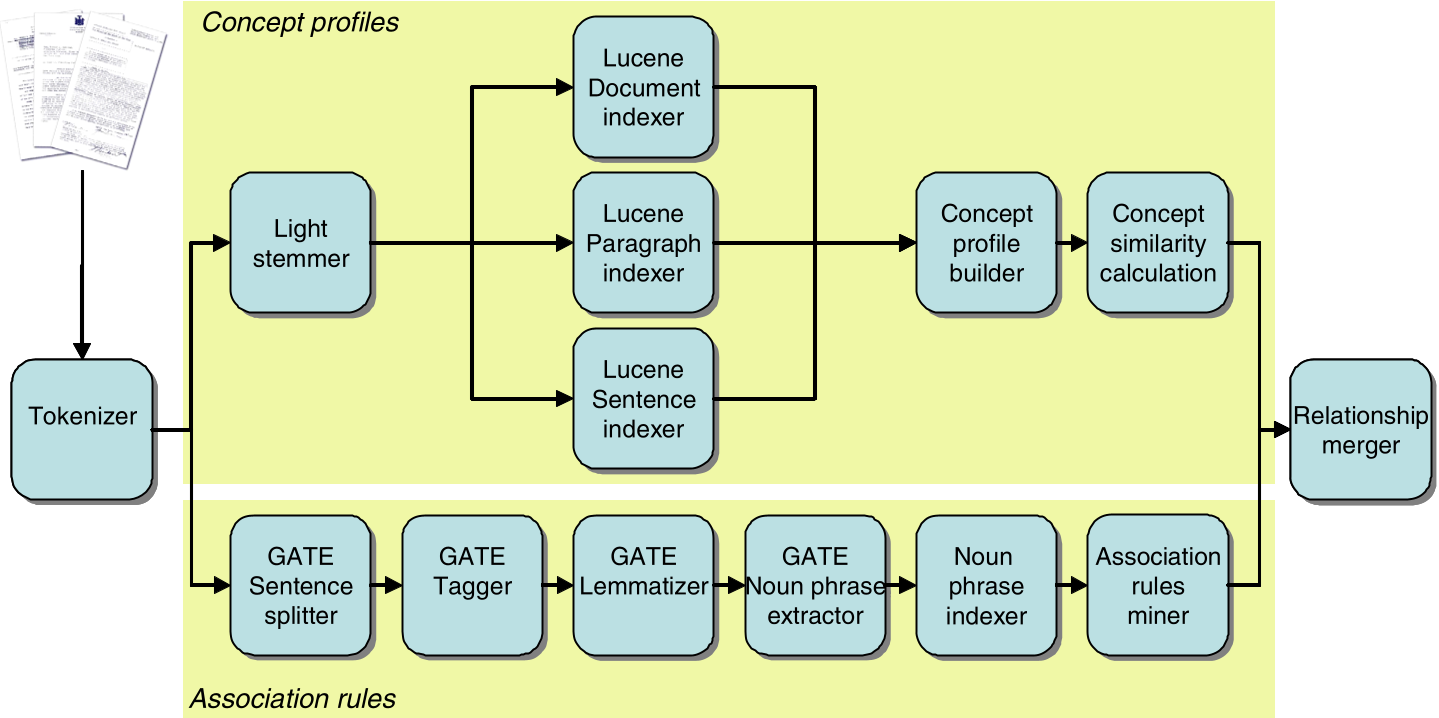
1. The Association Rules Chain (Global)
Using the Apriori algorithm, the system treats each document as a "transaction" and concepts as "items." It looks for rules where Concept A implies Concept B with high Support (frequency) and Confidence (reliability). This captures the "big picture" of the domain.
2. The Concept Profile Chain (Local)
This is the semantic heart of the paper. For every concept, the system builds a "Profile"—a vector of related terms weighted by their proximity (sentence vs. paragraph vs. document).
- TF-ICF Weighting: A variation of TF-IDF, where "ICF" (Inverse Concept Frequency) helps identify terms that are uniquely descriptive of a specific concept.
- Cosine Similarity: By calculating the angle between two profiles, the system finds concepts that "behave" similarly in text.
Experiments & Results: Precision is Key
The team tested their system on a Project Management corpus (PMBOK). The results revealed a fascinating complementarity:
| Metric | Association Rules | Concept Profiles | Hybrid (Intersection) |
|---|---|---|---|
| Valid Relationships | 82% | 86% | 97% |
| "Highly Related" | 7% | 24% | 30% |
As the data shows, while the Concept Profile method is more "talented" at finding high-quality links (24% vs 7%), combining it with Association Rules pushes the precision to a nearly human-grade level.
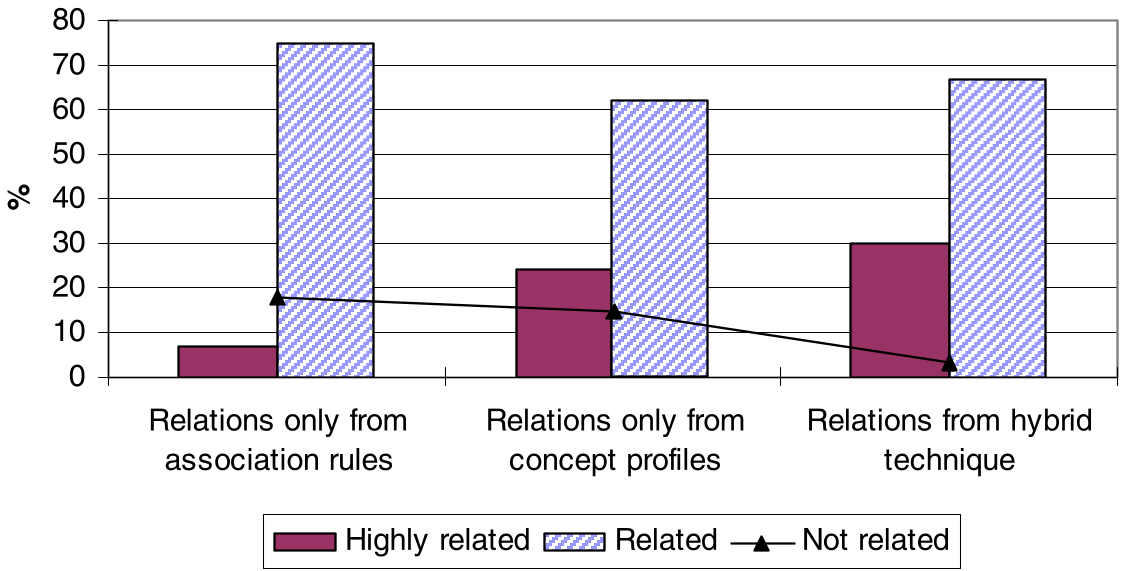
In the chart above (Figure 3 in the paper), the right-most column bars represent the Hybrid approach, showing a massive reduction in "Not Related" noise (black section).
Critical Analysis & Conclusion
Takeaways
The brilliance of this work lies in Inductive Bias. Association rules bring the "Breadth" (statistical power), while Concept Profiles provide the "Depth" (linguistic nuance). Together, they act as a mutual filter.
Limitations
- Naming the Link: While the system knows Concept A and B are related, it still struggles to label the relationship (e.g., is it is_a, part_of, or manages?).
- Data Scarcity: Both methods still require a "prominent" number of occurrences, making it hard to find relationships for rare, niche terms.
Future Outlook
This hybrid framework lays the groundwork for modular ontology learning. Future iterations could plug in LLM-based embeddings into the "Concept Profile" chain to capture even deeper context, while maintaining the statistical rigor of the co-occurrence chain to prevent hallucinations.