
Harmonizing Semantics and Quality: A Hybrid Approach to Web Table Integration
A Hybrid Machine-Crowdsourcing Approach for Web Table Matching and Cleaning
This paper introduces a hybrid machine-crowdsourcing framework for simultaneous web table matching and data cleaning. By leveraging Knowledge Bases (specifically Yago) alongside human intelligence, the method achieves an F-measure of 95.3% on semantic annotation, significantly outperforming standalone machine or crowd-based pipelines.
TL;DR
Integrating web tables is often a "chicken and egg" problem: you need clean data to understand the table's schema, but you need a correct schema to identify dirty data. This paper breaks the cycle by proposing a Hybrid Machine-Crowdsourcing framework that performs table matching and cleaning simultaneously. By leveraging the Yago Knowledge Base (KB) and strategic human intervention, the system achieves a 95.3% F-measure, proving that semantics and data quality are two sides of the same coin.
The "Isolation" Problem in Data Integration
Traditionally, researchers treated Schema Matching (What does this column represent?) and Data Cleaning (Is this value correct?) as separate silos. This leads to a cascading failure:
- Dirty data misleads matching: An erroneous "Bridgeport" entry in a Capital column might lead a machine to misidentify the column as "Largest City."
- Poor matching hinders cleaning: If the machine thinks a column is "Largest City" when it is actually "Capital," it might "correct" valid data to fit the wrong schema.
The authors argue that these tasks must be unified. If we identify errors during matching, matching improves; if we understand semantics better, error detection becomes more accurate.
Methodology: The Hybrid Semantics Graph
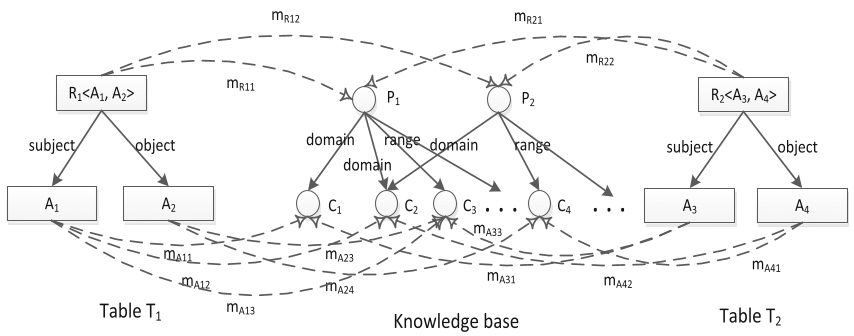
The core of the proposed solution is the Table Semantics Graph. This graph bridges the gap between raw web tables and structured Knowledge Bases.
1. Candidate Generation
The system first performs instance-based mapping. It matches table values to entities in Yago to generate candidate Column Types (e.g., City, State) and Column Relationships (e.g., isCapitalOf).
2. The Utility-Based Selection Model
Crowdsourcing is expensive, so the system must ask the "smartest" questions. It uses a utility function based on:
- Difficulty: How uncertain is the machine about this column?
- Inconsistency: How much does the data deviate from the current semantic hypothesis?
- Influence: If we solve this column, how much will it help us infer the semantics of other columns?
3. Relative Trust & Iterative Refinement
The algorithm employs two thresholds () to handle inconsistency. If inconsistency is low (), the system trusts the semantics and cleans the data. If inconsistency is high, it prioritizes re-validating the semantics via the crowd.
Experimental Insights
The researchers tested their approach on WikiTables and WebTables, using Yago as the reference KB.
Key Performance Metrics:
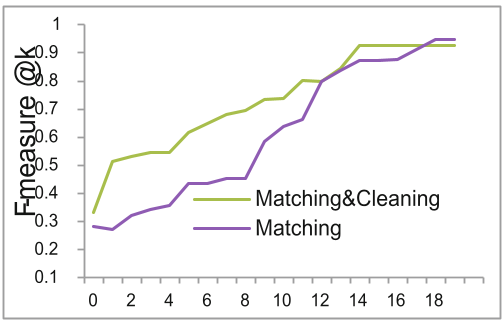
- F-Measure: The hybrid method hit 95.3%, far outstripping pure machine-based methods (which hovered around 50%).
- Efficiency: The utility-based selection model proved more effective than selecting variables based solely on difficulty or influence, reaching peak performance in fewer iterations.
- Value Overlap: Remarkably, the system performed well even when matched columns had a value overlap of less than 0.1, a scenario where traditional instance-based matching usually fails.
Critical Analysis & Conclusion
Takeaway
The primary contribution is the validation of the unified approach. By treating matching and cleaning as interdependent, the system reduces the crowdsourcing budget while increasing accuracy. The "Influence" factor in the utility model is particularly clever, as it captures the structural dependencies of relational data.
Limitations
- KB Dependency: The system relies heavily on the coverage of the KB. While Yago covers ~80% of entities, "long-tail" or niche domains might require significantly more crowdsourcing.
- Crowd Reliability: The paper assumes a mostly honest crowd. In real-world scenarios, malicious or low-quality workers could degrade the "Relative Trust" mechanism.
Future Outlook
As we move into the era of LLMs, the "Crowd" in this hybrid model could potentially be replaced or augmented by Foundation Models, allowing this unified matching-cleaning logic to scale to billions of tables with minimal human overhead.