
Tweeting as a Catalyst for Change: How Social Media Engagement Sways the Vote
Hybrid media consumption: How tweeting during a televised political debate influences the vote decision
This study investigates "hybrid media consumption" through a field experiment examining how active tweeting versus passive monitoring of Twitter during a televised political debate affects voters. Conducted during the 2012 U.S. Senate race in Hawaii, it demonstrates that active engagement on microblogging platforms significantly influences vote choice, specifically aligning participants with the majority sentiment of the Twitter stream.
TL;DR
A groundbreaking field experiment reveals that the act of tweeting during a political debate isn't just about sharing opinions—it's about forming them. While merely watching others tweet has little effect, active participation makes voters significantly more likely to flip their choice to match the prevailing sentiment of the "online crowd."
The Rise of the Networked Viewer
Gone are the days when television was a passive, solitary experience. Today, we inhabit a "hybrid media environment." During major political events, Twitter serves as a parallel stream of consciousness. But does this digital chatter actually change minds, or does it just create more noise?
The authors of this study set out to find if the "dual-task" of processing a televised debate while managing a microblog feed alters how we feel, what we remember, and—most importantly—who we vote for.
The Experiment: Watching, Observing, and Tweeting
The researchers divided 51 participants into three distinct groups during a high-stakes 2012 U.S. Senate debate in Hawaii:
- Tweeters: Actively posted using the hashtag
#kitvdebate. - Twitter Observers: Followed the live feed but remained silent.
- Control Group: Viewed the debate in traditional isolation.
The Sentiment Gap
During this specific debate, the Twitter "room" was not balanced. An analysis of the hashtag showed a heavy slant:
- Candidate Lingle (R): 73% positive sentiment.
- Candidate Hirono (D): 87% negative sentiment.
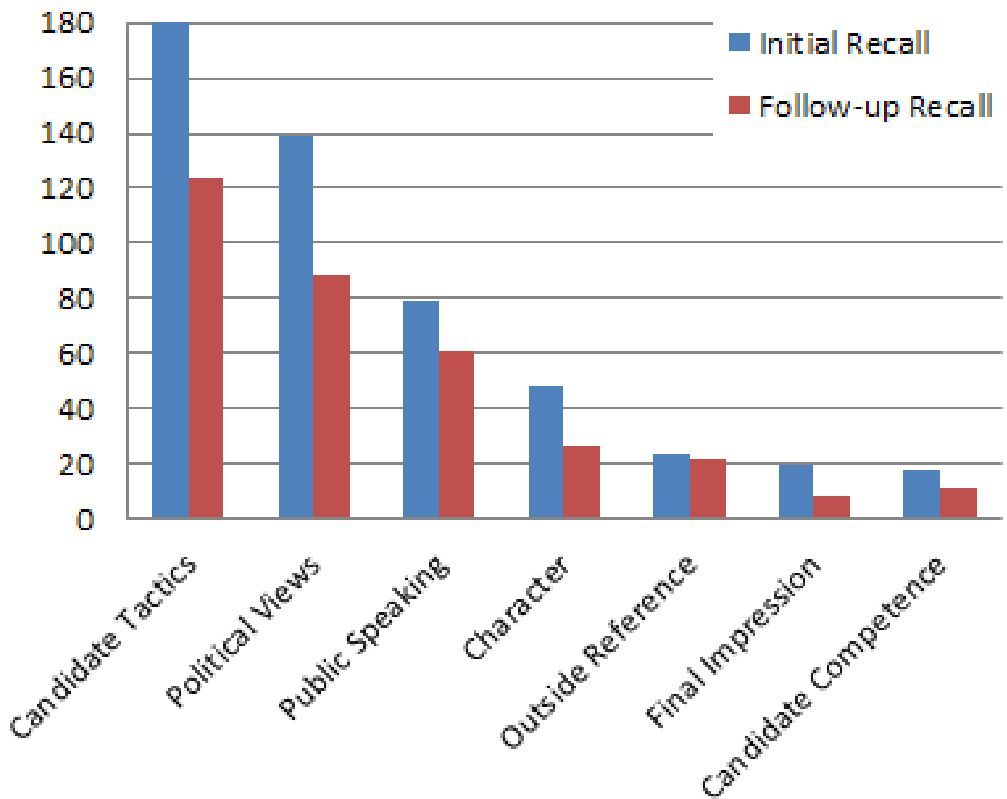 The chart above shows that while recall types (Tactics, Views, Character) were similar across groups, the cognitive processing of these elements varied based on participation.
Key Finding: The Power of Public Commitment
The most striking result was not in what people remembered, but in how they voted.
- The Flip: Active Tweeters were the only group to show a significant shift in voting preference immediately following the debate.
- The Direction: They moved toward the candidate who was "winning" on Twitter (Lingle), regardless of their pre-debate stance.
- The Persistence: This change wasn't just a fleeting emotion; it remained stable two weeks later.
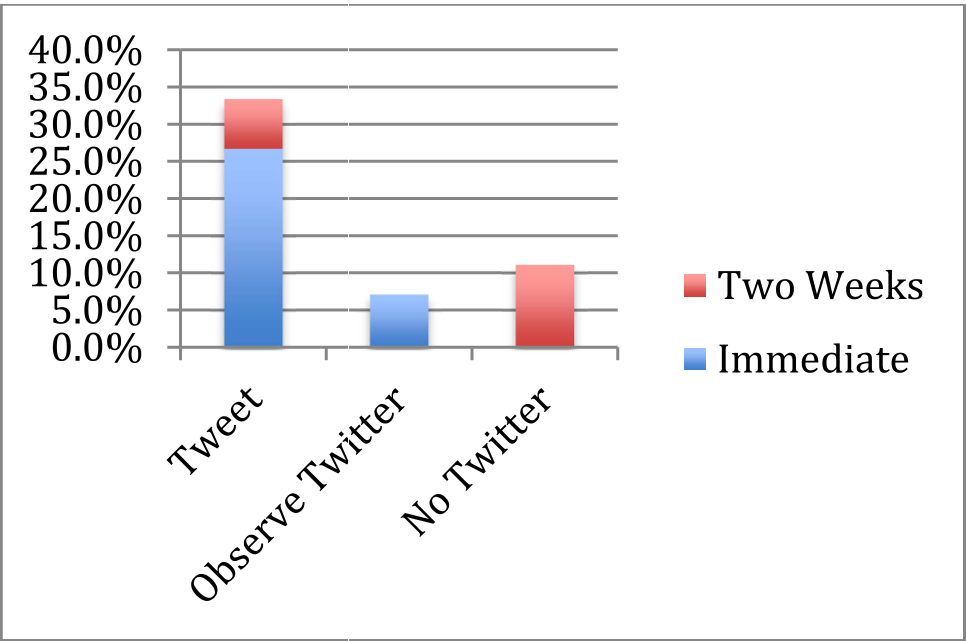 Tweeters significantly outperformed observers and the control group in "vote switching," suggesting that the act of writing the tweet—the motor and cognitive effort—anchors the social influence.
Why Does Tweeting Change Minds?
The authors provide two compelling psychological explanations:
1. Cognitive Elaboration
To post a tweet, you must re-synthesize information. This "cognitive labor" makes you process the debate more deeply than a passive viewer. If the majority of the info you are re-processing is one-sided, your own opinion is likely to follow that path.
2. Normative Conformity
Twitter acts as a "Virtual Town Square." When Tweeters see a minority opinion (pro-Hirono) being met with "backlash" (e.g., "R U ON CRACK?"), they feel social pressure to align with the dominant group to gain social acceptance.
Critical Insight: The "Echo" in the Chamber
Perhaps the most profound takeaway is that expressing a belief publicly on social media influences the messenger as much as the audience.
The study found that three out of four "vote switchers" had declared a debate winner on Twitter. By making a public declaration, they committed themselves to a new identity. As the study concludes: "Social media contributors may also have the power to influence themselves."
Conclusion & Future Outlook
This work challenges the idea that we are immune to the "herd" when we are behind a screen. For democracy, this is a double-edged sword. While social media can increase engagement, it may also act as a powerful engine for political homogenization. Future research must determine whether we are using Twitter to become more thoughtful—or simply to find a crowd to follow.