
IPSO–TSAB: Bridging Global Exploration and Local Mastery in Job Shop Scheduling
17969_A Hybrid Particle-Swarm Tabu Search Algorithm for Solving Job Shop Scheduling Problems.
This paper introduces IPSO–TSAB, a hybrid metaheuristic algorithm combining an Improved Particle Swarm Optimization (PSO) with a Tabu Search (TS) to solve the Job Shop Scheduling Problem (JSSP). The method leverages a balance strategy in PSO to provide high-quality initial solutions for TS, achieving SOTA results across 55 benchmark instances including the notoriously difficult Taillard series.
TL;DR
Optimization of Job Shop Scheduling (JSSP) is notoriously difficult due to its complexity. This paper introduces IPSO–TSAB, a hybrid powerhouse that uses an Improved Particle Swarm Optimization to "scout" the search space and a Tabu Search to "mine" the best results. By solving the continuous-to-discrete mapping problem and balancing exploration/exploitation, it sets new performance benchmarks.
The "Big Valley" Intuition
Why do standard algorithms fail? Research indicates that JSSP landscapes often exhibit a Big Valley (BV) structure: high-quality solutions are not scattered randomly but are clustered in a relatively small area.
- Single-solution methods (Tabu Search) are great at mining but get stuck if they start outside the valley.
- Population methods (PSO) find the valley quickly but often "hover" over the floor without reaching the deepest point.
IPSO–TSAB solves this by using PSO to identify the valley floor and TS to find the exact global minimum.
Methodology: The Hybrid Engine
1. Real-Integer Mapping
The most technical hurdle in using PSO (designed for continuous space) for JSSP (discrete) is the mapping. The authors propose a unique Real-Integer Encode/Decode scheme. This allows the algorithm to update weights in continuous space while maintaining a feasible, constraint-compliant operation sequence for the schedule.
2. The Balance Strategy ()
Standard PSO equations were modified. The authors introduced a balance operator : This operator generates larger momentum in early stages to jump out of local optima and finer steps in later stages for localized tuning.
3. Exploiting the Gap
The authors discovered that the region between an individual particle's best () and the swarm's global best () is highly likely to contain the global optimum.
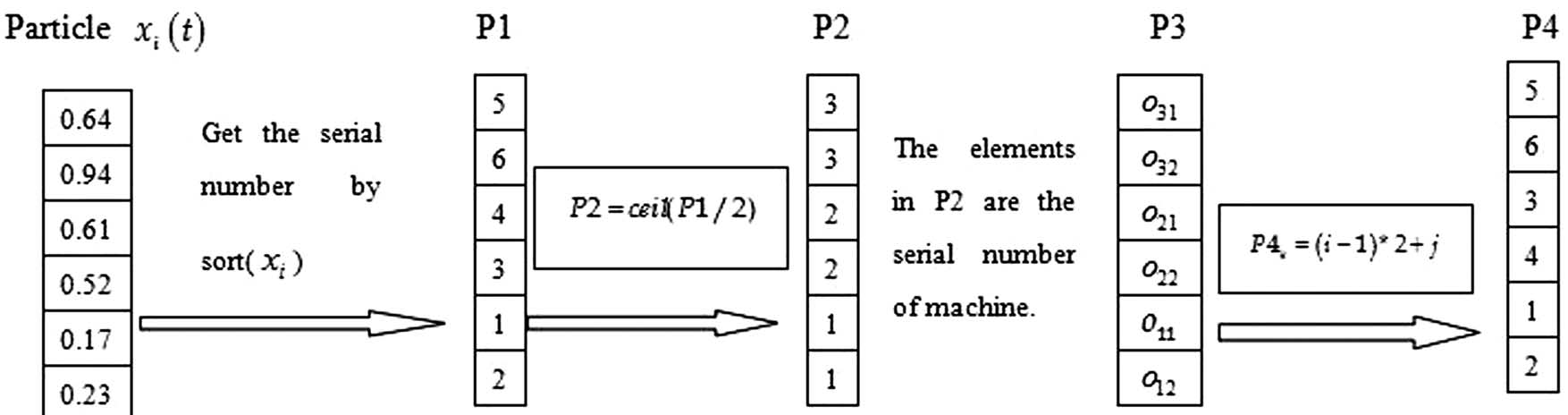 Figure 1: The flow of the IPSO-TSAB algorithm, showing the transition between PSO scouting and TSAB intensification.
Experimental Battleground
IPSO–TSAB was tested against 55 benchmark problems. In the Taillard series—widely regarded as the gold standard for JSSP difficulty—IPSO–TSAB showed its strength.
| Instance Set | Size | i-TSAB MRE | IPSO–TSAB b-MRE |
|---|---|---|---|
| TA01-10 | 15×15 | 0.45% | 0.0001% |
| TA21-30 | 20×20 | 6.50% | 0.0294% |
| TA41-50 | 30×20 | 4.70% | 0.9441% |
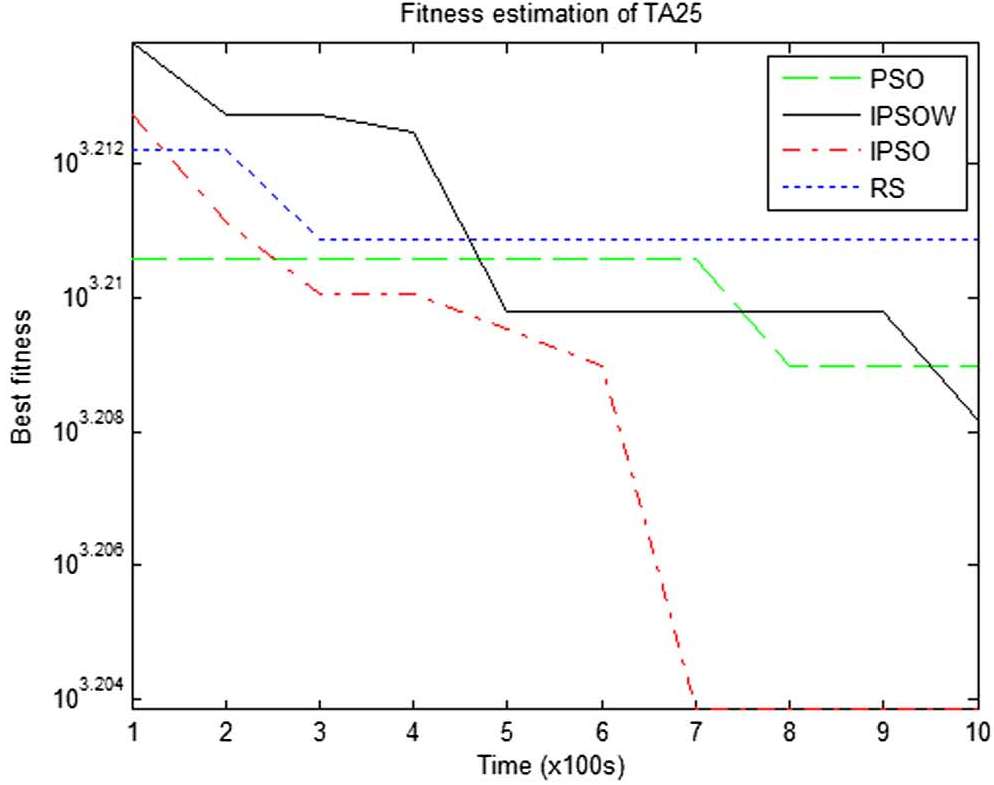 Figure 2: Convergence comparison showing IPSO reaching lower makespan values faster than traditional PSO and Random Search (RS).
Critical Analysis
The brilliance of this work lies in the Real-Integer Decoding approach. By allowing a population-based search to communicate directly with a local searcher without losing "search momentum," the authors have mitigated the premature convergence of PSO.
However, there is a trade-off: computational time. While IPSO–TSAB finds better solutions, the hybrid nature and local search strategy mean that for extremely large-scale real-time industrial applications, the overhead might be significant compared to simple priority-rule heuristics.
Conclusion
IPSO–TSAB proves that hybridization is not just about "sticking two algorithms together"; it's about matching the search mechanics of one (exploration) to the strengths of the other (exploitation) through a mathematically sound bridge. For researchers in Industry 4.0 and combinatorial optimization, this provides a blueprint for tackling NP-hard scheduling tasks.