
Beyond Simple Hybridization: Optimizing Scientific Article Recommendation via Multiview Clustering
Hybrid Recommendation of Articles in Scientific Social Networks Using Optimization and Multiview Clustering
The paper introduces a novel hybrid article recommendation framework for scientific social networks that integrates Content-Based Filtering (CBF) and Collaborative Filtering (CF). The core contribution is a multiview clustering algorithm that iteratively groups researchers based on both rating patterns and content history, while optimizing the classification process using the BAT meta-heuristic.
TL;DR
In the era of "information overload" for researchers, finding relevant papers is a needle-in-a-stack task. This paper presents MVC-HAR, a hybrid system that doesn't just average Content-Based and Collaborative Filtering results. Instead, it uses a BAT-optimized Kmedoids algorithm and a Multiview Clustering approach to iteratively refine researcher groups, leading to significantly more accurate "Top-M" recommendations on the CiteULike dataset.
The "Sparsity" Bottleneck in Scientific Networks
Most recommendation engines fail in scientific social networks for two reasons:
- High Dimensionality vs. Sparse Data: Thousands of tags and millions of articles exist, but a single researcher only interacts with a tiny fraction.
- The Context Void: Traditional Collaborative Filtering (CF) doesn't "understand" the text, while Content-Based Filtering (CBF) ignores the community wisdom (who is friends with whom).
The authors argue that existing "Hybrid" models (like HAR-SI) are too linear. They treat content and social ratings as separate inputs rather than two views of the same researcher's identity.
Methodology: The BAT-Kmedoids & Multiview Engine
1. NLP-Enhanced Content Profiles
Unlike basic keyword matching, the authors implement an NLP pipeline involving Stemming and N-grams (up to 3-grams). This allows the system to recognize that "Neural Networks" and "Neural Net" refer to the same concept, reducing the "noise" in the CBF matching phase.
2. BAT-Optimized Clustering
To solve the scalability problem, the researchers use K-medoids rather than K-means (as medoids are actual historical data points, making them more robust to outliers). They optimize this using the BAT algorithm, a meta-heuristic inspired by echolocation. This allows the system to find the "global optimum" cluster centers faster without getting stuck in the local minima common in standard CF.
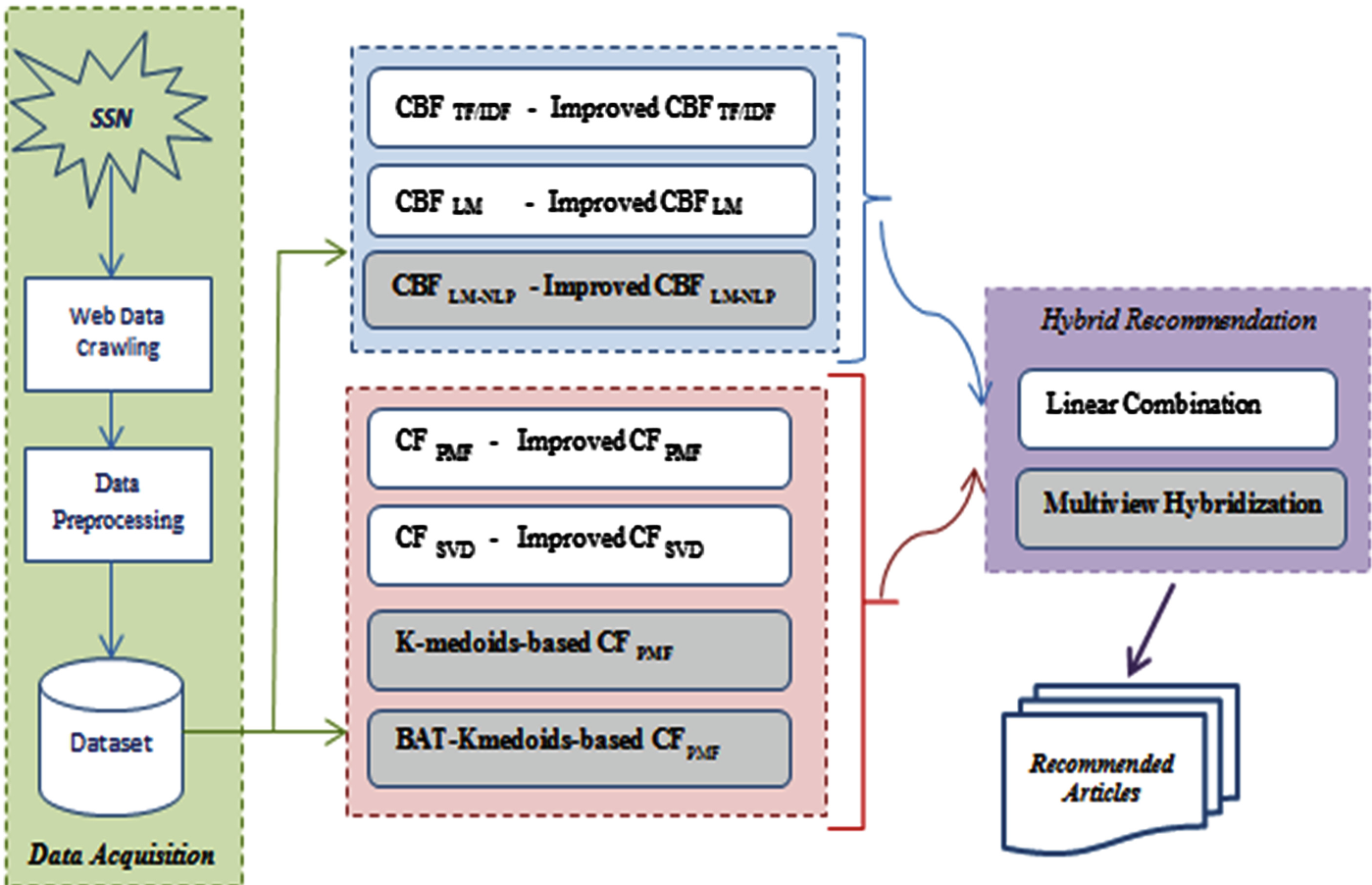 Figure 1: The overarching architecture of the proposed hybrid recommendation system.
3. Iterative Multiview Refinement
This is the "special sauce." Instead of a one-pass calculation, the algorithm:
- Initializes clusters based on Content.
- Swaps medoids based on Similarity (Ratings/Social).
- Re-adjusts clusters until both "views" converge on a stable group of neighbors.
Experimental Results & Critical Analysis
The evaluation used the CiteULike dataset (621 researchers, 45,720 articles).
Key Findings:
- NLP Matters: The
Improved LM-NLP(using tags and titles) outperformed every other CBF variant, confirming that raw keyword counts are insufficient for scholarly data. - Multiview Superiority: As shown in the performance charts, the Multiview approach (MVC-HAR) consistently beats the HAR-SI baseline.
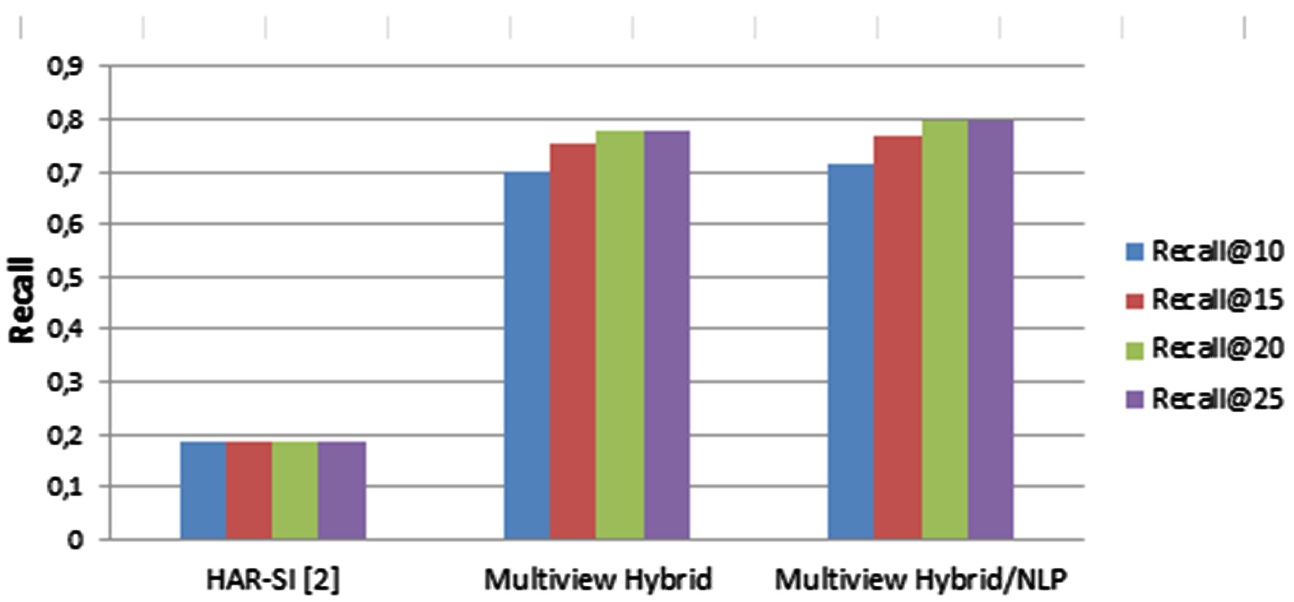 Figure 2: Precision and Recall comparison showing the leap in accuracy using Multiview Hybridization.
Academic Insight: Is it just an Optimization?
While the BAT algorithm provides a slight edge, the real "win" here is the Pruning & Integration phase of the clustering. By allowing a user to belong to two clusters (Overlapping Clustering), the system acknowledges that researchers often have multi-disciplinary interests (e.g., a researcher interested in both Artificial Intelligence and Biology).
Conclusion & Future Outlook
The paper effectively demonstrates that the future of recommendation isn't in better "Similarity Measures" alone, but in better Structure Discovery. By treating content and social interactions as two views of the same underlying manifold, MVC-HAR provides a robust path forward for academic platforms like ResearchGate or Mendeley.
Limitations to Watch: The complexity of the BAT-Kmedoids algorithm is . While accurate, this cubic complexity regarding the number of articles/users suggests that for industry-scale deployment, further approximation or distributed computing would be required.